



Improving Response to Foodborne Disease Outbreaks in the United States: Findings of the Foodborne Disease Centers for Outbreak Response Enhancement (FoodCORE), 2010–2012
Supporting Files

-
2015 Jul-Aug
-
Available in CDC Stacks on July 01, 2016, 12:00 AM
File Language:
English
Details
-
Alternative Title:J Public Health Manag Pract
-
Journal Article:Journal of Public Health Management & Practice
-
Personal Author:
-
Description:Context
Each year foodborne diseases (FBD) affect approximately 1 in 6 Americans, resulting in 128,000 hospitalizations and 3,000 deaths. Decreasing resources impact the ability of public health officials to identify, respond to, and control FBD outbreaks. Geographically dispersed outbreaks necessitate multijurisdictional coordination across all levels of the public health system. Rapid response depends on rapid detection.
Objective
Targeted resources were provided to state and local health departments to improve completeness and timeliness of laboratory, epidemiology, and environmental health (EH) activities for FBD surveillance and outbreak response.
Design
Foodborne Disease Centers for Outbreak Response Enhancement (FoodCORE) centers, selected through competitive award, implemented work plans designed to make outbreak response more complete and faster in their jurisdiction. Performance metrics were developed and used to evaluate the impact and effectiveness of activities.
Participants
Departments of Health in Connecticut, New York City, Ohio, South Carolina, Tennessee, Utah, and Wisconsin.
Results
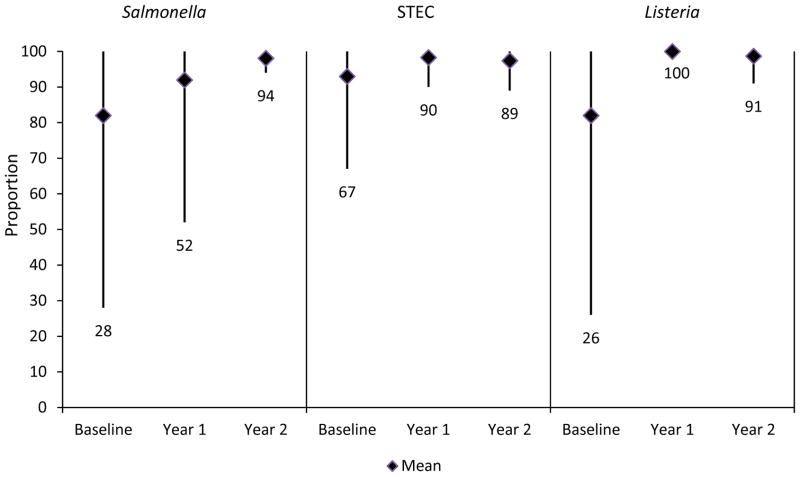
From the first year (Y1) of the program in October 2010 to the end of second year (Y2) in December 2012, the centers completed molecular subtyping for a higher proportion of Salmonella, Shiga toxin-producing E. coli, and Listeria (SSL) isolates (86% vs 98%) and reduced the average time to complete testing from a median of 8 to 4 days. The centers attempted epidemiologic interviews with more SSL case-patients (93% vs 99%) and the average time to attempt interviews was reduced from a median of 4 to 2 days. During Y2, nearly 200 EH assessments were conducted. FoodCORE centers began documenting model practices such as streamlining and standardizing case-patient interviewing.
Conclusion
Centers used targeted resources and process evaluation to implement and document practices that improve the completeness and timeliness of FBD surveillance and outbreak response activities in several public health settings. FoodCORE strategies and model practices could be replicated in other jurisdictions to improve FBD response. -
Subjects:
-
Source:J Public Health Manag Pract. 21(4):E18-E26.
-
DOI:
-
ISSN:1078-4659
-
Pubmed ID:24983761
-
Pubmed Central ID:PMC4629497
-
Document Type:
-
Funding:
-
Genre:
-
Place as Subject:
-
Rights:Public Domain
-
CIO:
-
Division:
-
Volume:21
-
Issue:4
-
Download URL:
-
File Type:
 [PDF - 271.61 KB]
 -
Collection(s):
-
Main Document Checksum:urn:sha-512:6a7c6b8ae1dab97c521942b2c3e42139133b697af9337ec79c39d929080b808e815b0fe1080dbc7e4e2c490a7bdad2b8e5bea75f30656b8b4683ff04df9e561b
Supporting Files

Related Documents
-
Tilashalski, Frances P.;
 Sillence, Elizabeth M.


File Language:
English
 Was this page helpful?
 Found an issue?



CDC STACKS serves as an archival repository of CDC-published products including
scientific findings, journal articles, guidelines, recommendations, or other public health information authored or
co-authored by CDC or funded partners.
As a repository, CDC STACKS retains documents in their original published format to ensure public access to scientific information.
As a repository, CDC STACKS retains documents in their original published format to ensure public access to scientific information.
You May Also Like
COLLECTION
CDC Public Access