



Delayed HIV detection among infants exposed to postnatal antiretroviral prophylaxis during breastfeeding
Supporting Files

-
9 24 2015 ; 9-24-
-
Available in CDC Stacks on September 24, 2016, 12:00 AM
File Language:
English
Details
-
Alternative Title:AIDS
-
Personal Author:
-
Description:Objective
The objective of this study is to determine whether detection of HIV infection was delayed in infants exposed to antiretroviral prophylaxis to prevent HIV transmission during breastfeeding.
Design
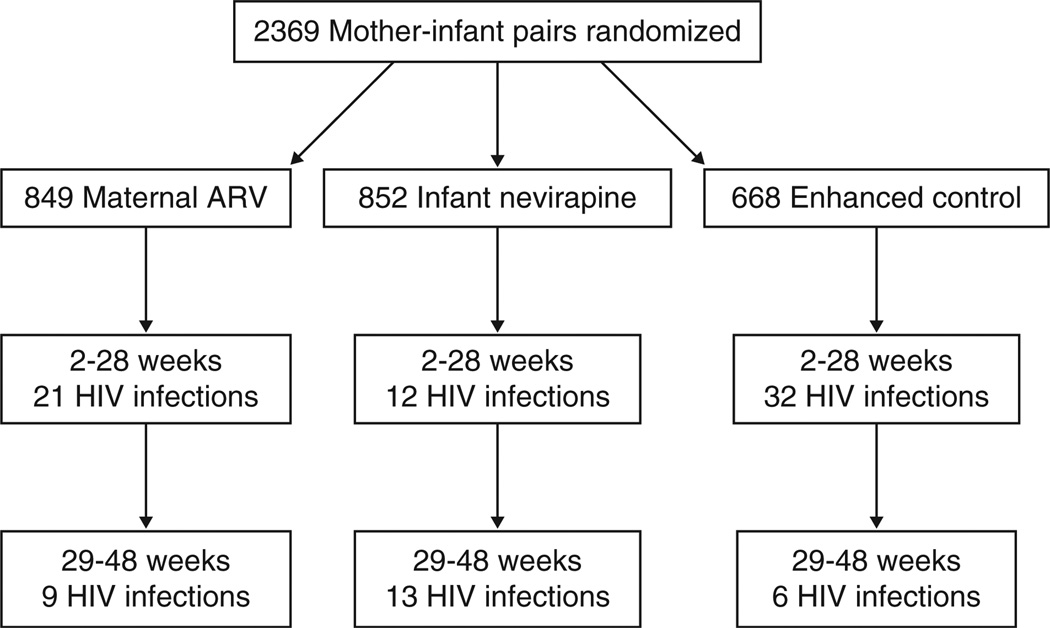
The Breastfeeding, Antiretrovirals and Nutrition (BAN) study was a randomized trial of 2369 mother–infant pairs conducted from 2004 to 2010. In addition to an intrapartum regimen, all mother–infant pairs were randomly assigned to three antiretroviral intervention arms during 28 weeks of breastfeeding: no further antiretroviral prophylaxis (control arm); infant-daily nevirapine (nevirapine arm); and maternal zidovudine, lamivudine and either nevirapine, nelfinavir or lopinavir-ritonavir (maternal arm). After breastfeeding cessation counselling and stopping the antiretroviral interventions by 28 weeks, 28 infant HIV infections occurred.
Methods
To determine whether these infections occurred during the breastfeeding and antiretroviral intervention phase but had delayed detection on the antiretroviral arms, we performed ultrasensitive (droplet digital PCR) HIV testing on infants with stored peripheral blood mononuclear cell (PBMC) specimens at 24 weeks (n = 9).
Results
Of the nine infants, all three on the infant nevirapine arm had detectable HIV DNA at 24 weeks, compared with two of four on the maternal antiretroviral arm and one of two on the control arm. For infants with detectable HIV at 24 weeks, the median delay in detection between the ultrasensitive and standard assays was 18.3 weeks for the nevirapine arm, 15.4 weeks for the maternal arm and 9.4 weeks for the control arm.
Conclusion
The prolonged inability to detect HIV with standard assays in the context of postnatal antiretroviral prophylaxis suggests that early antiretrovirals may restrict HIV replication sufficiently to lead to missed diagnosis among infected infants. Therefore, repeat virologic testing is warranted beyond the WHO-recommended point of testing at 6 weeks after breastfeeding cessation. -
Keywords:
-
Source:AIDS. 29(15):1953-1961
-
Pubmed ID:26153671
-
Pubmed Central ID:PMC4665628
-
Document Type:
-
Funding:SIP 22-09 U48-DP001944-01/DP/NCCDPHP CDC HHSUnited States/ ; D43 TW001039/TW/FIC NIH HHSUnited States/ ; U48DP001944/ACL HHSUnited States/ ; P30 AI094189/AI/NIAID NIH HHSUnited States/ ; SIP 26-04 U48-DP000059-01/DP/NCCDPHP CDC HHSUnited States/ ; R01 HD080474/HD/NICHD NIH HHSUnited States/ ; R21 AI100656/AI/NIAID NIH HHSUnited States/ ; R24 TW007988/TW/FIC NIH HHSUnited States/ ; P30-AI50410/AI/NIAID NIH HHSUnited States/ ; R24 HD050924/HD/NICHD NIH HHSUnited States/ ; SIP 13-01U48-CCU409660-09/PHS HHSUnited States/ ; R24HD050924/HD/NICHD NIH HHSUnited States/ ; U48 DP000059/DP/NCCDPHP CDC HHSUnited States/ ; P30 AI050410/AI/NIAID NIH HHSUnited States/
-
Volume:29
-
Issue:15
-
Download URL:
-
File Type:
 [PDF - 608.86 KB]
 -
Collection(s):
-
Main Document Checksum:urn:sha256:acb219a48c039d3da29f140c0db1b71560918ca0bf98a05203b1ccf88b76f8bd
Supporting Files


File Language:
English
 Was this page helpful?
 Found an issue?

CDC STACKS serves as an archival repository of CDC-published products including
scientific findings, journal articles, guidelines, recommendations, or other public health information authored or
co-authored by CDC or funded partners.
As a repository, CDC STACKS retains documents in their original published format to ensure public access to scientific information.
As a repository, CDC STACKS retains documents in their original published format to ensure public access to scientific information.
You May Also Like
COLLECTION
CDC Public Access