


Inclusion of the glucocorticoid receptor in a hypothalamic pituitary adrenal axis model reveals bistability
Supporting Files
Public Domain

-
Feb 14 2007
-
Details
-
Alternative Title:Theor Biol Med Model
-
Personal Author:
-
Description:Background
The body's primary stress management system is the hypothalamic pituitary adrenal (HPA) axis. The HPA axis responds to physical and mental challenge to maintain homeostasis in part by controlling the body's cortisol level. Dysregulation of the HPA axis is implicated in numerous stress-related diseases.
Results
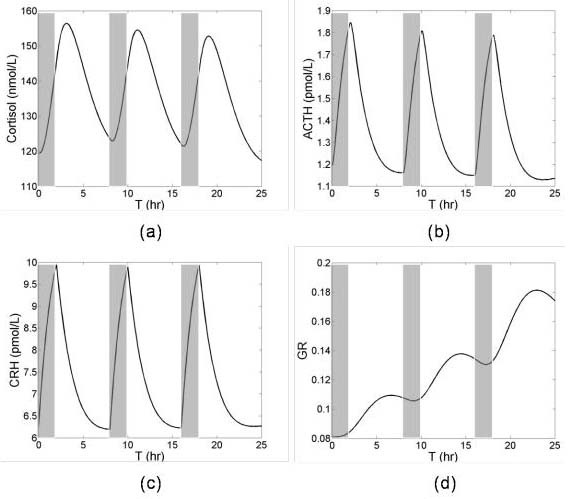
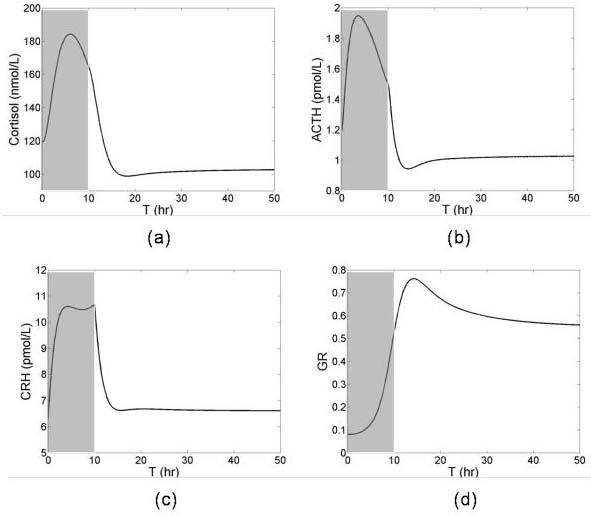
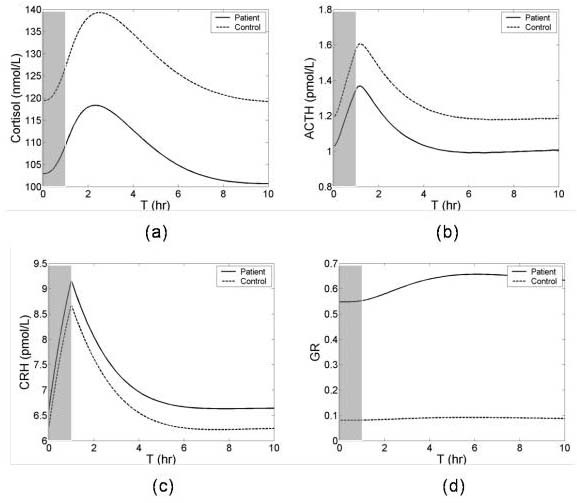
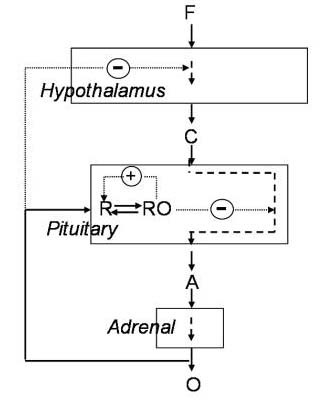
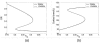
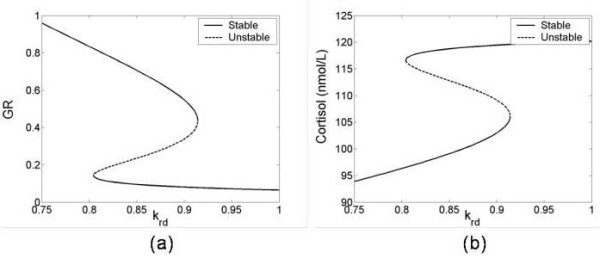
We developed a structured model of the HPA axis that includes the glucocorticoid receptor (GR). This model incorporates nonlinear kinetics of pituitary GR synthesis. The nonlinear effect arises from the fact that GR homodimerizes after cortisol activation and induces its own synthesis in the pituitary. This homodimerization makes possible two stable steady states (low and high) and one unstable state of cortisol production resulting in bistability of the HPA axis. In this model, low GR concentration represents the normal steady state, and high GR concentration represents a dysregulated steady state. A short stress in the normal steady state produces a small perturbation in the GR concentration that quickly returns to normal levels. Long, repeated stress produces persistent and high GR concentration that does not return to baseline forcing the HPA axis to an alternate steady state. One consequence of increased steady state GR is reduced steady state cortisol, which has been observed in some stress related disorders such as Chronic Fatigue Syndrome (CFS).
Conclusion
Inclusion of pituitary GR expression resulted in a biologically plausible model of HPA axis bistability and hypocortisolism. High GR concentration enhanced cortisol negative feedback on the hypothalamus and forced the HPA axis into an alternative, low cortisol state. This model can be used to explore mechanisms underlying disorders of the HPA axis.
-
Subjects:
-
Source:Theor Biol Med Model. 2007; 4:8.
-
Document Type:
-
Volume:4
-
Collection(s):
-
Main Document Checksum:urn:sha-512:0e27b51a3915c3b4dcfefd19f360790708324e65b3cd50b80f749588f37248abf18e10588f466464257d9c52e3da257e93bf3ef86bbcdbd53f4a4359871b0aa4
-
Download URL:
-
File Type:
 [PDF
- 760.58 KB
]
[PDF
- 760.58 KB
]
Supporting Files


ON THIS PAGE





CDC STACKS serves as an archival repository of CDC-published products including
scientific findings,
journal articles, guidelines, recommendations, or other public health information authored or
co-authored by CDC or funded partners.
As a repository, CDC STACKS retains documents in their original published format to ensure public access to scientific information.
As a repository, CDC STACKS retains documents in their original published format to ensure public access to scientific information.
You May Also Like
COLLECTION
CDC Public Access