


Anemia and Red Blood Cell Abnormalities in HIV-Infected and HIV-Exposed Breastfed Infants: A Secondary Analysis of the Kisumu Breastfeeding Study
Supporting Files
Public Domain

-
November 03 2015
-
File Language:
English
Details
-
Alternative Title:PLoS One
-
Personal Author:
-
Corporate Authors:
-
Description:Background
Anemia results in increased morbidity and mortality, underscoring the need to better understand its pathophysiology amongst HIV-exposed and infected children in sub-Saharan Africa, the region where most infant HIV exposure and infections occur.
Methods
This analysis used samples obtained from children in the Kisumu Breastfeeding Study (KiBS). KiBS was a longitudinal phase IIB, open-label, one-arm clinical trial, designed to investigate the safety, tolerability and effectiveness of a maternal triple-antiretroviral (ARV) regimen for prevention of mother-to-child transmission (PMTCT) of HIV, during late pregnancy and early infancy while breastfeeding. Blood samples from 482 children were obtained at birth, 2, 6, 10 and 14 weeks and 6, 9, 12, 18 and 24 months. Severity of anemia was graded using the NIH Division of AIDS (DAIDS) toxicity tables. We describe the proportion of children with anemia and anomalies in red blood cell parameters at various time points over 24 months and compare rates of anemia between HIV-infected and HIV-uninfected children and by mothers’ ARV regimen and infant malaria infection.
Results
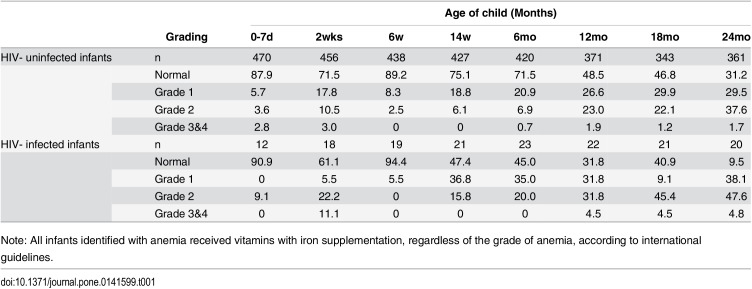
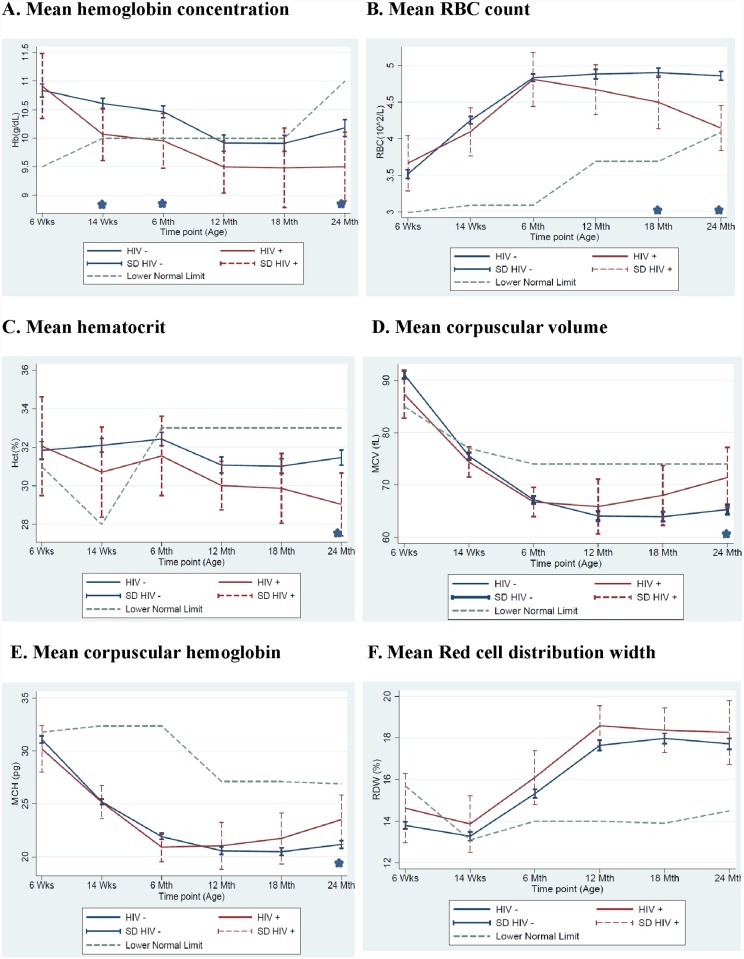
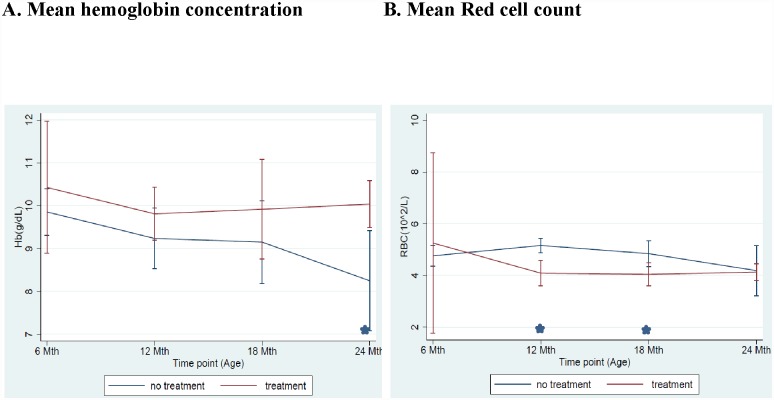
The proportion of children with anemia significantly increased after the breastfeeding period in both HIV-infected and HIV-uninfected children with higher proportion among HIV-infected children compared to HIV-uninfected children (RR: 1.72; CI: 1.22–2.44, p = 0.002). Maternal triple-antiretroviral regimen was not associated with infant anemia (p = 0.11). There was no significant difference in mean hemoglobin between HIV-uninfected children with and without malaria at each time point except at 24 months.
Conclusion
A relatively lower proportion of children with severe anemia during the breastfeeding period suggest that exposure to mother’s triple antiretroviral combinations through breast milk, posed minimal risk of hematologic toxicity.
-
Subjects:
-
Source:PLoS One. 10(11)
-
Pubmed ID:26529316
-
Pubmed Central ID:PMC4631368
-
Document Type:
-
Place as Subject:
-
Volume:10
-
Issue:11
-
Collection(s):
-
Main Document Checksum:urn:sha256:ab58be22757e9ba6ea2cb70e00c3a220a71dd6a49b541f480834b50bab568163
-
Download URL:
-
File Type:
 [PDF
- 1.41 MB
]
[PDF
- 1.41 MB
]
Supporting Files


File Language:
English
ON THIS PAGE





CDC STACKS serves as an archival repository of CDC-published products including
scientific findings,
journal articles, guidelines, recommendations, or other public health information authored or
co-authored by CDC or funded partners.
As a repository, CDC STACKS retains documents in their original published format to ensure public access to scientific information.
As a repository, CDC STACKS retains documents in their original published format to ensure public access to scientific information.
You May Also Like
COLLECTION
CDC Public Access