


Breath acidification in adolescent runners exposed to atmospheric pollution: A prospective, repeated measures observational study
Supporting Files

-
Mar 07 2008
-
File Language:
English
Details
-
Alternative Title:Environ Health
-
Personal Author:
-
Description:Background
Vigorous outdoors exercise during an episode of air pollution might cause airway inflammation. The purpose of this study was to examine the effects of vigorous outdoor exercise during peak smog season on breath pH, a biomarker of airway inflammation, in adolescent athletes.
Methods
We measured breath pH both pre- and post-exercise on ten days during peak smog season in 16 high school athletes engaged in daily long-distance running in a downwind suburb of Atlanta. The association of post-exercise breath pH with ambient ozone and particulate matter concentrations was tested with linear regression.
Results
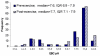
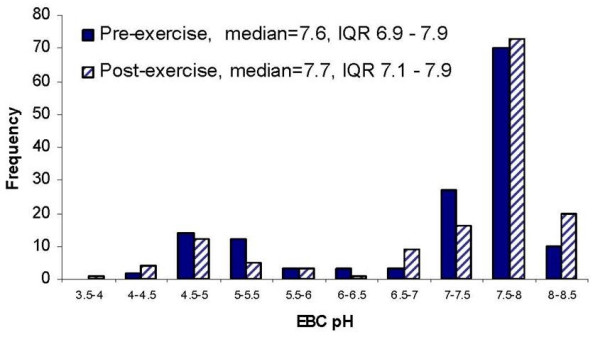
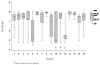
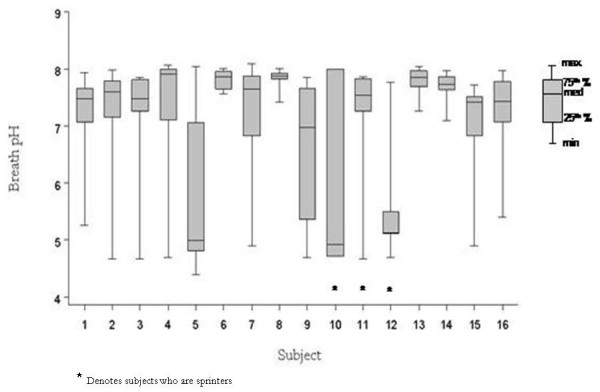
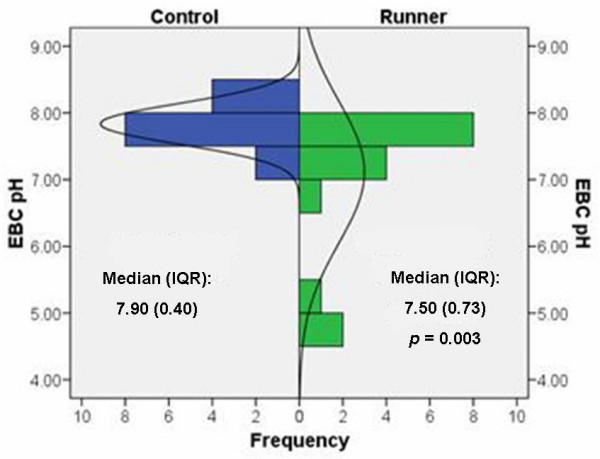
We collected 144 pre-exercise and 146 post-exercise breath samples from 16 runners (mean age 14.9 years, 56% male). Median pre-exercise breath pH was 7.58 (interquartile range: 6.90 to 7.86) and did not change significantly after exercise. We observed no significant association between ambient ozone or particulate matter and post-exercise breath pH. However both pre- and post-exercise breath pH were strikingly low in these athletes when compared to a control sample of 14 relatively sedentary healthy adults and to published values of breath pH in healthy subjects.
Conclusion
Although we did not observe an acute effect of air pollution exposure during exercise on breath pH, breath pH was surprisingly low in this sample of otherwise healthy long-distance runners. We speculate that repetitive vigorous exercise may induce airway acidification.
-
Subjects:
-
Source:Environ Health. 2008; 7:10.
-
Document Type:
-
Funding:
-
Place as Subject:
-
Volume:7
-
Collection(s):
-
Main Document Checksum:urn:sha-512:3c6e247ea8c0f0aa8ff40488f68fcde399950599ab42e33712c854155c4f91f0c78c080713c52b95951b97d3929d3f73e6452ed45233750e457f4ca9e7e157e4
-
Download URL:
-
File Type:
 [PDF
- 529.28 KB
]
[PDF
- 529.28 KB
]
Supporting Files


File Language:
English
ON THIS PAGE

CDC STACKS serves as an archival repository of CDC-published products including
scientific findings,
journal articles, guidelines, recommendations, or other public health information authored or
co-authored by CDC or funded partners.
As a repository, CDC STACKS retains documents in their original published format to ensure public access to scientific information.
As a repository, CDC STACKS retains documents in their original published format to ensure public access to scientific information.
You May Also Like
COLLECTION
CDC Public Access