


Multiple strains of Coxiella burnetii are present in the environment of St. Paul Island, Alaska
Supporting Files

-
8 2013
-
File Language:
English
Details
-
Alternative Title:Transbound Emerg Dis
-
Personal Author:
-
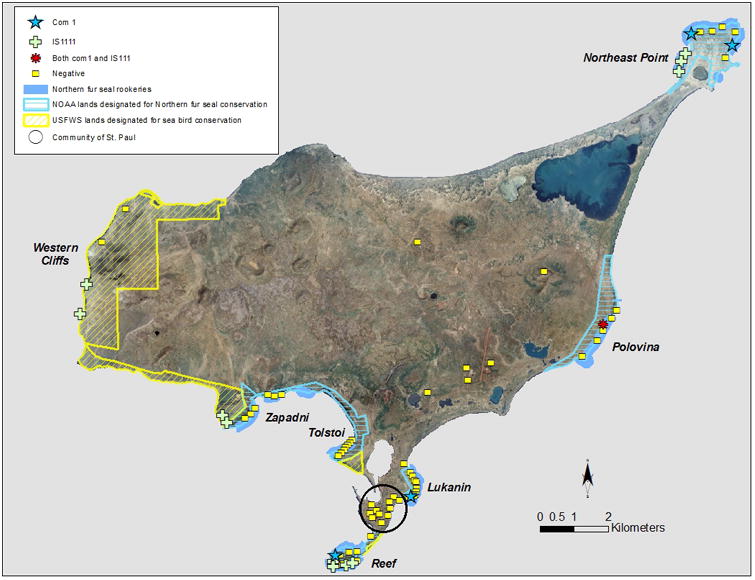
Description:In 2010, Coxiella burnetii was identified at a high prevalence in the placentas of Northern fur seals (Callorhinus ursinus) collected at a single rookery on St. Paul Island Alaska; an area of the United States where the agent was not known to be present. As contamination was hypothesized as a potential cause of false positives, but nothing was known about environmental C. burnetii in the region, an environmental survey was conducted to look for the prevalence and distribution of the organism on the island. While environmental prevalence was low, two strains of the organism were identified using PCR targeting the COM1 and IS1111 genes. The two strains are consistent with the organism that has been increasingly identified in marine mammals as well as a strain type more commonly found in terrestrial environments and associated with disease in humans and terrestrial animals. Further work is needed to elucidate information regarding the ecology of this organism in this region, particularly in association with the coastal environment.
-
Subjects:
-
Source:Transbound Emerg Dis. 60(4):345-350
-
Pubmed ID:22747976
-
Pubmed Central ID:PMC4620665
-
Document Type:
-
Funding:
-
Volume:60
-
Issue:4
-
Collection(s):
-
Main Document Checksum:urn:sha256:e9100d98c42d0408544dc96f2aa65dd43944c4ea4dbf9a75b332a59fa0ce2686
-
Download URL:
-
File Type:
 [PDF
- 160.20 KB
]
[PDF
- 160.20 KB
]
Supporting Files


File Language:
English
ON THIS PAGE

CDC STACKS serves as an archival repository of CDC-published products including
scientific findings,
journal articles, guidelines, recommendations, or other public health information authored or
co-authored by CDC or funded partners.
As a repository, CDC STACKS retains documents in their original published format to ensure public access to scientific information.
As a repository, CDC STACKS retains documents in their original published format to ensure public access to scientific information.
You May Also Like
COLLECTION
CDC Public Access