


The feasibility of using mobile-phone based SMS reminders and conditional cash transfers to improve timely immunization in rural Kenya
Supporting Files

-
Dec 13 2012
-
File Language:
English
Details
-
Alternative Title:Vaccine
-
Personal Author:
-
Description:Background
Demand-side strategies could contribute to achieving high and timely vaccine coverage in rural Africa, but require platforms to deliver either messages or conditional cash transfers (CCTs). We studied the feasibility of using short message system (SMS) reminders and mobile phone-based CCTs to reach parents in rural western Kenya.
Methods
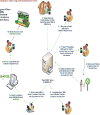
In a Health and Demographic Surveillance System (HDSS), mothers with children aged 0–3 weeks old were approached to determine who had access to a mobile phone. SMS reminders were sent three days prior to and on the scheduled day of immunization for 1st (age 6 weeks) and 2nd doses (age 10 weeks) of DTP-HepB-Hib (Pentavalent) vaccine, using open-source Rapid SMS software. Approximately $2.00 USD was sent as cash using mPESA, a mobile money transfer platform (2/3 of mothers), or airtime (1/3 of mothers) via phone if the child was vaccinated within 4 weeks of the scheduled date. Follow-up surveys were done when children reached 14 weeks of age.
Results
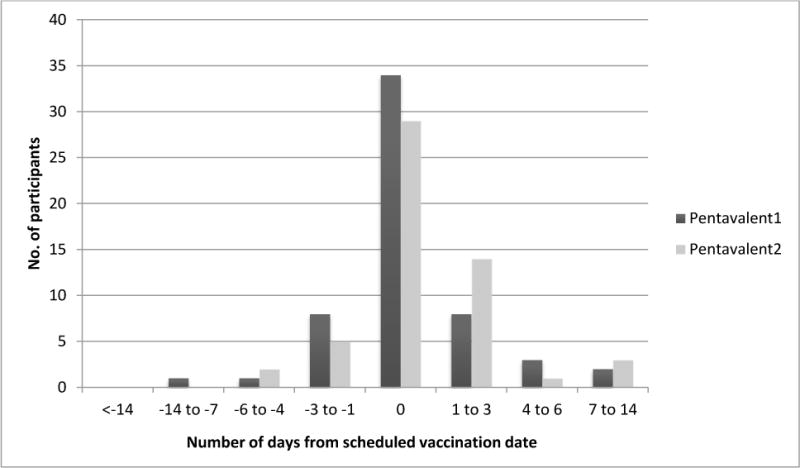
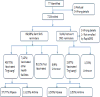
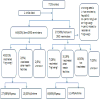
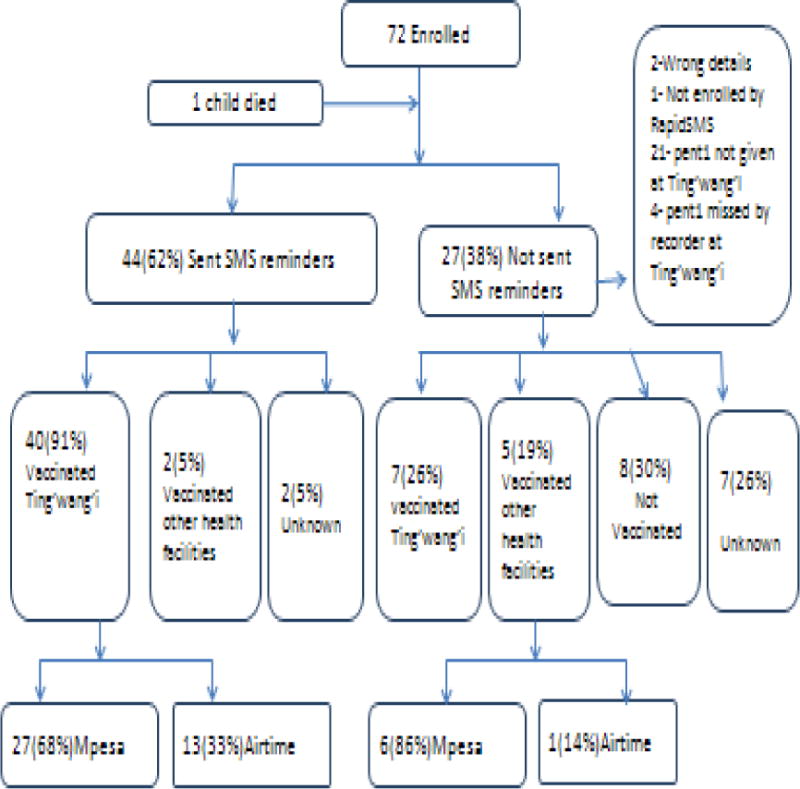
We approached 77 mothers; 72 were enrolled into the study (26% owned a phone and 74% used someone else’s). Of the 63 children with known vaccination status at 14 weeks of age, 57 (90%) received pentavalent1 and 54 (86%) received pentavalent2 within 4 weeks of their scheduled date. Of the 61 mothers with follow-up surveys administered at 14 weeks of age, 55 (90%) reported having received SMS reminders. Of the 54 women who reported having received SMS reminders and answered the CCT questions on the survey, 45 (83%) reported receiving their CCT. Most (89%) of mothers in the mPESA group obtained their cash within 3 days of being sent their credit via mobile phone. All mothers stated they preferred CCTs as cash via mobile phone rather than airtime.
Conclusion
The data show that in rural western Kenya mobile phone-based strategies are a potentially useful platform to deliver reminders and cash transfers. Follow-up studies are needed that provide evidence for the effectiveness of these strategies in improving vaccine coverage and timeliness.
-
Subjects:
-
Source:Vaccine. 31(6):987-993.
-
Pubmed ID:23246258
-
Pubmed Central ID:PMC4603391
-
Document Type:
-
Funding:
-
Place as Subject:
-
Volume:31
-
Issue:6
-
Collection(s):
-
Main Document Checksum:urn:sha256:d96df3f1978f77f2e13ed902554645e167632d4a8304ca7b612b70f1e7eb59a0
-
Download URL:
-
File Type:
 [PDF
- 434.97 KB
]
[PDF
- 434.97 KB
]
Supporting Files


File Language:
English
ON THIS PAGE




CDC STACKS serves as an archival repository of CDC-published products including
scientific findings,
journal articles, guidelines, recommendations, or other public health information authored or
co-authored by CDC or funded partners.
As a repository, CDC STACKS retains documents in their original published format to ensure public access to scientific information.
As a repository, CDC STACKS retains documents in their original published format to ensure public access to scientific information.
You May Also Like
COLLECTION
CDC Public Access