


Common variation at 2p13.3, 3q29, 7p13 and 17q25.1 associated with susceptibility to pancreatic cancer
Supporting Files

-
Jun 22 2015
-
File Language:
English
Details
-
Alternative Title:Nat Genet
-
Personal Author:Childs, Erica J ; Mocci, Evelina ; Campa, Daniele ; Bracci, Paige M ; Gallinger, Steven ; Goggins, Michael ; Li, Donghui ; Neale, Rachel ; Olson, Sara H ; Scelo, Ghislaine ; Amundadottir, Laufey T ; Bamlet, William R ; Bijlsma, Maarten F ; Blackford, Amanda ; Borges, Michael ; Brennan, Paul ; Brenner, Hermann ; Bueno-de-Mesquita, H Bas ; Canzian, Federico ; Capurso, Gabriele ; Cavestro, Giulia M ; Chaffee, Kari G ; Chanock, Stephen J ; Cleary, Sean P ; Cotterchio, Michelle ; Foretova, Lenka ; Fuchs, Charles ; Funel, Niccola ; Gazouli, Maria ; Hassan, Manal ; Herman, Joseph M ; Holcatova, Ivana ; Holly, Elizabeth A ; Hoover, Robert N ; Hung, Rayjean J ; Janout, Vladimir ; Key, Timothy J ; Kupcinskas, Juozas ; Kurtz, Robert C ; Landi, Stefano ; Lu, Lingeng ; Malecka-Panas, Ewa ; Mambrini, Andrea ; Mohelnikova-Duchonova, Beatrice ; Neoptolemos, John P ; Oberg, Ann L ; Orlow, Irene ; Pasquali, Claudio ; Pezzilli, Raffaele ; Rizzato, Cosmeri ; Saldia, Amethyst ; Scarpa, Aldo ; Stolzenberg-Solomon, Rachael Z ; Strobel, Oliver ; Tavano, Francesca ; Vashist, Yogesh K ; Vodicka, Pavel ; Wolpin, Brian M ; Yu, Herbert ; Petersen, Gloria M ; Risch, Harvey A ; Klein, Alison P
-
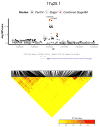
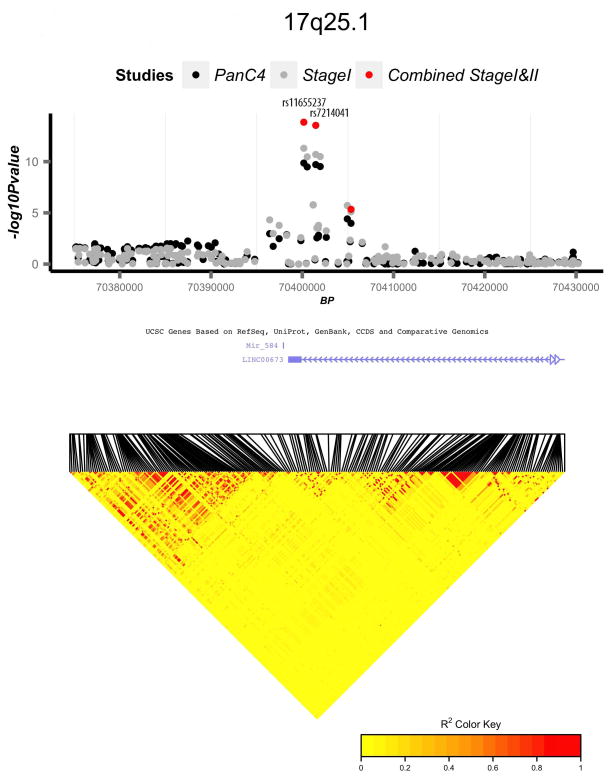
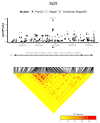
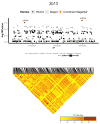
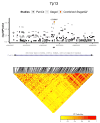
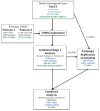
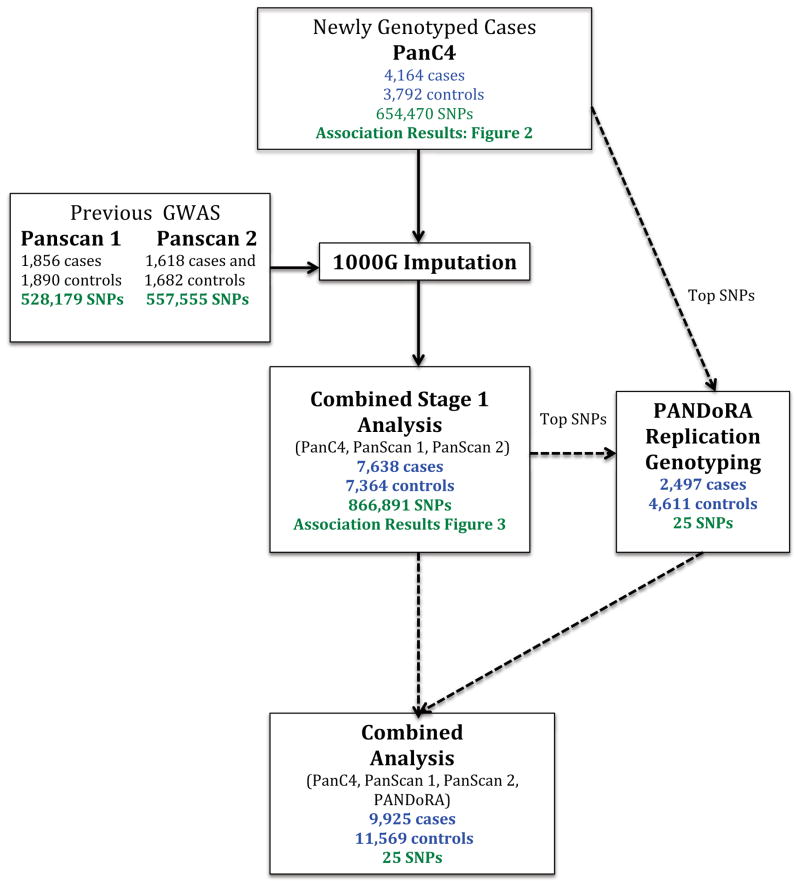
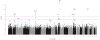
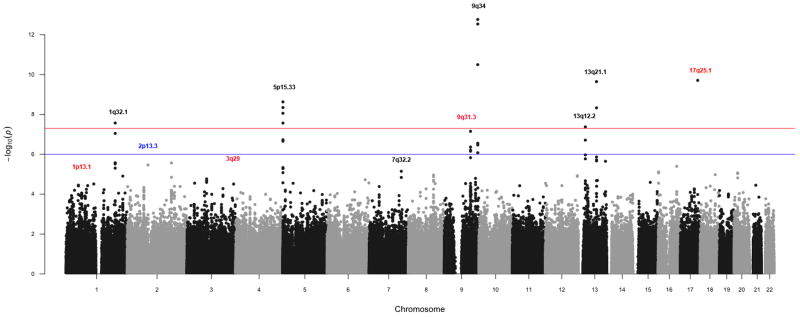
Description:Pancreatic cancer is the fourth leading cause of cancer death in the developed world. Both inherited high-penetrance mutations in BRCA2 (ref. 2), ATM, PALB2 (ref. 4), BRCA1 (ref. 5), STK11 (ref. 6), CDKN2A and mismatch-repair genes and low-penetrance loci are associated with increased risk. To identify new risk loci, we performed a genome-wide association study on 9,925 pancreatic cancer cases and 11,569 controls, including 4,164 newly genotyped cases and 3,792 controls in 9 studies from North America, Central Europe and Australia. We identified three newly associated regions: 17q25.1 (LINC00673, rs11655237, odds ratio (OR) = 1.26, 95% confidence interval (CI) = 1.19-1.34, P = 1.42 × 10(-14)), 7p13 (SUGCT, rs17688601, OR = 0.88, 95% CI = 0.84-0.92, P = 1.41 × 10(-8)) and 3q29 (TP63, rs9854771, OR = 0.89, 95% CI = 0.85-0.93, P = 2.35 × 10(-8)). We detected significant association at 2p13.3 (ETAA1, rs1486134, OR = 1.14, 95% CI = 1.09-1.19, P = 3.36 × 10(-9)), a region with previous suggestive evidence in Han Chinese. We replicated previously reported associations at 9q34.2 (ABO), 13q22.1 (KLF5), 5p15.33 (TERT and CLPTM1), 13q12.2 (PDX1), 1q32.1 (NR5A2), 7q32.3 (LINC-PINT), 16q23.1 (BCAR1) and 22q12.1 (ZNRF3). Our study identifies new loci associated with pancreatic cancer risk.
-
Subjects:
-
Source:Nat Genet. 47(8):911-916.
-
Pubmed ID:26098869
-
Pubmed Central ID:PMC4520746
-
Document Type:
-
Funding:5R01 CA098870/CA/NCI NIH HHS/United States ; HHSN261201000140C/PHS HHS/United States ; HHSN268201100011I/PHS HHS/United States ; P20 CA102701/CA/NCI NIH HHS/United States ; P30 CA008748/CA/NCI NIH HHS/United States ; P30 CA015083/CA/NCI NIH HHS/United States ; P50 CA102701/CA/NCI NIH HHS/United States ; P50 CA62924/CA/NCI NIH HHS/United States ; R01 CA097075/CA/NCI NIH HHS/United States ; R01 CA1009767/CA/NCI NIH HHS/United States ; R01 CA109767-S1/CA/NCI NIH HHS/United States ; R01 CA154823/CA/NCI NIH HHS/United States ; R01 CA97075/CA/NCI NIH HHS/United States ; R03 CA123546-02/CA/NCI NIH HHS/United States ; U58 DP003862-01/DP/NCCDPHP CDC HHS/United States ; Department of Health/United Kingdom
-
Place as Subject:
-
Volume:47
-
Issue:8
-
Collection(s):
-
Main Document Checksum:urn:sha256:9008b616e005296f6a4e111e5342534b59fb68fa06512075519b6b8be6124e12
-
Download URL:
-
File Type:
 [PDF
- 1.72 MB
]
[PDF
- 1.72 MB
]
Supporting Files


File Language:
English
ON THIS PAGE





CDC STACKS serves as an archival repository of CDC-published products including
scientific findings,
journal articles, guidelines, recommendations, or other public health information authored or
co-authored by CDC or funded partners.
As a repository, CDC STACKS retains documents in their original published format to ensure public access to scientific information.
As a repository, CDC STACKS retains documents in their original published format to ensure public access to scientific information.
You May Also Like
COLLECTION
CDC Public Access