


The Look AHEAD Trial: Bone Loss at 4-Year Follow-up in Type 2 Diabetes
Supporting Files

-
Jul 21 2014
-
Details
-
Alternative Title:Diabetes Care
-
Personal Author:
-
Corporate Authors:
-
Description:OBJECTIVE
To determine whether an intensive lifestyle intervention (ILI) designed to sustain weight loss and improve physical fitness in overweight or obese persons with type 2 diabetes was associated with bone loss after 4 years of follow-up.
RESEARCH DESIGN AND METHODS
This randomized controlled trial of intensive weight loss compared an ILI with a diabetes support and education (DSE) group among 1,309 overweight or obese subjects. Bone mineral density was assessed at baseline and after 1 year and 4 years of intervention.
RESULTS
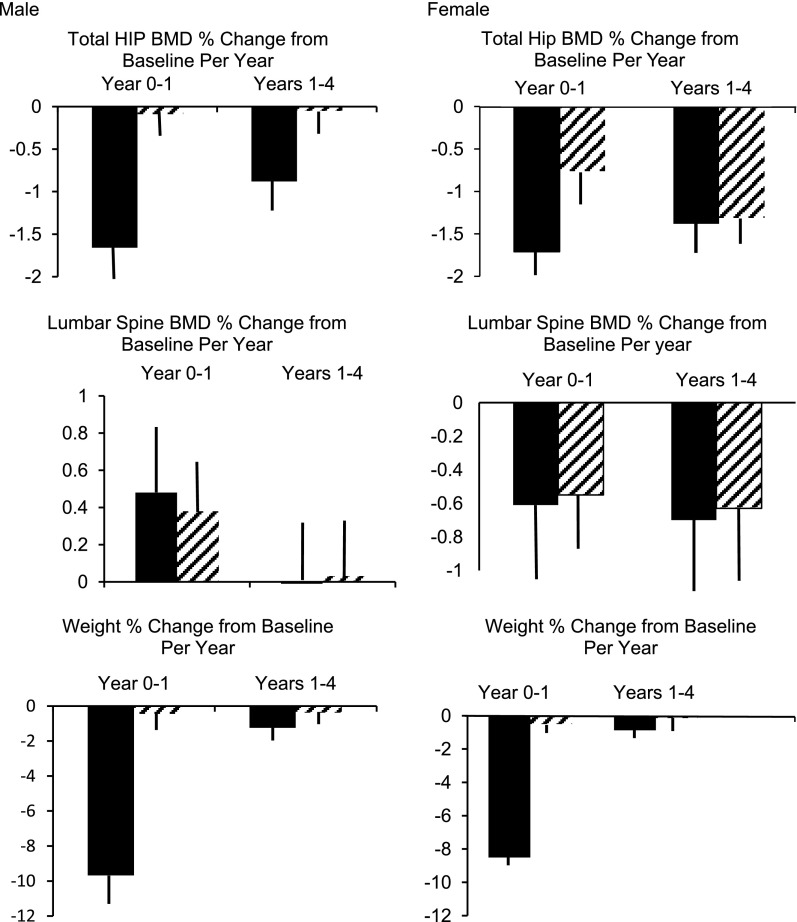
ILI was effective in producing significant weight loss (5.3% vs. 1.8% in ILI and DSE, respectively; P < 0.01) and increased fitness (6.4% vs. −0.8%) at year 4. In men, ILI participants had a greater rate of bone loss during the first year (−1.66% vs. −0.09% per year in ILI and DSE, respectively). Differences between groups were diminished by one-half after 4 years (−0.88% vs. −0.05% per year in ILI and DSE, respectively) but remained significant (P < 0.01). The difference in rate of hip bone loss between groups over 4 years was related to increased weight loss in ILI. Among women, the rate of bone loss did not differ between ILI and DSE after 4 years.
CONCLUSIONS
A 4-year weight loss intervention was significantly associated with a modest increase in bone loss at the hip in men but not in women.
-
Subjects:
-
Source:Diabetes Care. 2014; 37(10):2822-2829.
-
Pubmed ID:25048381
-
Pubmed Central ID:PMC4170123
-
Document Type:
-
Funding:DK-046204/DK/NIDDK NIH HHS/United States ; DK-56990/DK/NIDDK NIH HHS/United States ; DK-56992/DK/NIDDK NIH HHS/United States ; DK-57002/DK/NIDDK NIH HHS/United States ; DK-57008/DK/NIDDK NIH HHS/United States ; DK-57078/DK/NIDDK NIH HHS/United States ; DK-57131/DK/NIDDK NIH HHS/United States ; DK-57135/DK/NIDDK NIH HHS/United States ; DK-57136/DK/NIDDK NIH HHS/United States ; DK-57149/DK/NIDDK NIH HHS/United States ; DK-57151/DK/NIDDK NIH HHS/United States ; DK-57154/DK/NIDDK NIH HHS/United States ; DK-57171/DK/NIDDK NIH HHS/United States ; DK-57177/DK/NIDDK NIH HHS/United States ; DK-57178/DK/NIDDK NIH HHS/United States ; DK-57182/DK/NIDDK NIH HHS/United States ; DK-57219/DK/NIDDK NIH HHS/United States ; M01-RR-000056/RR/NCRR NIH HHS/United States ; M01-RR-00051/RR/NCRR NIH HHS/United States ; M01-RR-0021140/RR/NCRR NIH HHS/United States ; M01-RR-01066/RR/NCRR NIH HHS/United States ; M01-RR-01346/RR/NCRR NIH HHS/United States ; M01-RR-02719/RR/NCRR NIH HHS/United States ; P30 DK017047/DK/NIDDK NIH HHS/United States ; P30 DK079626/DK/NIDDK NIH HHS/United States ; P30-DK-48520/DK/NIDDK NIH HHS/United States ; UL1-RR-024153/RR/NCRR NIH HHS/United States
-
Volume:37
-
Issue:10
-
Collection(s):
-
Main Document Checksum:urn:sha256:735c087ea4275bc45d021e296cb505d4c31c7f7a0e2f88a7edc9e4d5a9cb1eb9
-
Download URL:
-
File Type:
 [PDF
- 788.19 KB
]
[PDF
- 788.19 KB
]
Supporting Files


ON THIS PAGE


CDC STACKS serves as an archival repository of CDC-published products including
scientific findings,
journal articles, guidelines, recommendations, or other public health information authored or
co-authored by CDC or funded partners.
As a repository, CDC STACKS retains documents in their original published format to ensure public access to scientific information.
As a repository, CDC STACKS retains documents in their original published format to ensure public access to scientific information.
You May Also Like
COLLECTION
CDC Public Access