


The Effects of Diabetes, Hypertension, Asthma, Heart Disease, and Stroke on Quality-Adjusted Life Expectancy
Supporting Files

-
2013 Jan-Feb
File Language:
English
Details
-
Alternative Title:Value Health
-
Personal Author:
-
Description:Objective
Quality-adjusted life expectancy (QALE) is a summary measure that combines mortality and health-related quality of life across different stages of life. The objective of this study was to estimate QALE loss due to five chronic diseases—diabetes mellitus, hypertension, asthma, heart disease, and stroke.
Methods
Health-related quality of life scores were from the 1993–2009 Behavioral Risk Factor Surveillance System. Using age-specific deaths from the Compressed Mortality File, this study constructed life tables to calculate losses in life expectancy and QALE due to each of the five diseases from 1993 through 2009 and for 50 US states and the District of Columbia.
Results
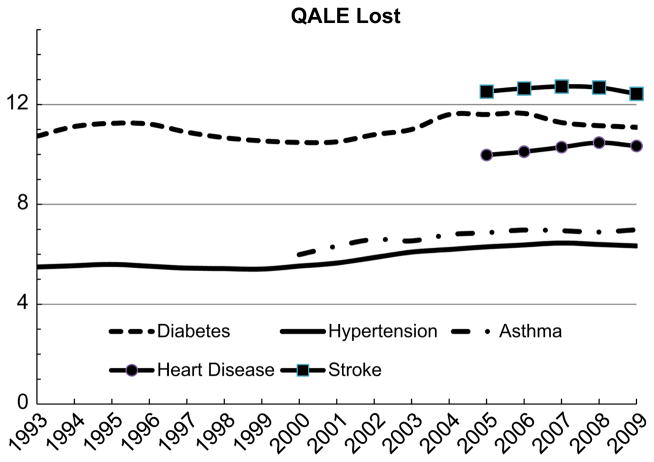
In 2009, the individual-level QALE loss for diabetic people, compared with nondiabetic people, was 11.1 years; for those with hypertension, 6.3 years; for those with asthma, 7.0 years; for those with heart disease, 10.3 years; and for those with stroke, 12.4 years. At the population level, diabetes, hypertension, asthma, heart disease, and stroke contributed 1.9, 2.2, 0.8, 1.2, and 0.8 years of population QALE loss at age 18 years, respectively.
Conclusions
Persons with each of the five diseases had significantly lower life expectancy and QALE. Because the prevalence of diabetes and hypertension has increased significantly in the United States in the last two decades, the burdens of these two conditions, measured by population QALE losses, had increased 83% and 29% from 1993 to 2009, respectively. Also, by examining changes in population QALE loss at different ages, policymakers can identify age groups most affected by particular diseases and develop the most cost-effective interventions by focusing on these groups.
-
Subjects:
-
Source:Value Health. 16(1):140-147.
-
Pubmed ID:23337225
-
Pubmed Central ID:PMC4590983
-
Document Type:
-
Funding:
-
Place as Subject:
-
Volume:16
-
Issue:1
-
Collection(s):
-
Main Document Checksum:urn:sha256:ba62cf558c7411127c3dd91f6d19af80f3ec10991aed5c9503447875afb76d27
-
Download URL:
-
File Type:
 [PDF
- 594.52 KB
]
[PDF
- 594.52 KB
]
Supporting Files


File Language:
English
ON THIS PAGE



CDC STACKS serves as an archival repository of CDC-published products including
scientific findings,
journal articles, guidelines, recommendations, or other public health information authored or
co-authored by CDC or funded partners.
As a repository, CDC STACKS retains documents in their original published format to ensure public access to scientific information.
As a repository, CDC STACKS retains documents in their original published format to ensure public access to scientific information.
You May Also Like
COLLECTION
CDC Public Access