



Length of Stay and Deaths in Diabetes-Related Preventable Hospitalizations Among Asian American, Pacific Islander, and White Older Adults on Medicare, Hawai‘i, December 2006–December 2010
Supporting Files

-
Aug 06 2015
File Language:
English
Details
-
Journal Article:Preventing Chronic Disease (PCD)
-
Personal Author:
-
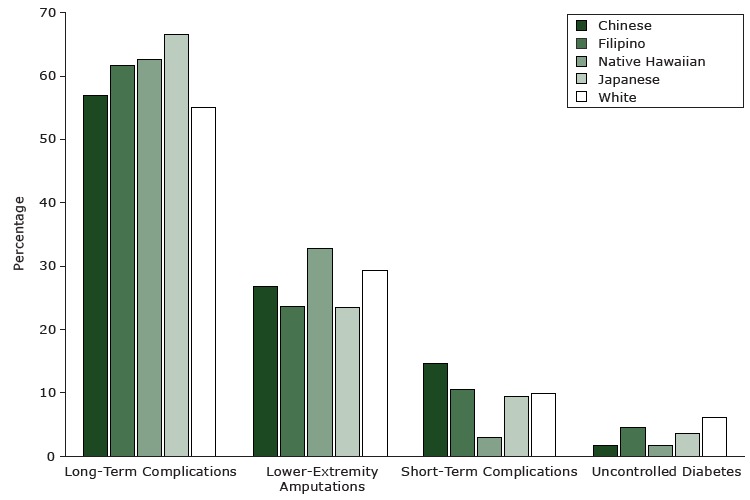
Description:Introduction ; The objective of this study was to compare in-hospital deaths and length of stays for diabetes-related preventable hospitalizations (D-RPHs) in Hawai‘i for Asian American, Pacific Islander, and white Medicare recipients aged 65 years or older. ; Methods ; We considered all hospitalizations of older (>65 years) Japanese, Chinese, Native Hawaiians, Filipinos, and whites living in Hawai‘i with Medicare as the primary insurer from December 2006 through December 2010 (n = 127,079). We used International Classification of Diseases – 9th Revision (ICD-9) codes to identify D-RPHs as defined by the Agency for Healthcare Research and Quality. Length of stays and deaths during hospitalization were compared for Asian American and Pacific Islander versus whites in multivariable regression models, adjusting for age, sex, location of residence (Oahu, y/n), and comorbidity. ; Results ; Among the group studied, 1,700 hospitalizations of 1,424 patients were D-RPHs. Native Hawaiians were significantly more likely to die during a D-RPH (odds ratio OR, 3.92; 95% confidence interval CI, 1.42–10.87) than whites. Filipinos had a significantly shorter length of stay (relative risk RR, 0.77; 95% CI, 0.62–0.95) for D-RPH than whites. Among Native Hawaiians with a D-RPH, 59% were in the youngest age group (65–75 y) whereas only 6.3% were in the oldest (≥85 y). By contrast, 23.2% of Japanese were in the youngest age group, and 32.2% were in the oldest. ; Conclusion ; This statewide study found significant differences in the clinical characteristics and outcomes of D-RPHs for Asian American and Pacific Islanders in Hawai‘i. Native Hawaiians were more likely to die during a D-RPH and were hospitalized at a younger age for a D-RPH than other studied racial/ethnic groups. Focused interventions targeting Native Hawaiians are needed to avoid these outcomes.
-
Subjects:
- Aged
- Aged, 80 and over
- Asian
- Diabetes Complications/ethnology
- Diabetes Complications/prevention & control
- Ethnicity
- Female
- Hospital Mortality/ethnology
- Hospitalization
- Humans
- International Classification of Diseases
- Length of Stay
- Male
- Medicare
- Multivariate Analysis
- Native Hawaiian or Other Pacific Islander
- White People
-
Source:Prev Chronic Dis. 12.
-
DOI:
-
ISSN:1545-1151
-
Pubmed ID:26247424
-
Pubmed Central ID:PMC4552136
-
Document Type:
-
Funding:G12 MD007601/MD/NIMHD NIH HHS/United States ; G12MD007601/MD/NIMHD NIH HHS/United States ; P20 MD000173/MD/NIMHD NIH HHS/United States ; P20GM103466/GM/NIGMS NIH HHS/United States ; R01HS019990/HS/AHRQ HHS/United States ; U54 MD007584/MD/NIMHD NIH HHS/United States ; U54MD007584/MD/NIMHD NIH HHS/United States
-
Place as Subject:
-
Volume:12
-
Download URL:
-
File Type:
 [PDF - 297.48 KB]
 -
Collection(s):
-
Main Document Checksum:urn:sha-512:f17f9691ee6e4ec05eb0730ba627b7028c46ddba28600ac3bbfdc9d4c12c2886d1da47b79b1eeb484f352168f00ee15f080fe815aa082b6139d7da02deb0df97
Supporting Files


File Language:
English
 Was this page helpful?
 Found an issue?

CDC STACKS serves as an archival repository of CDC-published products including
scientific findings, journal articles, guidelines, recommendations, or other public health information authored or
co-authored by CDC or funded partners.
As a repository, CDC STACKS retains documents in their original published format to ensure public access to scientific information.
As a repository, CDC STACKS retains documents in their original published format to ensure public access to scientific information.
You May Also Like
COLLECTION
Preventing Chronic Disease