


Uptake of meningococcal conjugate vaccine among adolescents in large managed care organizations, United States, 2005: Demand, supply and seasonality
Supporting Files
Public Domain

-
Nov 03 2009
-
File Language:
English
Details
-
Alternative Title:BMC Infect Dis
-
Personal Author:
-
Description:Background
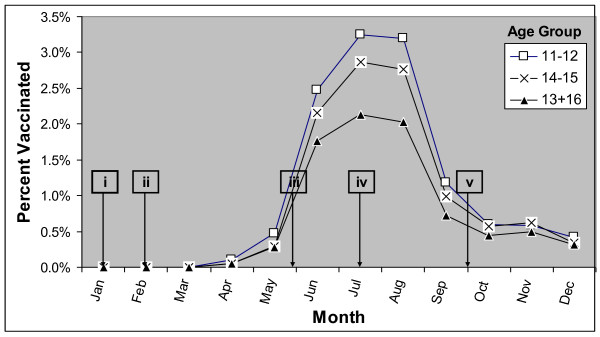
In February 2005, the US Advisory Committee on Immunization Practices recommended the new meningococcal conjugate vaccine (MCV4) for routine use among 11- to 12-year-olds (at the preadolescent health-care visit), 14- to 15-year-olds (before high-school entry), and groups at increased risk. Vaccine distribution started in March; however, in July, the manufacturer reported inability to meet demand and widespread MCV4 shortages were reported. Our objectives were to determine early uptake patterns among target (11-12 and 14-15 year olds) and non-target (13- plus 16-year-olds) age groups. A post hoc analysis was conducted to compare seasonal uptake patterns of MCV4 with polysaccharide meningococcal (MPSV4) and tetanus diphtheria (Td) vaccines.
Methods
We analyzed data for adolescents 11-16 years from five managed care organizations participating in the Vaccine Safety Datalink (VSD). For MCV4, we estimated monthly and cumulative coverage during 2005 and calculated risk ratios. For MPSV4 and Td, we combined 2003 and 2004 data and compared their seasonal uptake patterns with MCV4.
Results
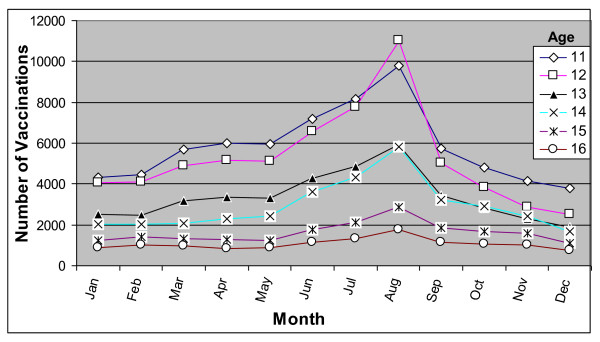
Coverage for MCV4 during 2005 among the 623,889 11-16 years olds was 10%. Coverage for 11-12 and 14-15 year olds was 12% and 11%, respectively, compared with 8% for 13- plus 16-year-olds (p < 0.001). Of the 64,272 MCV4 doses administered from March-December 2005, 73% were administered June-August. Fifty-nine percent of all MPSV4 doses and 38% of all Td doses were administered during June-August.
Conclusion
A surge in vaccine uptake between June and August was observed among adolescents for MCV4, MPSV4 and Td vaccines. The increase in summer-time vaccinations and vaccination of non-targeted adolescents coupled with supply limitations likely contributed to the reported shortages of MCV4 in 2005.
-
Subjects:
-
Source:BMC Infect Dis. 2009; 9:175.
-
Document Type:
-
Place as Subject:
-
Volume:9
-
Collection(s):
-
Main Document Checksum:urn:sha-512:5912e56c2d8f101d43737e13412dee5adb8770bc5a80f4895e2c61c1e5e3559a92849a43c551f48d255207042f6d2bef9f27f490097b7f6dbbe7ab7508ca86a1
-
Download URL:
-
File Type:
 [PDF
- 233.56 KB
]
[PDF
- 233.56 KB
]
Supporting Files


File Language:
English
ON THIS PAGE



CDC STACKS serves as an archival repository of CDC-published products including
scientific findings,
journal articles, guidelines, recommendations, or other public health information authored or
co-authored by CDC or funded partners.
As a repository, CDC STACKS retains documents in their original published format to ensure public access to scientific information.
As a repository, CDC STACKS retains documents in their original published format to ensure public access to scientific information.
You May Also Like
COLLECTION
CDC Public Access