



Evaluation of the impact of meningococcal serogroup A conjugate vaccine on the childhood immunization program’s second-year-of-life vaccination coverage in Burkina Faso
Supporting Files

-
10 31 2019 ; 10-31-
-
Available in CDC Stacks on 2023-12-13T00:00:00Z
File Language:
English
Details
-
Alternative Title:J Infect Dis
-
Personal Author:Zoma, Robert L. ; Walldorf, Jenny A. ; Tarbangdo, Felix ; Patel, Jaymin C. ; Diallo, Alpha Oumar ; Nkwenkeu, Sylvain F. ; Kambou, Ludovic ; Nikiema, Moumouni ; Ouedraogo, Arnaud ; Bationo, Ange B. ; Ouili, Romeo ; Badolo, Hermann ; Sawadogo, Guetawende ; Akshaya, Krishnaswamy ; Hatcher, Cynthia ; Hyde, Terri B. ; Aké, Flavien ; Novak, Ryan T. ; Wannemuehler, Kathleen ; Mirza, Imran ; Medah, Isaïe ; Soeters, Heidi M.
-
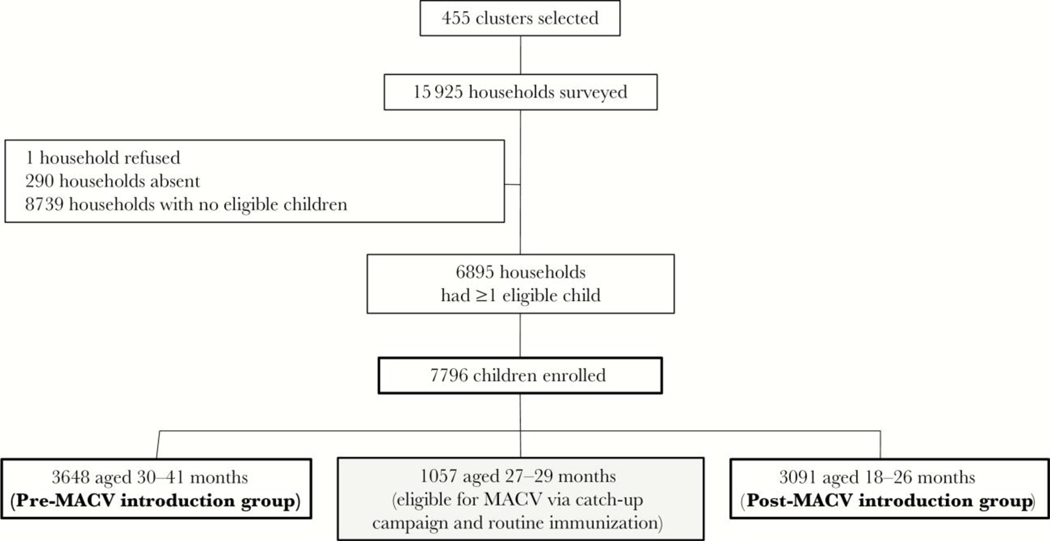
Description:Background: ; Following successful meningococcal serogroup A conjugate vaccine (MACV) campaigns since 2010, Burkina Faso introduced MACV in March 2017 into the routine Expanded Programme for Immunization (EPI) schedule at age 15–18 months, concomitantly with second-dose measles-containing vaccine (MCV2). We examined MCV2 coverage in pre- and post-MACV introduction cohorts to describe observed changes regionally and nationally. ; Methods: ; A nationwide household cluster survey of children 18–41 months of age was conducted 1 year after MACV introduction. Coverage was assessed by verification of vaccination cards or recall. Two age groups were included to compare MCV2 coverage pre-MACV introduction (30–41 months) versus post-MACV introduction (18–26 months). ; Results: ; In total, 15,925 households were surveyed; 7,796 children were enrolled, including 3,684 30–41 months of age and 3,091 18–26 months of age. Vaccination documentation was observed for 86% of children. MACV routine coverage was 58% (95% confidence interval CI:56–61%) with variation by region (41–76%). MCV2 coverage was 62% (CI:59–65%) pre-MACV introduction and 67% (CI:64–69%) post-MACV introduction, an increase of 4.5% (CI:1.3–7.7%). Among children who received routine MACV and MCV2, 93% (CI:91–94%) received both at the same visit. Lack of caregiver awareness about the 15- to 18-month visit and vaccine unavailability were common reported barriers to vaccination. ; Conclusion: ; A small yet significant increase in national MCV2 coverage was observed 1 year post-MACV introduction. MACV/MCV2 co-administration was common. Findings will help inform strategies to strengthen second-year-of-life immunization coverage, including to address the communication and vaccine availability barriers identified.
-
Keywords:
- Serogroup A meningococcal meningitis
- conjugate meningococcal vaccine
- measles vaccine
- Burkina Faso
- immunization schedule
- Adolescent
- Adult
- Female
- Humans
- Immunization Programs
- Immunization Schedule
- Infant
- Male
- Mass Vaccination
- Meningitis, Meningococcal
- Meningococcal Vaccines
- Middle Aged
- Neisseria meningitidis, Serogroup A
- Outcome Assessment, Health Care
- Vaccination Coverage
- Vaccines, Conjugate
- Young Adult
-
Source:J Infect Dis. 220(220 Suppl 4):S233-S243
-
Pubmed ID:31671442
-
Pubmed Central ID:PMC10718265
-
Document Type:
-
Funding:
-
Volume:220
-
Download URL:
-
File Type:
 [PDF - 289.89 KB]
 -
Collection(s):
-
Main Document Checksum:urn:sha256:120975c3115a00ed81dc8b30c9c54115af69beb9c1ae2baec78e6a1f528bbca4
Supporting Files


File Language:
English
 Was this page helpful?
 Found an issue?

CDC STACKS serves as an archival repository of CDC-published products including
scientific findings, journal articles, guidelines, recommendations, or other public health information authored or
co-authored by CDC or funded partners.
As a repository, CDC STACKS retains documents in their original published format to ensure public access to scientific information.
As a repository, CDC STACKS retains documents in their original published format to ensure public access to scientific information.
You May Also Like
COLLECTION
CDC Public Access