


Occupational Exposure Assessment in Carbon Nanotube and Nanofiber Primary and Secondary Manufacturers
Supporting Files

-
December 08 2011
-
File Language:
English
Details
-
Alternative Title:Ann Occup Hyg
-
Personal Author:
-
Description:Research Significance
Toxicological evidence suggests the potential for a wide range of health effects, which could result from exposure to carbon nanotubes (CNTs) and carbon nanofibers (CNFs). The National Institute for Occupational Safety and Health (NIOSH) has proposed a recommended exposure limit (REL) for CNTs/CNFs at the respirable size fraction. The current literature is lacking exposure information, with few studies reporting results for personal breathing zone (PBZ) samples in occupational settings. To address this gap, exposure assessments were conducted at six representative sites identified as CNT/CNF primary or secondary manufacturers.
Methods
Personal and area filter-based samples were collected for both the inhalable mass concentration and the respirable mass concentration of elemental carbon (EC) as well as CNT structure count analysis by transmission electron microscopy to assess exposures. When possible, full-shift PBZ samples were collected; area samples were collected on a task-based approach.
Results
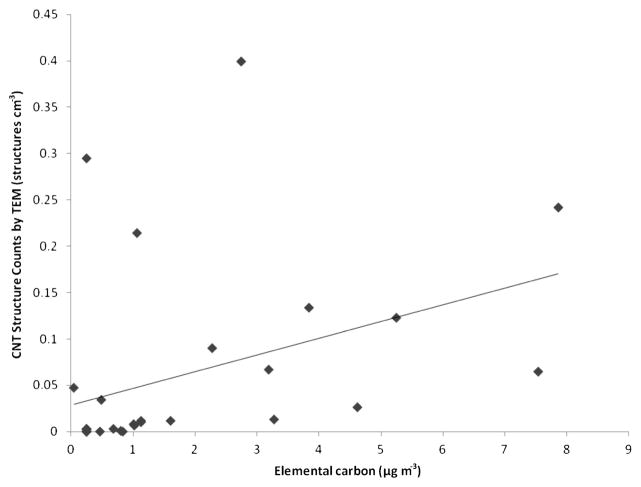
The vast majority of samples collected in this study were below the proposed REL (7 μg m−3). Two of the three secondary manufacturers’ surveyed found concentrations above the proposed REL. None of the samples collected at primary manufacturers were found to be above the REL. Visual and microscopy-based evidence of CNTs/CNFs were found at all sites, with the highest CNT/CNF structure counts being found in samples collected at secondary manufacturing sites. The statistical correlations between the filter-based samples for the mass concentration of EC and CNT structure counts were examined. A general trend was found with a P-value of 0.01 and a corresponding Pearson correlation coefficient of 0.44.
Conclusions
CNT/CNF concentrations were above the proposed NIOSH REL for PBZ samples in two secondary manufacturing facilities that use these materials for commercial applications. These samples were collected during dry powder handling processes, such as mixing and weighing, using fairly large quantities of CNTs/CNFs.
-
Subjects:
-
Source:Ann Occup Hyg. 56(5):542-556
-
Pubmed ID:22156567
-
Pubmed Central ID:PMC4522689
-
Document Type:
-
Funding:
-
Name as Subject:
-
Place as Subject:
-
Volume:56
-
Issue:5
-
Collection(s):
-
Main Document Checksum:urn:sha256:896594591584174547c58fbdc05ebc8f94a5b599e0efc854afe8926bb0a50188
-
Download URL:
-
File Type:
 [PDF
- 724.12 KB
]
[PDF
- 724.12 KB
]
Supporting Files


File Language:
English
ON THIS PAGE





CDC STACKS serves as an archival repository of CDC-published products including
scientific findings,
journal articles, guidelines, recommendations, or other public health information authored or
co-authored by CDC or funded partners.
As a repository, CDC STACKS retains documents in their original published format to ensure public access to scientific information.
As a repository, CDC STACKS retains documents in their original published format to ensure public access to scientific information.
You May Also Like
COLLECTION
CDC Public Access