



Prevalence of Esophageal Atresia among 18 International Birth Defects Surveillance Programs
Supporting Files

-
Sep 03 2012
-
Available in CDC Stacks on June 15, 2015, 12:00 AM
File Language:
English
Details
-
Alternative Title:Birth Defects Res A Clin Mol Teratol
-
Personal Author:Nassar, Natasha ; Leoncini, Emanuele ; Amar, Emmanuelle ; Arteaga-Vázquez, Jazmín ; Bakker, Marian K. ; Bower, Carol ; Canfield, Mark A. ; Castilla, Eduardo E. ; Cocchi, Guido ; Correa, Adolfo ; Csáky-Szunyogh, Melinda ; Feldkamp, Marcia L. ; Khoshnood, Babak ; Landau, Danielle ; Lelong, Nathalie ; López-Camelo, Jorge S. ; Lowry, R. Brian ; McDonnell, Robert ; Merlob, Paul ; Métneki, Julia ; Morgan, Margery ; Mutchinick, Osvaldo M. ; Palmer, Miland N. ; Rissmann, Anke ; Siffel, Csaba ; Sìpek, Antonin ; Szabova, Elena ; Tucker, David ; Mastroiacovo, Pierpaolo
-
Description:BACKGROUND
The prevalence of esophageal atresia (EA) has been shown to vary across different geographical settings. Investigation of geographical differences may provide an insight into the underlying etiology of EA.
METHODS
The study population comprised infants diagnosed with EA during 1998 to 2007 from 18 of the 46 birth defects surveillance programs, members of the International Clearinghouse for Birth Defects Surveillance and Research. Total prevalence per 10,000 births for EA was defined as the total number of cases in live births, stillbirths, and elective termination of pregnancy for fetal anomaly (ETOPFA) divided by the total number of all births in the population.
RESULTS
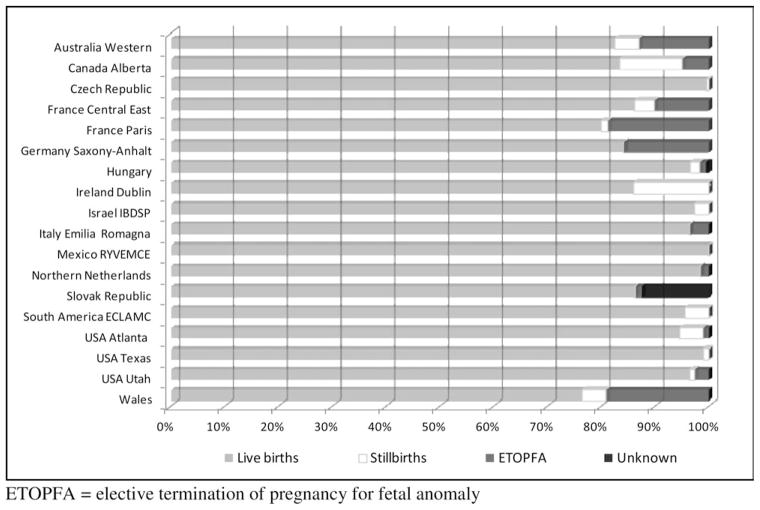
Among the participating programs, a total of 2943 cases of EA were diagnosed with an average prevalence of 2.44 (95% confidence interval CI, 2.35–2.53) per 10,000 births, ranging between 1.77 and 3.68 per 10,000 births. Of all infants diagnosed with EA, 2761 (93.8%) were live births, 82 (2.8%) stillbirths, 89 (3.0%) ETOPFA, and 11 (0.4%) had unknown outcomes. The majority of cases (2020, 68.6%), had a reported EA with fistula, 749 (25.5%) were without fistula, and 174 (5.9%) were registered with an unspecified code.
CONCLUSIONS
On average, EA affected 1 in 4099 births (95% CI, 1 in 3954–4251 births) with prevalence varying across different geographical settings, but relatively consistent over time and comparable between surveillance programs. Findings suggest that differences in the prevalence observed among programs are likely to be attributable to variability in population ethnic compositions or issues in reporting or registration procedures of EA, rather than a real risk occurrence difference. -
Subjects:
-
Source:Birth Defects Res A Clin Mol Teratol. 2012; 94(11):893-899.
-
Pubmed ID:22945024
-
Pubmed Central ID:PMC4467200
-
Document Type:
-
Funding:
-
Volume:94
-
Issue:11
-
Download URL:
-
File Type:
 [PDF - 347.95 KB]
 -
Collection(s):
-
Main Document Checksum:urn:sha-512:600e88e9b2db89b6ff78207b409c191f0b06845c1210bd69e3a5fcfa92f56f7d97e506f594e1044b4c03807a22e5c183dfbbac85db0d1879e967d9311572ae94
Supporting Files


File Language:
English
 Was this page helpful?
 Found an issue?

CDC STACKS serves as an archival repository of CDC-published products including
scientific findings, journal articles, guidelines, recommendations, or other public health information authored or
co-authored by CDC or funded partners.
As a repository, CDC STACKS retains documents in their original published format to ensure public access to scientific information.
As a repository, CDC STACKS retains documents in their original published format to ensure public access to scientific information.
You May Also Like
COLLECTION
CDC Public Access