


A Quantitative Glycogen Assay to Verify Use of Self-Administered Vaginal Swabs
Supporting Files

-
Dec 2012
-
File Language:
English
Details
-
Alternative Title:Sex Transm Dis
-
Personal Author:
-
Description:Background
Self-administered swabs are used to sample vaginal contents for a variety of clinical purposes including detection of sexually transmitted infections, condom breakage, and vaginal product use. The goal of this study was to determine whether a quantitative glycogen assay can be used to assess whether a swab has been exposed to the vagina to assure study compliance.
Study Design
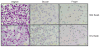
Buccal, skin, or vaginal samples were tested to determine whether a commercial quantitative glycogen assay can differentiate vaginal specimens. In addition, archived remnant de-identified vaginal swabs from clinical trials were tested. Periodic acid–Schiff stain was used to identify glycogen-positive cells as a confirmation test.
Results
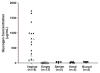
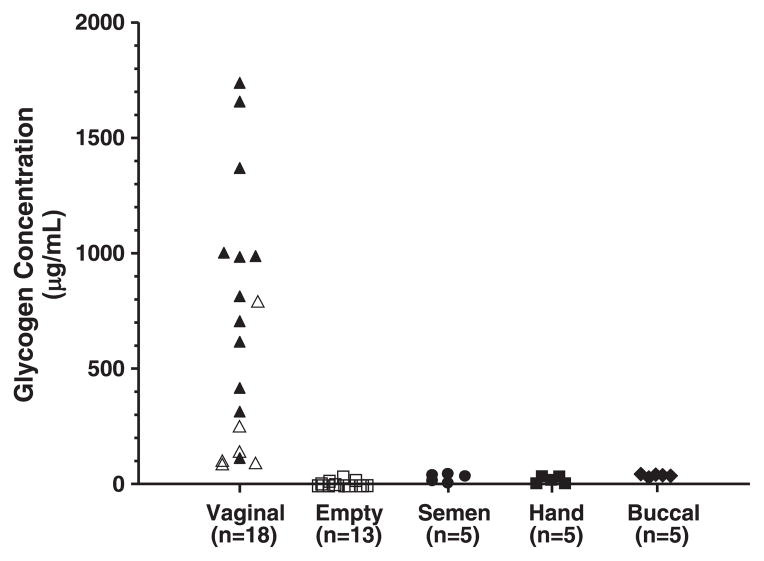
Glycogen concentrations in eluates of vaginal swabs from reproductive-aged women were significantly higher than those from unused swabs (mean ± SE, 964 ± 135 μg/mL vs. 14.7 ± 2.5 μg/mL, P < 0.001) and swabs exposed to buccal and finger/hand epithelia (40.3 ± 4.8 and 18.5 ± 5.4 μg/mL, P < 0.001). Glycogen concentrations were lower and more variable in vaginal swabs from older perimenopausal/menopausal women (mean ± SE, 235 ± 123, P < 0.01). Semen and sample storage longer than 1 year did not affect glycogen detection. Using a cutoff of 100 μg/mL of glycogen, 30 of 30 vaginal swabs from reproductive-aged women versus 0 of 28 control swabs were positive, for an assay sensitivity of 1 (95% confidence interval, 0.86–1) and specificity of 1 (95% confidence interval, 0.85–1). Periodic acid–Schiff stain correlated with soluble glycogen results but was less specific.
Conclusions
The quantitative glycogen assay provides a simple and inexpensive method to validate the use of self-administered swabs for sampling vaginal contents in clinical studies.
-
Subjects:
-
Source:Sex Transm Dis. 2012; 39(12):949-953.
-
Pubmed ID:23191948
-
Pubmed Central ID:PMC4452942
-
Document Type:
-
Funding:
-
Volume:39
-
Issue:12
-
Collection(s):
-
Main Document Checksum:urn:sha256:ea3a8294fc0702890478972dcd73a4c2b77dfdd6b7ffe66ccd77c7f461970537
-
Download URL:
-
File Type:
 [PDF
- 545.76 KB
]
[PDF
- 545.76 KB
]
Supporting Files


File Language:
English
ON THIS PAGE




CDC STACKS serves as an archival repository of CDC-published products including
scientific findings,
journal articles, guidelines, recommendations, or other public health information authored or
co-authored by CDC or funded partners.
As a repository, CDC STACKS retains documents in their original published format to ensure public access to scientific information.
As a repository, CDC STACKS retains documents in their original published format to ensure public access to scientific information.
You May Also Like
COLLECTION
CDC Public Access