


Prevalence and Prognosis of Unrecognized Myocardial Infarction Determined by Cardiac Magnetic Resonance in Older Adults
Supporting Files

-
Sep 5 2012
-
File Language:
English
Details
-
Alternative Title:JAMA
-
Personal Author:
-
Description:Context
Unrecognized myocardial infarction (MI) is prognostically important but electrocardiography (ECG), the main epidemiology tool for detection, is insensitive to MI.
Objective
Determine prevalence and mortality risk for unrecognized MI (UMI) detected by cardiac magnetic resonance (CMR) or ECG.
Design
ICELAND MI is a cohort substudy of the Age, Gene/Environment Susceptibility-Reykjavik Study (enrollment January 2004–January 2007) using ECG or CMR to detect UMI.
Setting
Community dwelling participants in Iceland over age 67.
Participants
936 participants (ages 67–93 years) including 670 who were randomly selected and 266 with diabetes.
Main Outcome Measures
MI prevalence and mortality through September 1, 2011. Results reported with 95% confidence limits and net reclassification improvement (NRI).
Results
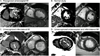
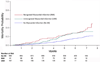
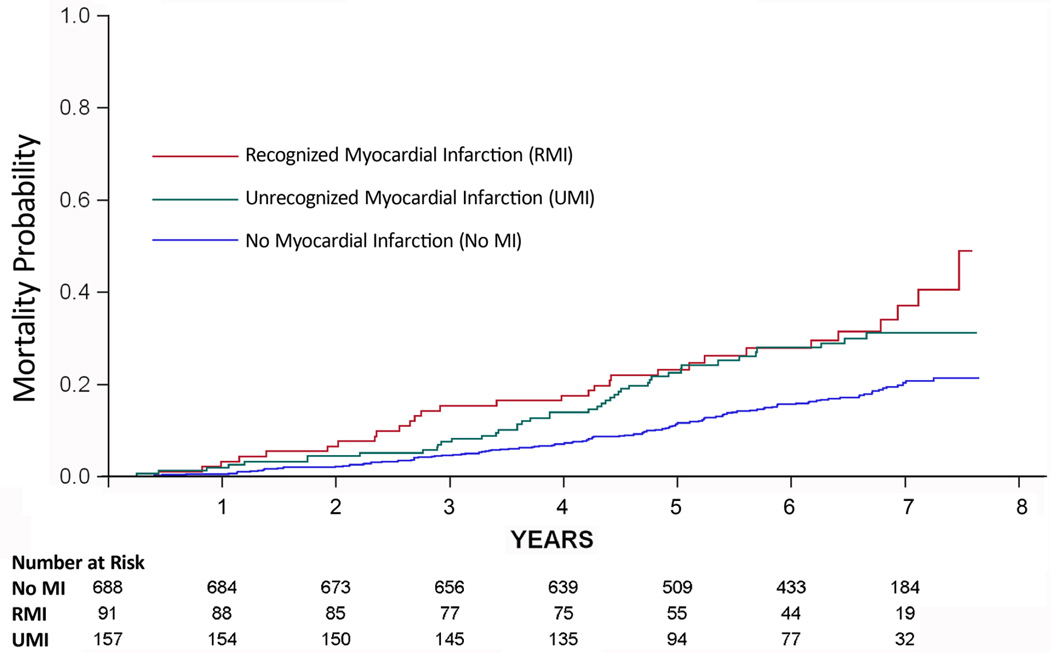
Of 936 participants, 91 had recognized MI (RMI; 9.7% CI 8–12%), and 157 had UMI by CMR (17%; CI 14–19%) which was more prevalent than the 46 UMI by ECG (5%; CI 4–6%, p<0.001). Diabetic participants had more UMI by CMR than UMI by ECG (n=72; 21%; CI 17–26% vs. n=15; 4%; CI 2–7%, p<0.001). UMI by CMR was associated with atherosclerosis risk factors, coronary calcium, coronary revascularization, and peripheral vascular disease. Over a median of 6.4 years, 33% (CI 23–43%) of individuals with RMI died (30 of 91) and 28% (CI 21–35%) with UMI died (44 of 157), both higher rates than the 17% (CI 15–20%) with no MI that died (119 of 688). UMI by CMR improved risk stratification for mortality over RMI (NRI: 0.34; CI 0.16–0.53). Adjusting for age, sex, diabetes, and RMI, UMI by CMR remained associated with mortality (HR 1.45 CI 1.02–2.06, absolute risk increase (ARI) 8%) and significantly improved risk stratification for mortality, NRI 0.16 (CI 0.01–0.31)) but UMI by ECG did not (HR 0.88, CI 0.45–1.73 ARI −2%; NRI: −0.05; CI −0.17–0.05). Compared to those with RMI, participants with UMI by CMR used cardiac medications such as statins less often (36%; CI, 28–43% or 56/157 vs.73%; CI 63–82% or 66/91; p<0.001).
Conclusions
In a community-based cohort, the prevalence of UMI by CMR was higher than the prevalence of recognized MI or UMI by ECG, and was associated with increased mortality risk.
-
Subjects:
-
Source:JAMA. 308(9):890-896.
-
Pubmed ID:22948699
-
Pubmed Central ID:PMC4137910
-
Document Type:
-
Funding:N01 AG012100/AG/NIA NIH HHS/United States ; N01-AG-12100/AG/NIA NIH HHS/United States ; Z01 AG007380-02/Intramural NIH HHS/United States ; Z01 AG007380-03/Intramural NIH HHS/United States ; Z01 HL004607-08 CE/CE/NCIPC CDC HHS/United States ; Z01 HL004607-09/Intramural NIH HHS/United States ; Z01 HL004607-10/Intramural NIH HHS/United States ; Z99 HL999999/Intramural NIH HHS/United States ; ZIA AG007380-04/Intramural NIH HHS/United States ; ZIA AG007380-05/Intramural NIH HHS/United States ; ZIA AG007380-06/Intramural NIH HHS/United States ; ZIA AG007380-07/Intramural NIH HHS/United States ; ZIA HL004607-11/Intramural NIH HHS/United States ; ZIA HL004607-12/Intramural NIH HHS/United States ; ZIA HL004607-14/Intramural NIH HHS/United States ; ZIA HL006136-01/Intramural NIH HHS/United States ; ZIA HL006136-02/Intramural NIH HHS/United States ; ZIE HL006139-01/Intramural NIH HHS/United States ; ZIE HL006139-02/Intramural NIH HHS/United States
-
Place as Subject:
-
Volume:308
-
Issue:9
-
Collection(s):
-
Main Document Checksum:urn:sha256:5bc847d7089001383bc75ef8bec2e6407d69a28c96963e9bdfbfe4c5be642369
-
Download URL:
-
File Type:
 [PDF
- 501.47 KB
]
[PDF
- 501.47 KB
]
Supporting Files


File Language:
English
ON THIS PAGE


CDC STACKS serves as an archival repository of CDC-published products including
scientific findings,
journal articles, guidelines, recommendations, or other public health information authored or
co-authored by CDC or funded partners.
As a repository, CDC STACKS retains documents in their original published format to ensure public access to scientific information.
As a repository, CDC STACKS retains documents in their original published format to ensure public access to scientific information.
You May Also Like
COLLECTION
CDC Public Access