


The latency-associated nuclear antigen, a multifunctional protein central to Kaposi’s sarcoma-associated herpesvirus latency
Supporting Files

-
12 2011
File Language:
English
Details
-
Alternative Title:Future Microbiol
-
Personal Author:
-
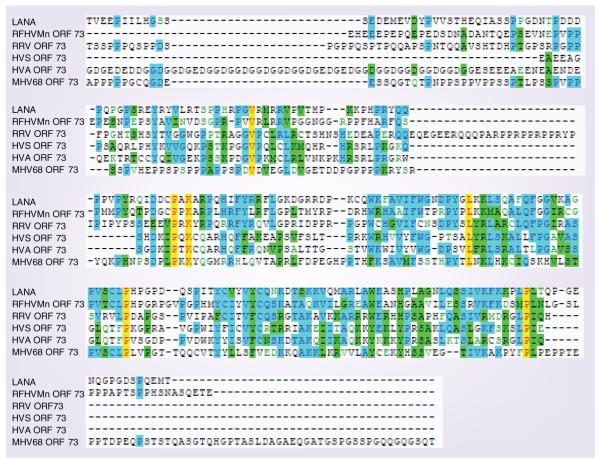
Description:Latency-associated nuclear antigen (LANA) is encoded by the Kaposi's sarcoma (KS)-associated herpesvirus (KSHV) open reading frame 73. LANA is expressed during latent KSHV infection of cells, including tumor cells, such as primary effusion lymphoma, KS and multicentric Castleman's disease. Latently infected cells have multiple extrachromosomal copies of covalently closed circular KSHV genomes (episomes) that are stably maintained in proliferating cells. LANA's best characterized function is that of mediating episome persistence. It does so by binding terminal repeat sequences to the chromosomal matrix, thus ensuring episome replication with each cell division and efficient DNA segregation to daughter nuclei after mitosis. To achieve these functions, LANA associates with different host cell proteins, including chromatin-associated proteins and proteins involved in DNA replication. In addition to episome maintenance, LANA has transcriptional regulatory effects and affects cell growth. LANA exerts these functions through interactions with different cell proteins.
-
Subjects:
-
Source:Future Microbiol. 2011; 6(12)
-
Pubmed ID:22122438
-
Pubmed Central ID:PMC3857968
-
Document Type:
-
Funding:P30 NS047466/NS/NINDS NIH HHSUnited States/ ; P30AR050498/AR/NIAMS NIH HHSUnited States/ ; PR093491/PR/OCPHP CDC HHSUnited States/ ; R01 CA082036/CA/NCI NIH HHSUnited States/ ; P30NS047466/NS/NINDS NIH HHSUnited States/ ; R01 AR050498/AR/NIAMS NIH HHSUnited States/ ; CA082036/CA/NCI NIH HHSUnited States/
-
Volume:6
-
Issue:12
-
Collection(s):
-
Main Document Checksum:urn:sha256:952fd49f92db1c0d1b59bec9b11bb8cc6e28de210366fa46f0378dcd1c415728
-
Download URL:
-
File Type:
 [PDF
- 1.15 MB
]
[PDF
- 1.15 MB
]
Supporting Files


File Language:
English
ON THIS PAGE




CDC STACKS serves as an archival repository of CDC-published products including
scientific findings,
journal articles, guidelines, recommendations, or other public health information authored or
co-authored by CDC or funded partners.
As a repository, CDC STACKS retains documents in their original published format to ensure public access to scientific information.
As a repository, CDC STACKS retains documents in their original published format to ensure public access to scientific information.
You May Also Like
COLLECTION
CDC Public Access