


Association between obesity and vulnerability and serologic response to influenza vaccination in older adults
Supporting Files

-
Apr 03 2012
-
File Language:
English
Details
-
Alternative Title:Vaccine
-
Personal Author:Talbot, HK ; Coleman, LA ; Crimin, K ; Zhu, Y ; Rock, MT ; Meece, J ; Shay, DK ; Belongia, EA ; Griffin, MR
-
Description:Background
Serologic response to influenza vaccination declines with age. Few other host factors are known to be associated with serologic response. Our objective was to determine whether obesity and vulnerability independently predicted serologic response to influenza vaccination.
Methods
Adults ≥ 50 yrs were recruited during the 2008-09 influenza season. Subjects provided pre- and post-vaccination sera for measuring antibody titers to 2008-09 vaccine components. Body mass index (BMI) was calculated as weight (kg) ÷ height (m)2. Data were collected on vulnerability using the Vulnerable Elders Survey (VES13). Logistic regression evaluated the associations between obesity and vulnerability and the serologic response to vaccination (both seroprotection andseroconversion), adjusting for gender, age, comorbidities, pre-vaccination titer, and site.
Results
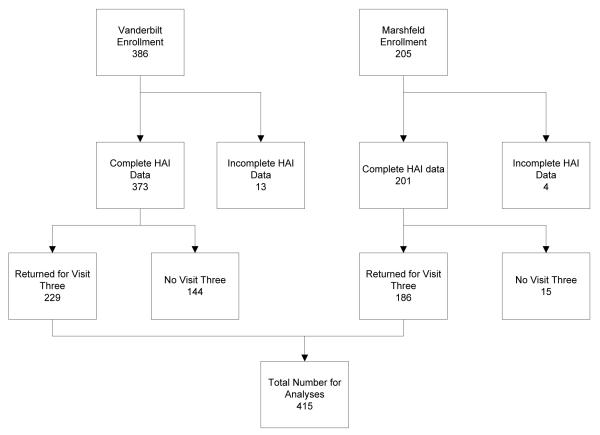
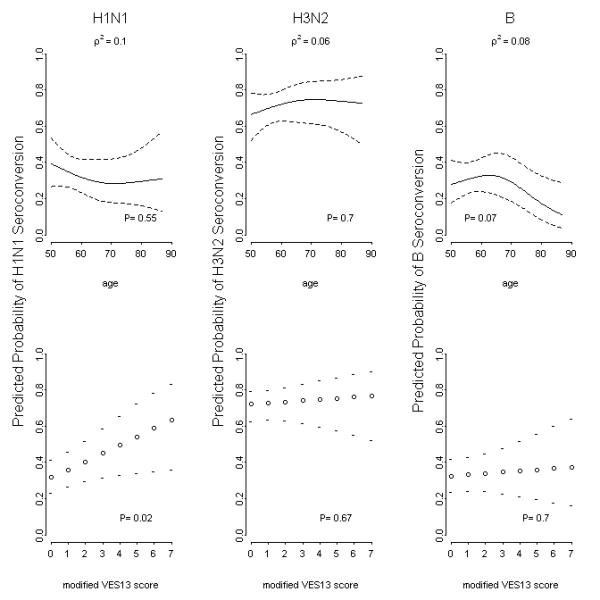
Mean (± standard deviation) age of 415 study subjects was 65 ± 10 yrs; 40% were obese. Mean BMI was 29 ± 5.6 kg/m2; mean VES13 was 1.6 ± 1.8. The proportions of subjects who seroconverted and had seroprotective titers were 40% and 49%, respectively, for A/Brisbane/59 (H1N1); 73% and 80% for A/Brisbane/10 (H3N2); and 34% and 94% for B/Florida. Modified VES-13 (score 0 to 10, with 10 being most vulnerable) was not associated with seroprotection against H1N1 or H3N2, and VES-13 was directly associated with seroconversion to H1N1 but not H3N2 or B. Obesity (BMI ≥ 30 kg/m2 vs. BMI 18.5 – 30) was not associated with seroprotection for H1N1 or H3N2; obesity was directly associated with seroconversion to H3N2 but not H1N1 or B. Age was inversely associated with seroprotection and seroconversion against H1N1 and with seroconversion to influenza B.
Conclusion
Based on this sample of older healthy subjects, there were no consistent relationships between VES 13 or obesity and either seroprotection or seroconversion to three influenza vaccine antigens.
-
Subjects:
-
Source:Vaccine. 30(26):3937-3943.
-
Pubmed ID:22484350
-
Pubmed Central ID:PMC3770527
-
Document Type:
-
Funding:UL1 TR000445/TR/NCATS NIH HHS/United States ; 1 U18 IP000184-01/IP/NCIRD CDC HHS/United States ; K23 AI074863/AI/NIAID NIH HHS/United States ; TL1 RR024978/RR/NCRR NIH HHS/United States ; KL2 RR024977/RR/NCRR NIH HHS/United States ; 5 U18 IP000183-02/IP/NCIRD CDC HHS/United States ; K23 AI074863-01A1/AI/NIAID NIH HHS/United States ; U18 IP000184/IP/NCIRD CDC HHS/United States ; U18 IP000183/IP/NCIRD CDC HHS/United States ; RR024975/RR/NCRR NIH HHS/United States ; KL2 TR000446/TR/NCATS NIH HHS/United States ; TL1 TR000447/TR/NCATS NIH HHS/United States ; UL1 RR024975/RR/NCRR NIH HHS/United States
-
Volume:30
-
Issue:26
-
Collection(s):
-
Main Document Checksum:urn:sha256:c3a9a465cd3bf84c5a4259fe77e3c05b0ba3841594e8b8cbd03af5545aa7d347
-
Download URL:
-
File Type:
 [PDF
- 97.18 KB
]
[PDF
- 97.18 KB
]
Supporting Files


File Language:
English
ON THIS PAGE



CDC STACKS serves as an archival repository of CDC-published products including
scientific findings,
journal articles, guidelines, recommendations, or other public health information authored or
co-authored by CDC or funded partners.
As a repository, CDC STACKS retains documents in their original published format to ensure public access to scientific information.
As a repository, CDC STACKS retains documents in their original published format to ensure public access to scientific information.
You May Also Like
COLLECTION
CDC Public Access