


Selection Bias in Population-Based Cancer Case–Control Studies Due to Incomplete Sampling Frame Coverage
Supporting Files

-
Apr 06 2012
-
File Language:
English
Details
-
Alternative Title:Cancer Epidemiol Biomarkers Prev
-
Personal Author:
-
Description:Background
Increasing numbers of individuals are choosing to opt out of population-based sampling frames due to privacy concerns. This is especially a problem in the selection of controls for case–control studies, as the cases often arise from relatively complete population-based registries, whereas control selection requires a sampling frame. If opt out is also related to risk factors, bias can arise.
Methods
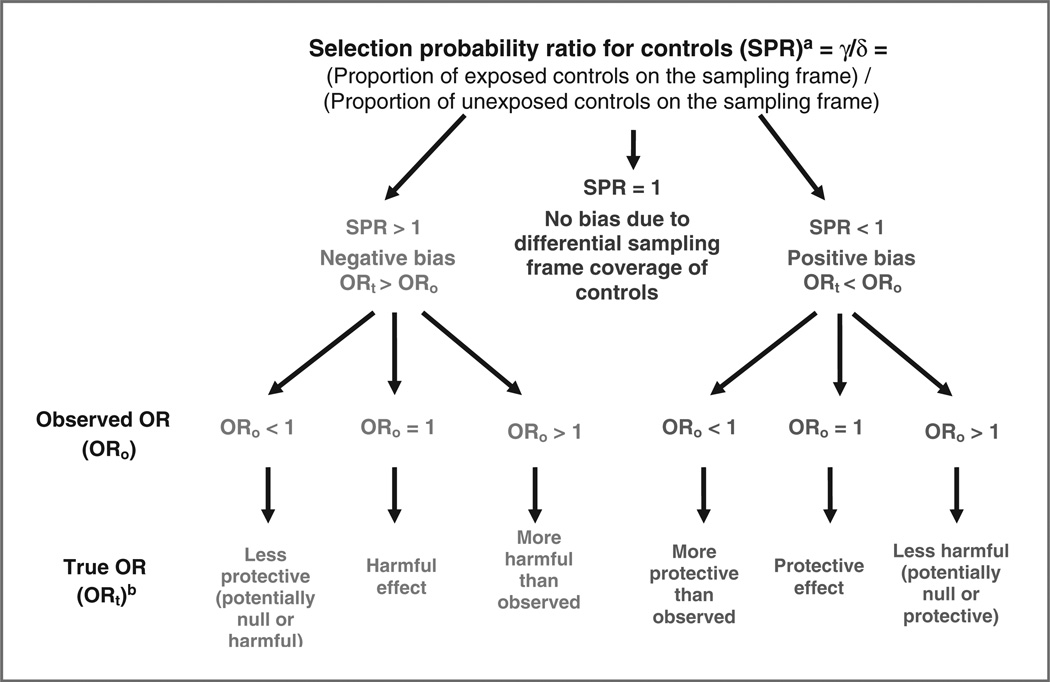
We linked breast cancer cases who reported having a valid driver’s license from the 2004–2008 Wisconsin women’s health study (N = 2,988) with a master list of licensed drivers from the Wisconsin Department of Transportation (WDOT). This master list excludes Wisconsin drivers that requested their information not be sold by the state. Multivariate-adjusted selection probability ratios (SPR) were calculated to estimate potential bias when using this driver’s license sampling frame to select controls.
Results
A total of 962 cases (32%) had opted out of the WDOT sampling frame. Cases age <40 (SPR = 0.90), income either unreported (SPR = 0.89) or greater than $50,000 (SPR = 0.94), lower parity (SPR = 0.96 per one-child decrease), and hormone use (SPR = 0.93) were significantly less likely to be covered by the WDOT sampling frame (α = 0.05 level).
Conclusions
Our results indicate the potential for selection bias due to differential opt out between various demographic and behavioral subgroups of controls. As selection bias may differ by exposure and study base, the assessment of potential bias needs to be ongoing.
Impact
SPRs can be used to predict the direction of bias when cases and controls stem from different sampling frames in population-based case–control studies.
-
Subjects:
-
Source:Cancer Epidemiol Biomarkers Prev. 2012; 21(6):881-886.
-
Pubmed ID:22490319
-
Pubmed Central ID:PMC3645306
-
Document Type:
-
Funding:CA47147/CA/NCI NIH HHS/United States ; CA67264/CA/NCI NIH HHS/United States ; CD000712/CD/ODCDC CDC HHS/United States ; K05 CA152715/CA/NCI NIH HHS/United States ; R01 CA047147/CA/NCI NIH HHS/United States ; R01 CA067264/CA/NCI NIH HHS/United States ; UL1 RR025011/RR/NCRR NIH HHS/United States ; UL1 TR000427/TR/NCATS NIH HHS/United States
-
Volume:21
-
Issue:6
-
Collection(s):
-
Main Document Checksum:urn:sha256:966b74f3a54bf8241d153355c9bc23581344d6504015f7f0ecd7aeaff038db09
-
Download URL:
-
File Type:
 [PDF
- 759.26 KB
]
[PDF
- 759.26 KB
]
Supporting Files


File Language:
English
ON THIS PAGE

CDC STACKS serves as an archival repository of CDC-published products including
scientific findings,
journal articles, guidelines, recommendations, or other public health information authored or
co-authored by CDC or funded partners.
As a repository, CDC STACKS retains documents in their original published format to ensure public access to scientific information.
As a repository, CDC STACKS retains documents in their original published format to ensure public access to scientific information.
You May Also Like
COLLECTION
CDC Public Access