


SSBP2 variants are associated with survival in glioblastoma patients
Supporting Files

-
6 1 2012
-
File Language:
English
Details
-
Alternative Title:Clin Cancer Res
-
Personal Author:Xiao, Yuanyuan ; Decker, Paul A. ; Rice, Terri ; McCoy, Lucie S. ; Smirnov, Ivan ; Patoka, Joseph S. ; Hansen, Helen M. ; Wiemels, Joe L. ; Tihan, Tarik ; Prados, Michael D. ; Chang, Susan M. ; Berger, Mitchel S. ; Kosel, Matthew L. ; Fridley, Brooke L. ; Lachance, Daniel H. ; O’Neill, Brian Patrick ; Buckner, Jan C. ; Thompson, Reid C. ; Nabors, L. B. ; Olson, Jeffrey J. ; Brem, Steve ; Madden, Melissa H. ; Browning, James E. ; Wiencke, John K. ; Egan, Kathleen M. ; Jenkins, Robert B. ; Wrensch, Margaret R.
-
Description:Purpose
Glioblastoma is a devastating, incurable disease with few known prognostic factors. Here we present the first genome-wide survival and validation study for glioblastoma.
Methods
Cox regressions for survival with 314,635 inherited autosomal single nucleotide polymorphisms (SNPs) among 315 San Francisco Adult Glioma Study patients for discovery and three independent validation datasets (87 Mayo Clinic, 232 GliomaSE and 115 The Cancer Genome Atlas patients) were used to identify SNPs associated with overall survival for Caucasian glioblastoma patients treated with the current standard of care, resection, radiation and temozolomide (total n=749). Tumor expression of the gene that contained the identified prognostic SNP was examined in three separate datasets (total n=619). Genotype imputation was used to estimate hazard ratios (HRs) for SNPs that had not been directly genotyped.
Results
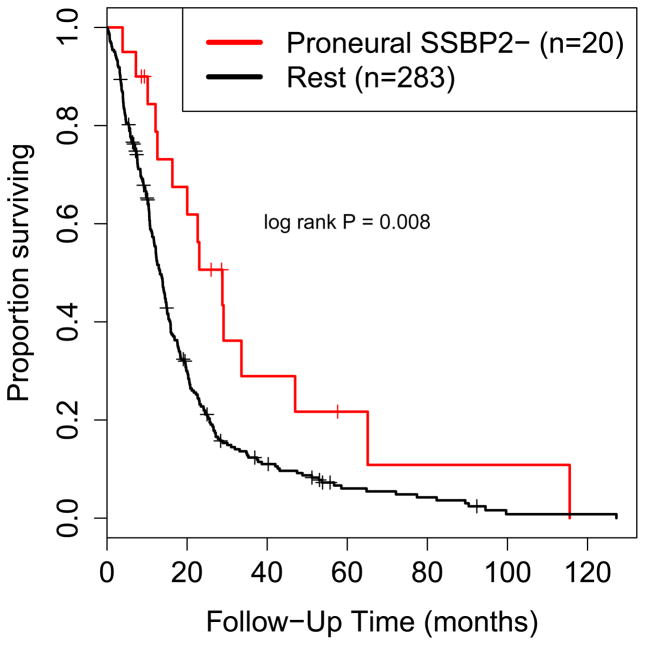
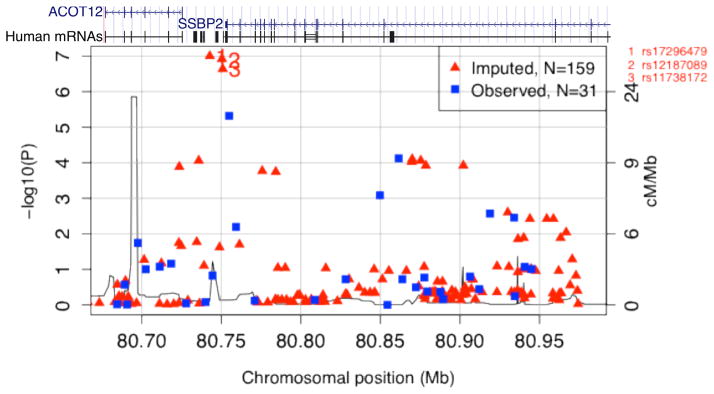
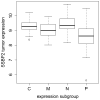
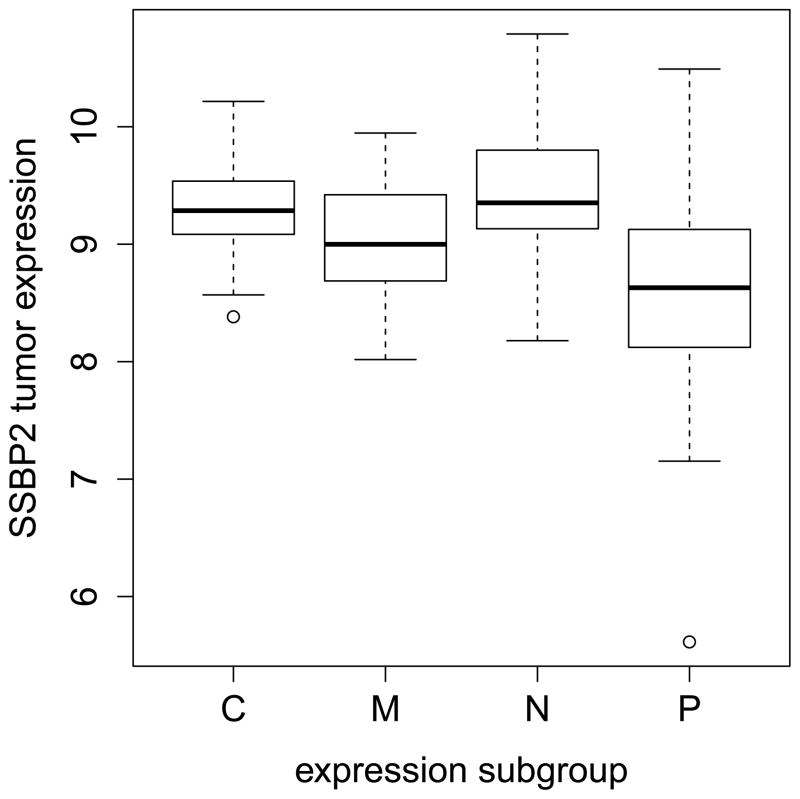
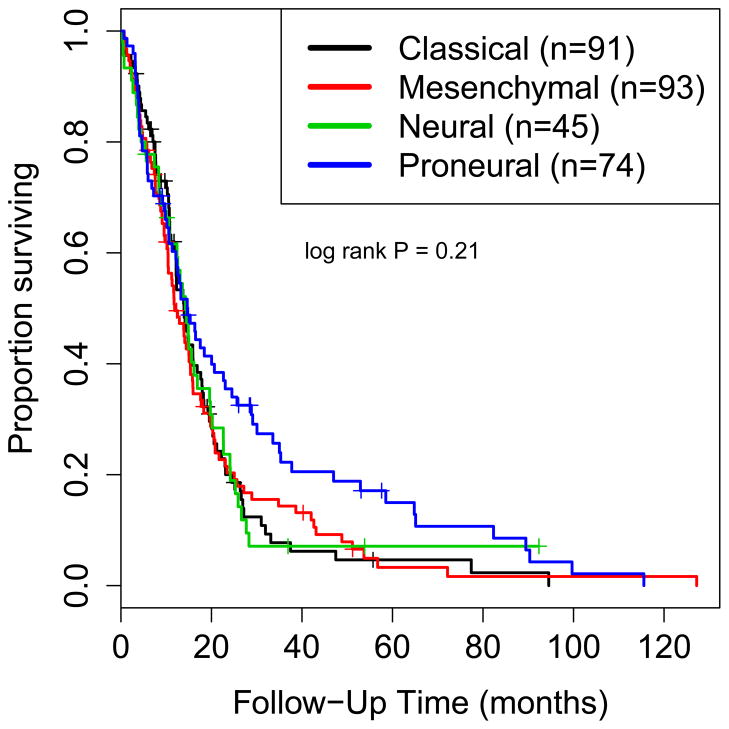
From the discovery and validation analyses, we identified a variant in SSBP2 (single-stranded DNA-binding protein 2) on 5q14.1 associated with overall survival in combined analyses (hazard ratio (HR) = 1.64; P = 1.3X10⁻⁶). Expression of SSBP2 in tumors from three independent datasets also was significantly related to patient survival (P = 5.3 X 10⁻⁴). Using genotype imputation, the SSBP2 SNP rs17296479 had the strongest statistically significant genome-wide association with poorer overall patient survival (HR = 1.79; 95% CI: 1.45–2.22; P = 1.0 X 10⁻⁷).
Conclusion
The minor allele of SSBP2 SNP rs17296479 and the increased tumor expression of SSBP2 were statistically significantly associated with poorer overall survival among glioblastoma patients. With further confirmation, previously unrecognized inherited variations influencing survival may warrant inclusion in clinical trials to improve randomization. Unaccounted for genetic influence on survival could produce unwanted bias in such studies.
-
Subjects:
-
Source:Clin Cancer Res. 18(11):3154-3162
-
Pubmed ID:22472174
-
Pubmed Central ID:PMC3607457
-
Document Type:
-
Funding:R01 CA116174/CA/NCI NIH HHSUnited States/ ; P50 CA108961/CA/NCI NIH HHSUnited States/ ; HHSN261201000035C/CA/NCI NIH HHSUnited States/ ; HHSN261201000036C/CA/NCI NIH HHSUnited States/ ; 1U58 DP000807-01/DP/NCCDPHP CDC HHSUnited States/ ; P50 CA097257/CA/NCI NIH HHSUnited States/ ; R01CA52689/CA/NCI NIH HHSUnited States/ ; P30 CA15083/CA/NCI NIH HHSUnited States/ ; R01 CA052689/CA/NCI NIH HHSUnited States/ ; U58 DP000807/DP/NCCDPHP CDC HHSUnited States/ ; P30 CA076292/CA/NCI NIH HHSUnited States/ ; P30 CA015083/CA/NCI NIH HHSUnited States/ ; HHSN261201000035I/CA/NCI NIH HHSUnited States/ ; P50CA097257/CA/NCI NIH HHSUnited States/ ; HHSN261201000034C/CA/NCI NIH HHSUnited States/ ; P50CA108961/CA/NCI NIH HHSUnited States/
-
Volume:18
-
Issue:11
-
Collection(s):
-
Main Document Checksum:urn:sha256:a4370a7968805ffb2a3bc40a9ae2480fe20c587d9b0be7d691148c984c24870b
-
Download URL:
-
File Type:
 [PDF
- 894.66 KB
]
[PDF
- 894.66 KB
]
Supporting Files


File Language:
English
ON THIS PAGE

CDC STACKS serves as an archival repository of CDC-published products including
scientific findings,
journal articles, guidelines, recommendations, or other public health information authored or
co-authored by CDC or funded partners.
As a repository, CDC STACKS retains documents in their original published format to ensure public access to scientific information.
As a repository, CDC STACKS retains documents in their original published format to ensure public access to scientific information.
You May Also Like
COLLECTION
CDC Public Access