



Association of Neighborhood Characteristics with Bystander-Initiated CPR
Supporting Files

-
Oct 25 2012
-
File Language:
English
Details
-
Alternative Title:N Engl J Med
-
Personal Author:
-
Description:BACKGROUND
For persons who have an out-of-hospital cardiac arrest, the probability of receiving bystander-initiated cardiopulmonary resuscitation (CPR) may be influenced by neighborhood characteristics.
METHODS
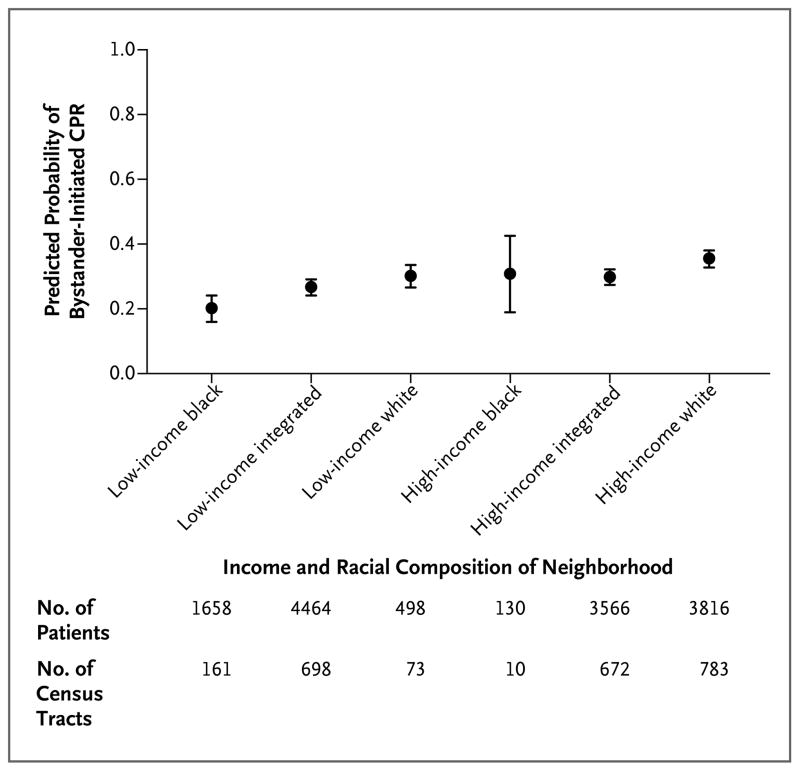
We analyzed surveillance data prospectively submitted from 29 U.S. sites to the Cardiac Arrest Registry to Enhance Survival between October 1, 2005, and December 31, 2009. The neighborhood in which each cardiac arrest occurred was determined from census-tract data. We classified neighborhoods as high-income or low-income on the basis of a median household income threshold of $40,000 and as white or black if more than 80% of the census tract was predominantly of one race. Neighborhoods without a predominant racial composition were classified as integrated. We analyzed the relationship between the median income and racial composition of a neighborhood and the performance of bystander-initiated CPR.
RESULTS
Among 14,225 patients with cardiac arrest, bystander-initiated CPR was provided to 4068 (28.6%). As compared with patients who had a cardiac arrest in high-income white neighborhoods, those in low-income black neighborhoods were less likely to receive bystander-initiated CPR (odds ratio, 0.49; 95% confidence interval [CI], 0.41 to 0.58). The same was true of patients with cardiac arrest in neighborhoods characterized as low-income white (odds ratio, 0.65; 95% CI, 0.51 to 0.82), low-income integrated (odds ratio, 0.62; 95% CI, 0.56 to 0.70), and high-income black (odds ratio, 0.77; 95% CI, 0.68 to 0.86). The odds ratio for bystander-initiated CPR in high-income integrated neighborhoods (1.03; 95% CI, 0.64 to 1.65) was similar to that for high-income white neighborhoods.
CONCLUSIONS
In a large cohort study, we found that patients who had an out-of-hospital cardiac arrest in low-income black neighborhoods were less likely to receive bystander-initiated CPR than those in high-income white neighborhoods. (Funded by the Centers for Disease Control and Prevention and others.)
-
Subjects:
-
Source:N Engl J Med. 2012; 367(17):1607-1615.
-
Pubmed ID:23094722
-
Pubmed Central ID:PMC3515681
-
Document Type:
-
Funding:
-
Volume:367
-
Issue:17
-
Collection(s):
-
Main Document Checksum:urn:sha256:d7a3cbd9293c8404c9b7f886570b071b65c94e01683bd381b77ea0b5cdae7fe6
-
Download URL:
-
File Type:
 [PDF
- 707.30 KB
]
[PDF
- 707.30 KB
]
Supporting Files


File Language:
English
 Was this page helpful?
 Found an issue?


CDC STACKS serves as an archival repository of CDC-published products including
scientific findings,
journal articles, guidelines, recommendations, or other public health information authored or
co-authored by CDC or funded partners.
As a repository, CDC STACKS retains documents in their original published format to ensure public access to scientific information.
As a repository, CDC STACKS retains documents in their original published format to ensure public access to scientific information.
You May Also Like
COLLECTION
CDC Public Access