


Variation in the ICAM1–ICAM4–ICAM5 locus is associated with systemic lupus erythematosus susceptibility in multiple ancestries
Supporting Files

-
11 2012
-
File Language:
English
Details
-
Alternative Title:Ann Rheum Dis
-
Personal Author:Kim, Kwangwoo ; Brown, Elizabeth E ; Choi, Chan-Bum ; Alarcón-Riquelme, Marta E ; Kelly, Jennifer A ; Glenn, Stuart B ; Ojwang, Joshua O ; Adler, Adam ; Lee, Hye-Soon ; Boackle, Susan A ; Criswell, Lindsey A ; Alarcón, Graciela S ; Edberg, Jeffrey C ; Stevens, Anne M ; Jacob, Chaim O ; Gilkeson, Gary S ; Kamen, Diane L ; Tsao, Betty P ; Anaya, Juan-Manuel ; Guthridge, Joel M ; Nath, Swapan K ; Richardson, Bruce ; Sawalha, Amr H ; Kang, Young Mo ; Shim, Seung Cheol ; Suh, Chang-Hee ; Lee, Soo-Kon ; Kim, Chang-sik ; Merrill, Joan T ; Petri, Michelle ; Ramsey-Goldman, Rosalind ; Vilá, Luis M ; Niewold, Timothy B ; Martin, Javier ; Pons-Estel, Bernardo A ; Vyse, Timothy J ; Freedman, Barry I ; Moser, Kathy L ; Gaffney, Patrick M ; Williams, Adrienne ; Comeau, Mary ; Reveille, John D ; James, Judith A ; Scofield, R Hal ; Langefeld, Carl D ; Kaufman, Kenneth M ; Harley, John B ; Kang, Changwon ; Kimberly, Robert P ; Bae, Sang-Cheol
-
Description:Objective
Systemic lupus erythematosus (SLE; OMIM 152700) is a chronic autoimmune disease for which the aetiology includes genetic and environmental factors. ITGAM, integrin αΜ (complement component 3 receptor 3 subunit) encoding a ligand for intracellular adhesion molecule (ICAM) proteins, is an established SLE susceptibility locus. This study aimed to evaluate the independent and joint effects of genetic variations in the genes that encode ITGAM and ICAM.
Methods
The authors examined several markers in the ICAM1–ICAM4–ICAM5 locus on chromosome 19p13 and the single ITGAM polymorphism (rs1143679) using a large-scale case–control study of 17 481 unrelated participants from four ancestry populations. The single marker association and gene–gene interaction were analysed for each ancestry, and a meta-analysis across the four ancestries was performed.
Results
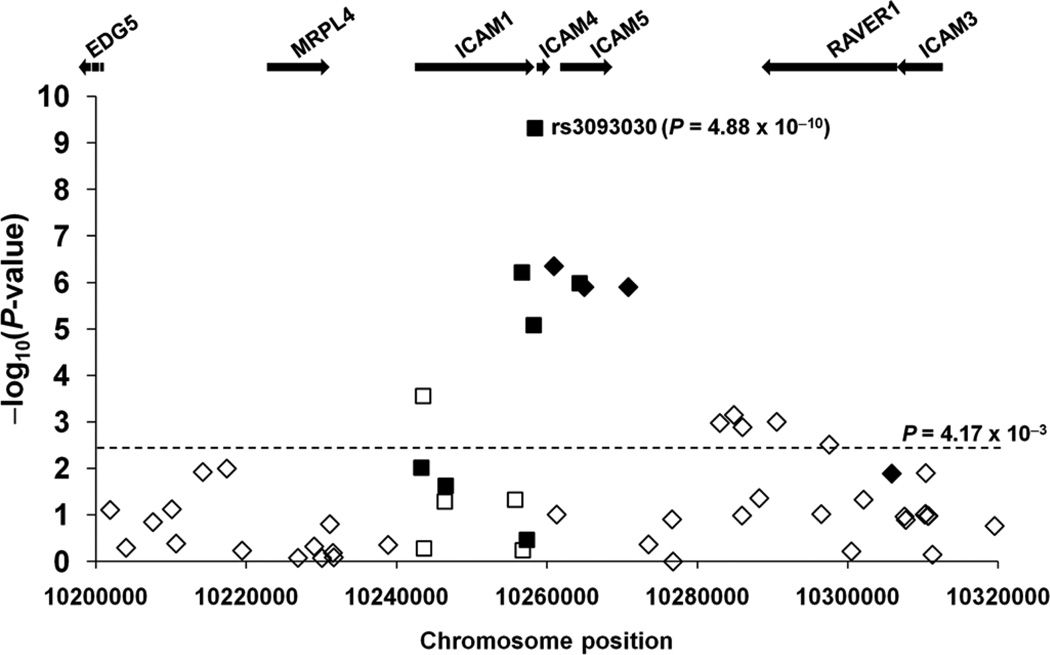
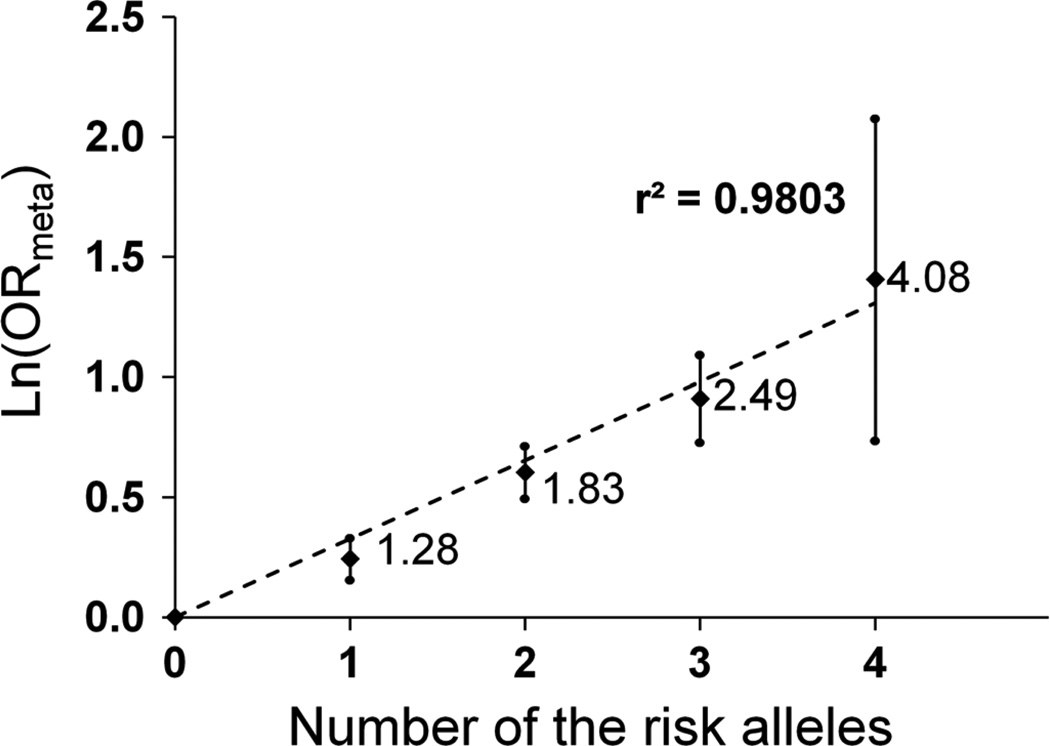
The A-allele of ICAM1–ICAM4–ICAM5 rs3093030, associated with elevated plasma levels of soluble ICAM1, and the A-allele of ITGAM rs1143679 showed the strongest association with increased SLE susceptibility in each of the ancestry populations and the trans-ancestry meta-analysis (ORmeta=1.16, 95% CI 1.11 to 1.22; p=4.88×10⁻¹⁰ and ORmeta=1.67, 95% CI 1.55 to 1.79; p=3.32×10−46, respectively). The effect of the ICAM single-nucleotide polymorphisms (SNPs) was independent of the effect of the ITGAM SNP rs1143679, and carriers of both ICAM rs3093030-AA and ITGAM rs1143679-AA had an OR of 4.08 compared with those with no risk allele in either SNP (95% CI 2.09 to 7.98; p=3.91×10⁻⁵).
Conclusion
These findings are the first to suggest that an ICAM–integrin-mediated pathway contributes to susceptibility to SLE.
-
Subjects:
-
Source:Ann Rheum Dis. 71(11):1809-1814
-
Pubmed ID:22523428
-
Pubmed Central ID:PMC3466387
-
Document Type:
-
Funding:P30 DK042086/DK/NIDDK NIH HHSUnited States/ ; UL1 RR024148/RR/NCRR NIH HHSUnited States/ ; K24 AI078004/AI/NIAID NIH HHSUnited States/ ; RR015577/RR/NCRR NIH HHSUnited States/ ; UL1RR025005/RR/NCRR NIH HHSUnited States/ ; K24-AR002138/AR/NIAMS NIH HHSUnited States/ ; P60 AR053308/AR/NIAMS NIH HHSUnited States/ ; N01AR62277/AR/NIAMS NIH HHSUnited States/ ; M01 RR000079/RR/NCRR NIH HHSUnited States/ ; AR043814/AR/NIAMS NIH HHSUnited States/ ; P20 RR020143/RR/NCRR NIH HHSUnited States/ ; U19 AI082714/AI/NIAID NIH HHSUnited States/ ; AR058554/AR/NIAMS NIH HHSUnited States/ ; UL1RR025741/RR/NCRR NIH HHSUnited States/ ; T32 HD007463/HD/NICHD NIH HHSUnited States/ ; UL1 RR025005/RR/NCRR NIH HHSUnited States/ ; R01-AR33062/AR/NIAMS NIH HHSUnited States/ ; AR060366/AR/NIAMS NIH HHSUnited States/ ; P60-AR053308/AR/NIAMS NIH HHSUnited States/ ; M01-RR00079/RR/NCRR NIH HHSUnited States/ ; AI083194/AI/NIAID NIH HHSUnited States/ ; UL1 RR024999/RR/NCRR NIH HHSUnited States/ ; RC1 AR058554/AR/NIAMS NIH HHSUnited States/ ; P30 AR053483/AR/NIAMS NIH HHSUnited States/ ; R21 AI094377/AI/NIAID NIH HHSUnited States/ ; CA141700-01/CA/NCI NIH HHSUnited States/ ; K08 AI083790/AI/NIAID NIH HHSUnited States/ ; P60-AR049459/AR/NIAMS NIH HHSUnited States/ ; AI094377/AI/NIAID NIH HHSUnited States/ ; UL1 TR000154/TR/NCATS NIH HHSUnited States/ ; P20 RR015577/RR/NCRR NIH HHSUnited States/ ; AR053483/AR/NIAMS NIH HHSUnited States/ ; 5UL1RR025777/RR/NCRR NIH HHSUnited States/ ; AR044804/AR/NIAMS NIH HHSUnited States/ ; UL1 RR025741/RR/NCRR NIH HHSUnited States/ ; AR042460/AR/NIAMS NIH HHSUnited States/ ; RR020143/RR/NCRR NIH HHSUnited States/ ; AI24717/AI/NIAID NIH HHSUnited States/ ; N01 AR062277/AR/NIAMS NIH HHSUnited States/ ; T32 GM063483/GM/NIGMS NIH HHSUnited States/ ; P30 CA046934/CA/NCI NIH HHSUnited States/ ; K08-AI083790/AI/NIAID NIH HHSUnited States/ ; AI082714/AI/NIAID NIH HHSUnited States/ ; AI071651/AI/NIAID NIH HHSUnited States/ ; UL1 TR000062/TR/NCATS NIH HHSUnited States/ ; R01 AR043814/AR/NIAMS NIH HHSUnited States/ ; P60 AR049459/AR/NIAMS NIH HHSUnited States/ ; R37 AI024717/AI/NIAID NIH HHSUnited States/ ; R01 AR042460/AR/NIAMS NIH HHSUnited States/ ; R01 AR057172/AR/NIAMS NIH HHSUnited States/ ; AI063622/AI/NIAID NIH HHSUnited States/ ; R01 AR033062/AR/NIAMS NIH HHSUnited States/ ; AR052300/AR/NIAMS NIH HHSUnited States/ ; R01 AI024717/AI/NIAID NIH HHSUnited States/ ; PR094002/PR/OCPHP CDC HHSUnited States/ ; UL1 RR025777/RR/NCRR NIH HHSUnited States/ ; R01 AR060366/AR/NIAMS NIH HHSUnited States/ ; P01-AR49084/AR/NIAMS NIH HHSUnited States/ ; UL1 RR029882/RR/NCRR NIH HHSUnited States/ ; L30 AI071651/AI/NIAID NIH HHSUnited States/ ; R01 AR043727/AR/NIAMS NIH HHSUnited States/ ; R01 CA141700/CA/NCI NIH HHSUnited States/ ; R21-AI070304/AI/NIAID NIH HHSUnited States/ ; P50 AR048940/AR/NIAMS NIH HHSUnited States/ ; R01 AR044804/AR/NIAMS NIH HHSUnited States/ ; K24 AR002138/AR/NIAMS NIH HHSUnited States/ ; R01 AR052300/AR/NIAMS NIH HHSUnited States/ ; HD07463/HD/NICHD NIH HHSUnited States/ ; AR048940/AR/NIAMS NIH HHSUnited States/ ; AR43727/AR/NIAMS NIH HHSUnited States/ ; UL1RR024999/RR/NCRR NIH HHSUnited States/ ; R21 AI070304/AI/NIAID NIH HHSUnited States/ ; P01 AI083194/AI/NIAID NIH HHSUnited States/ ; N01-AR-6-227/AR/NIAMS NIH HHSUnited States/ ; GM063483/GM/NIGMS NIH HHSUnited States/ ; AR043274/AR/NIAMS NIH HHSUnited States/ ; P60 AR030692/AR/NIAMS NIH HHSUnited States/ ; P60-2-AR30692/AR/NIAMS NIH HHSUnited States/ ; P01 AR049084/AR/NIAMS NIH HHSUnited States/ ; P30-AR055385/AR/NIAMS NIH HHSUnited States/ ; R01 AI063622/AI/NIAID NIH HHSUnited States/ ; P30-DK42086/DK/NIDDK NIH HHSUnited States/ ; R01 AR042525/AR/NIAMS NIH HHSUnited States/ ; UL1RR029882/RR/NCRR NIH HHSUnited States/ ; R01 AR043274/AR/NIAMS NIH HHSUnited States/ ; P60 AR062755/AR/NIAMS NIH HHSUnited States/
-
Volume:71
-
Issue:11
-
Collection(s):
-
Main Document Checksum:urn:sha256:a48258ead653870c96cba3b28df6c571839808eac1060d686d9359492232085e
-
Download URL:
-
File Type:
 [PDF
- 1.00 MB
]
[PDF
- 1.00 MB
]
Supporting Files


File Language:
English
ON THIS PAGE

CDC STACKS serves as an archival repository of CDC-published products including
scientific findings,
journal articles, guidelines, recommendations, or other public health information authored or
co-authored by CDC or funded partners.
As a repository, CDC STACKS retains documents in their original published format to ensure public access to scientific information.
As a repository, CDC STACKS retains documents in their original published format to ensure public access to scientific information.
You May Also Like
COLLECTION
CDC Public Access