


The association of psychotropic medication use with the cognitive, functional, and neuropsychiatric trajectory of Alzheimer’s disease
Supporting Files

-
Feb 29 2012
-
File Language:
English
Details
-
Alternative Title:Int J Geriatr Psychiatry
-
Personal Author:
-
Description:Objective
The use of psychotropic medications in Alzheimer’s disease (AD) has been associated with both deleterious and potentially beneficial outcomes. We examined the longitudinal association of psychotropic medication use with cognitive, functional, and neuropsychiatric symptom (NPS) trajectories among community-ascertained incident AD cases from the Cache County Dementia Progression Study.
Methods
A total of 230 participants were followed for a mean of 3.7 years. Persistency index (PI) was calculated for all antidepressants, selective serotonin reuptake inhibitors (SSRIs), antipsychotics (atypical and typical), and benzodiazepines as the proportion of observed time of medication exposure. Mixed-effects models were used to examine the association between PI for each medication class and Mini-Mental State Exam (MMSE), Clinical Dementia Rating Sum of Boxes (CDR-Sum), and Neuropsychiatric Inventory – Total (NPI-Total) trajectories, controlling for appropriate demographic and clinical covariates.
Results
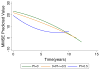
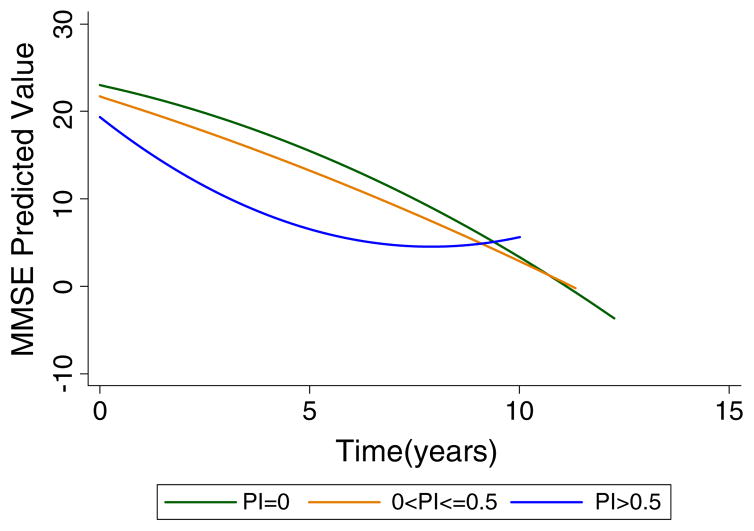
At baseline, psychotropic medication use was associated with greater severity of dementia and poorer medical status. Higher PI for all medication classes was associated with a more rapid decline in MMSE. For antidepressant, SSRI, benzodiazepine, and typical antipsychotic use, a higher PI was associated with a more rapid increase in CDR-Sum. For SSRIs, antipsychotics, and typical antipsychotics, a higher PI was associated with more rapid increase in NPI-Total.
Conclusions
Psychotropic medication use was associated with more rapid cognitive and functional decline in AD, and not with improved NPS. Clinicians may tend to prescribe psychotropic medications to AD patients at risk of poorer outcomes, but one cannot rule out the possibility of poorer outcomes being caused by psychotropic medications.
-
Subjects:
-
Source:Int J Geriatr Psychiatry. 2011; 27(12):1248-1257
-
Pubmed ID:22374884
-
Pubmed Central ID:PMC3448859
-
Document Type:
-
Funding:U01 GM092654/GM/NIGMS NIH HHS/United States ; AG11380/AG/NIA NIH HHS/United States ; R01MH086881/MH/NIMH NIH HHS/United States ; R01AG21136/AG/NIA NIH HHS/United States ; R15 AG037392/AG/NIA NIH HHS/United States ; P30 AG028377/AG/NIA NIH HHS/United States ; R21AG033769/AG/NIA NIH HHS/United States ; U01 DD 000698/DD/NCBDD CDC HHS/United States ; R03 AG032427/AG/NIA NIH HHS/United States ; AG027841/AG/NIA NIH HHS/United States ; R01 AG 31272/AG/NIA NIH HHS/United States ; R01 MH085018-01A2/MH/NIMH NIH HHS/United States ; K08 AG029157/AG/NIA NIH HHS/United States ; R01MH085740-01A2/MH/NIMH NIH HHS/United States ; RAG031348-02S1/PHS HHS/United States ; 5K08AG029157-03/AG/NIA NIH HHS/United States ; U01 DD000698/DD/NCBDD CDC HHS/United States ; R01 ES016669/ES/NIEHS NIH HHS/United States ; R01 AG 21136/AG/NIA NIH HHS/United States ; K12 HD043489/HD/NICHD NIH HHS/United States ; R03AG032427-01A1/AG/NIA NIH HHS/United States ; R01 MH087979/MH/NIMH NIH HHS/United States ; R01 MH085740/MH/NIMH NIH HHS/United States ; R01 AG033032/AG/NIA NIH HHS/United States ; R01 MH085018/MH/NIMH NIH HHS/United States ; P30 AG021334/AG/NIA NIH HHS/United States ; R01 MH076953/MH/NIMH NIH HHS/United States ; U01AG15477/AG/NIA NIH HHS/United States ; R01 MH083738/MH/NIMH NIH HHS/United States ; R21 AG033769/AG/NIA NIH HHS/United States ; R37 AA012303/AA/NIAAA NIH HHS/United States ; K24 AG027841/AG/NIA NIH HHS/United States ; U01 MH066136/MH/NIMH NIH HHS/United States ; R01AG31272/AG/NIA NIH HHS/United States ; U01 AG015477/AG/NIA NIH HHS/United States ; R01AG11380/AG/NIA NIH HHS/United States ; U01 AG037526/AG/NIA NIH HHS/United States ; R37 DA011796/DA/NIDA NIH HHS/United States ; 5K12HD043489-08/HD/NICHD NIH HHS/United States ; R01 AG021136/AG/NIA NIH HHS/United States ; P30AAG021334/PHS HHS/United States ; E1A6031348/PHS HHS/United States ; U01AG037526-01/AG/NIA NIH HHS/United States ; R01 MH086881/MH/NIMH NIH HHS/United States ; 5R01AG033032-02/AG/NIA NIH HHS/United States ; R37 AA12303/AA/NIAAA NIH HHS/United States ; R01 AG031272/AG/NIA NIH HHS/United States ; R01 AG011380/AG/NIA NIH HHS/United States ; AG028377/AG/NIA NIH HHS/United States ; 09CRP2250944/PHS HHS/United States ; R01 AG21136/AG/NIA NIH HHS/United States ; AG021136/AG/NIA NIH HHS/United States ; R01 AG031348/AG/NIA NIH HHS/United States ; K08 AG029157-01A1/AG/NIA NIH HHS/United States
-
Volume:27
-
Issue:12
-
Collection(s):
-
Main Document Checksum:urn:sha256:ede378171b1b1ff7af2025bb627e723bbf74a0126cbd78210c00d3734545a3e7
-
Download URL:
-
File Type:
 [PDF
- 401.07 KB
]
[PDF
- 401.07 KB
]
Supporting Files


File Language:
English
ON THIS PAGE

CDC STACKS serves as an archival repository of CDC-published products including
scientific findings,
journal articles, guidelines, recommendations, or other public health information authored or
co-authored by CDC or funded partners.
As a repository, CDC STACKS retains documents in their original published format to ensure public access to scientific information.
As a repository, CDC STACKS retains documents in their original published format to ensure public access to scientific information.
You May Also Like
COLLECTION
CDC Public Access