


Performance of Simplified Scoring Systems for Hand Diagrams in Carpal Tunnel Syndrome Screening
Supporting Files

-
October 05 2011
-
File Language:
English
Details
-
Alternative Title:J Hand Surg Am
-
Personal Author:
-
Description:Purpose
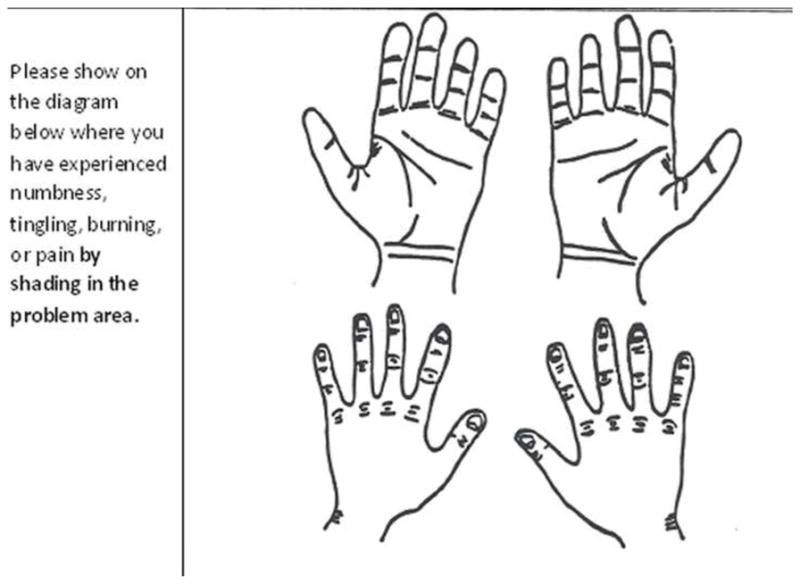
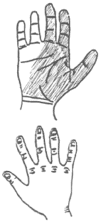
Katz et al have published a standardized scoring system of hand diagrams for carpal tunnel syndrome. The purpose of this study was to quantitatively evaluate alternative scoring of the hand diagram for detection of carpal tunnel syndrome.
Methods
In a prospective study of 1107 workers, 221 workers with hand symptoms completed hand diagrams and electrodiagnostic testing for carpal tunnel syndrome. Scoring algorithms for the hand diagrams included the Katz rating; a median nerve digit score (0–2) with a maximum of 2 symptomatic digits of thumb, index, and long; and isolated digit scores (0–1) of thumb, index, or long. Intraclass correlation coefficients quantified inter-rater reliability. Sensitivity, specificity, and logistic regression analyses evaluated scoring systems performances ability to predict abnormal median nerve conduction.
Results
One hundred ten (50%) subjects illustrated symptoms within the median nerve distribution. All scoring systems demonstrated substantial inter-rater reliability. “Classic” or “probable” Katz scores, median nerve digit score of 2, and positive long finger scores were significantly associated with abnormal median nerve distal sensory latency and median-ulnar difference. Abnormal distal motor latency was significantly associated with the median nerve digit score of 2 and positive long finger scores. Increasing Katz scores from “possible” to “probable” and “classic” were not associated with greater odds of electrodiagnostic abnormality. Positive long finger scores performed at least as well as the most rigorous scoring by Katz.
Conclusions
Symptoms diagramed within the median nerve distribution are associated with abnormal nerve conduction among workers. The median nerve digit score and the long finger score offer increased ease of use compared to the Katz method while maintaining similar performance characteristics. The long finger appears best suited for isolated digit scoring to predict abnormal median nerve conduction in a working population.
-
Subjects:
-
Source:J Hand Surg Am. 2011; 37(1):10-17
-
Pubmed ID:21975100
-
Pubmed Central ID:PMC3438892
-
Document Type:
-
Funding:
-
Volume:37
-
Issue:1
-
Collection(s):
-
Main Document Checksum:urn:sha256:e35840315a8605e4e4d58fc0213eeb4f3c2fe553c73c32d03b725ab1309bf96a
-
Download URL:
-
File Type:
 [PDF
- 318.72 KB
]
[PDF
- 318.72 KB
]
Supporting Files


File Language:
English
ON THIS PAGE


CDC STACKS serves as an archival repository of CDC-published products including
scientific findings,
journal articles, guidelines, recommendations, or other public health information authored or
co-authored by CDC or funded partners.
As a repository, CDC STACKS retains documents in their original published format to ensure public access to scientific information.
As a repository, CDC STACKS retains documents in their original published format to ensure public access to scientific information.
You May Also Like
COLLECTION
CDC Public Access