


A VpreB3 homologue from a marsupial, the gray short-tailed opossum, Monodelphis domestica
Supporting Files

-
Jun 09 2012
File Language:
English
Details
-
Alternative Title:Immunogenetics
-
Personal Author:
-
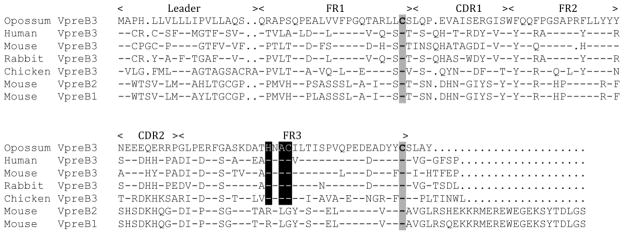
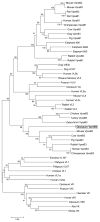
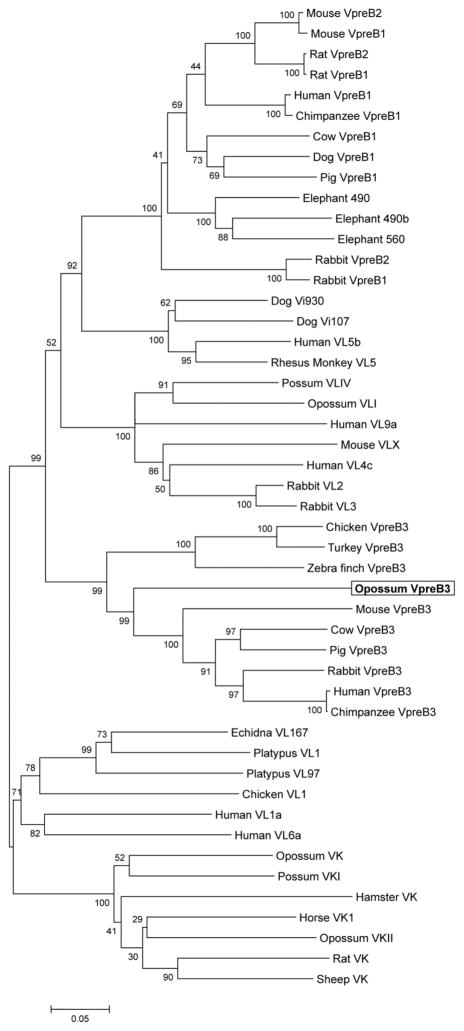
Description:A VpreB surrogate light (SL) chain was identified for the first time in a marsupial, the opossum Monodelphis domestica. Comparing the opossum VpreB to homologues from eutherian (placental mammals) and avian species supported the marsupial gene being VpreB3. VpreB3 is a protein that is not known to traffic to the cell surface as part of the pre-B cell receptor. Rather, VpreB3 associates with nascent immunoglobulin chains in the endoplasmic reticulum. Homologues of other known SL chains VpreB1, VpreB2, and λ5, which are found in eutherian mammals, were not found in the opossum genome, nor have they been identified in the genomes of nonmammals. VpreB3 likely evolved from earlier gene duplication, independent of that which generated VpreB1 and VpreB2 in eutherians. The apparent absence of VpreB1, VpreB2, and λ5 in marsupials suggests that an extracellular pre-B cell receptor containing SL chains, as it has been defined in humans and mice, may be unique to eutherian mammals. In contrast, the conservation of VpreB3 in marsupials and its presence in nonmammals is consistent with previous hypotheses that it is playing a more primordial role in B cell development.
-
Subjects:
-
Source:Immunogenetics. 64(8):647-652.
-
Pubmed ID:22684248
-
Pubmed Central ID:PMC3396720
-
Document Type:
-
Funding:
-
Volume:64
-
Issue:8
-
Collection(s):
-
Main Document Checksum:urn:sha256:2cc4ceded75e5b997d6d81114390a1962544a9f90bcc72f9696852c032a99a2b
-
Download URL:
-
File Type:
 [PDF
- 1.04 MB
]
[PDF
- 1.04 MB
]
Supporting Files


File Language:
English
ON THIS PAGE


CDC STACKS serves as an archival repository of CDC-published products including
scientific findings,
journal articles, guidelines, recommendations, or other public health information authored or
co-authored by CDC or funded partners.
As a repository, CDC STACKS retains documents in their original published format to ensure public access to scientific information.
As a repository, CDC STACKS retains documents in their original published format to ensure public access to scientific information.
You May Also Like
COLLECTION
CDC Public Access