



Interstitial contacts in an RNA-dependent RNA polymerase lattice
Supporting Files

-
9 30 2011
-
Available in CDC Stacks on September 30, 2012, 12:00 AM
File Language:
English
Details
-
Alternative Title:J Mol Biol
-
Personal Author:
-
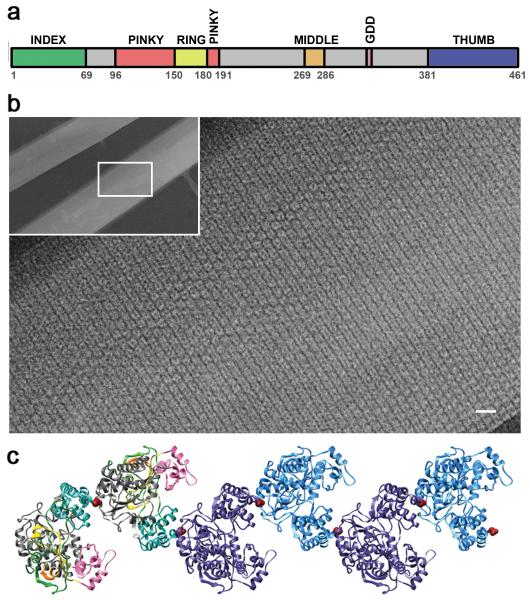
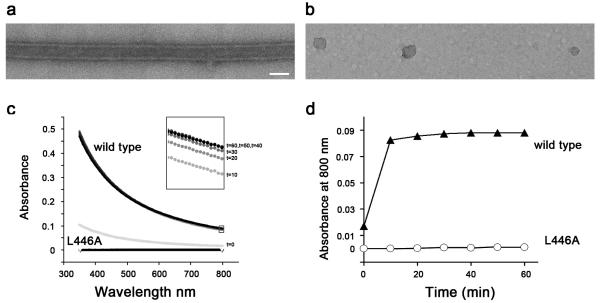
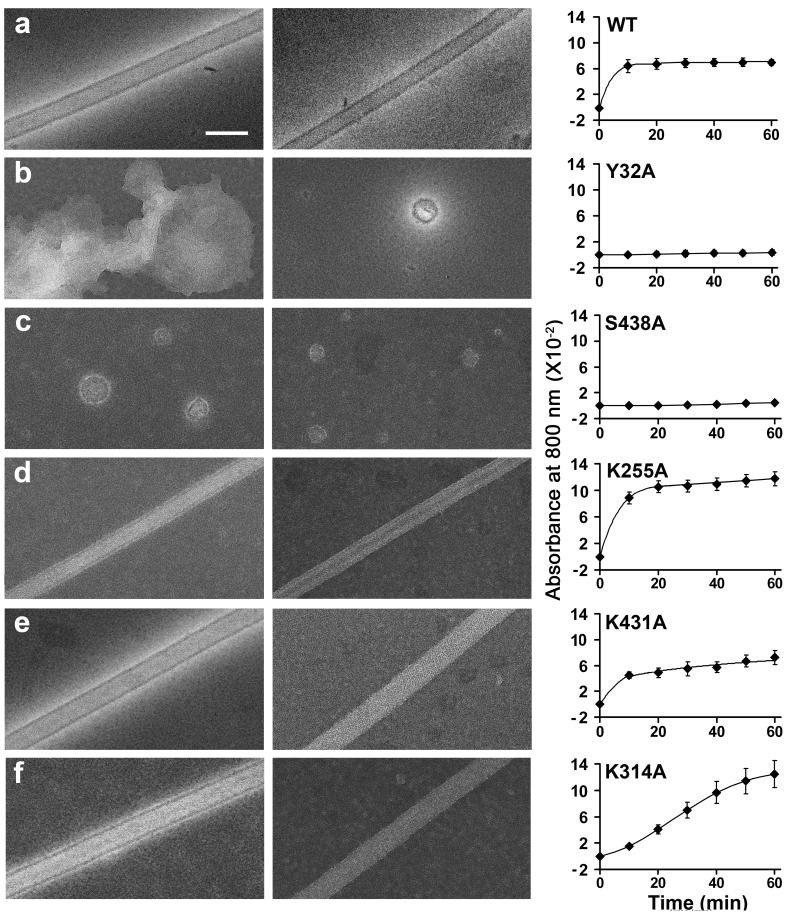
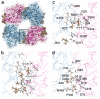
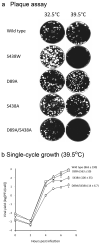
Description:Catalytic activities can be facilitated by ordered enzymatic arrays that co-localize and orient enzymes and their substrates. The purified RNA-dependent RNA polymerase from poliovirus self-assembles to form two-dimensional lattices, possibly facilitating the assembly of viral RNA replication complexes on the cytoplasmic face of intracellular membranes. Creation of a two-dimensional lattice requires at least two different molecular contacts between polymerase molecules. One set of polymerase contacts, between the "thumb" domain of one polymerase and the back of the "palm" domain of another, has been previously defined. To identify the second interface needed for lattice formation and to test its function in viral RNA synthesis, we used a hybrid approach of electron microscopic and biochemical evaluation of both wild-type and mutant viral polymerases to evaluate computationally generated models of this second interface. A unique solution satisfied all constraints and predicted a two-dimensional structure formed from antiparallel arrays of polymerase fibers that use contacts from the flexible amino-terminal region of the protein. Enzymes that contained mutations in this newly defined interface did not form lattices and altered the structure of wild-type lattices. When reconstructed into virus, mutations that disrupt lattice assembly exhibited growth defects, synthetic lethality or both, supporting the function of the oligomeric lattice in infected cells. Understanding the structure of polymerase lattices within the multimeric RNA-dependent RNA polymerase complex should facilitate antiviral drug design and provide a precedent for other positive-strand RNA viruses.
-
Subjects:
- Amino Acid Substitution
- Models, Biological
- Models, Molecular
- Mutagenesis, Site-Directed
- Poliovirus
- Protein Binding
- Protein Conformation
- Protein Interaction Domains and Motifs
- Protein Interaction Maps
- Protein Multimerization
- Protein Structure, Quaternary
- Protein Structure, Secondary
- RNA-Dependent RNA Polymerase
-
Source:J Mol Biol. 2011; 412(4):737-750
-
Pubmed ID:21839092
-
Pubmed Central ID:PMC3249232
-
Document Type:
-
Funding:S10 RR025434/RR/NCRR NIH HHSUnited States/ ; DP1 OD000827/OD/NIH HHSUnited States/ ; T15 LM007033/LM/NLM NIH HHSUnited States/ ; T32 AI07328/AI/NIAID NIH HHSUnited States/ ; T32 AI007328-21/AI/NIAID NIH HHSUnited States/ ; DP1 OD000827-05/OD/NIH HHSUnited States/ ; R01 GM055722/GM/NIGMS NIH HHSUnited States/ ; R01 GM055722-09/GM/NIGMS NIH HHSUnited States/ ; GM55722/GM/NIGMS NIH HHSUnited States/ ; S10 RR025434-01/RR/NCRR NIH HHSUnited States/ ; R37 AI047365/AI/NIAID NIH HHSUnited States/ ; DP1 827/DP/NCCDPHP CDC HHSUnited States/ ; T32 AI007328/AI/NIAID NIH HHSUnited States/
-
Volume:412
-
Issue:4
-
Download URL:
-
File Type:
 [PDF - 2.97 MB]
 -
Collection(s):
-
Main Document Checksum:urn:sha256:2e29254c094e720c8b7beee0fdc64ddad61c42b9fc81e50c3b7f0b449b900673
Supporting Files


File Language:
English
 Was this page helpful?
 Found an issue?








CDC STACKS serves as an archival repository of CDC-published products including
scientific findings, journal articles, guidelines, recommendations, or other public health information authored or
co-authored by CDC or funded partners.
As a repository, CDC STACKS retains documents in their original published format to ensure public access to scientific information.
As a repository, CDC STACKS retains documents in their original published format to ensure public access to scientific information.
You May Also Like
COLLECTION
CDC Public Access