


Improving Accuracy of Influenza-Associated Hospitalization Rate Estimates
Supporting Files

-
Sep 2015
-
File Language:
English
Details
-
Alternative Title:Emerg Infect Dis
-
Personal Author:Millman, Alexander J. ; Reed, Carrie ; Kirley, Pam Daily ; Aragon, Deborah ; Meek, James ; Farley, Monica M. ; Ryan, Patricia ; Collins, Jim ; Lynfield, Ruth ; Baumbach, Joan ; Zansky, Shelley ; Bennett, Nancy M. ; Fowler, Brian ; Thomas, Ann ; Lindegren, Mary L. ; Atkinson, Annette ; Finelli, Lyn ; Chaves, Sandra S.
-
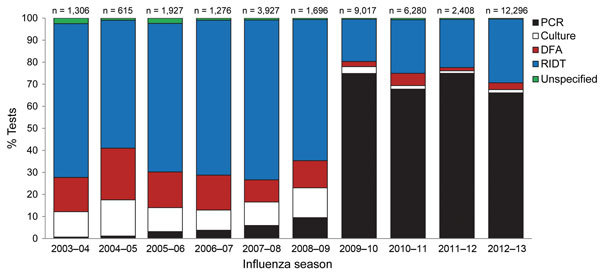
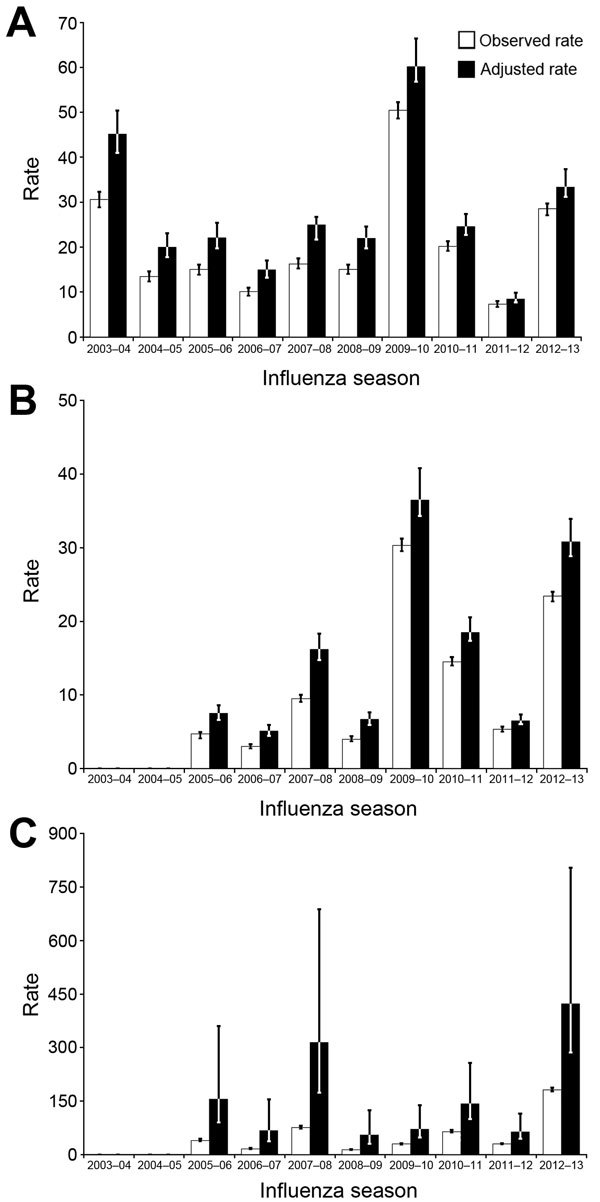
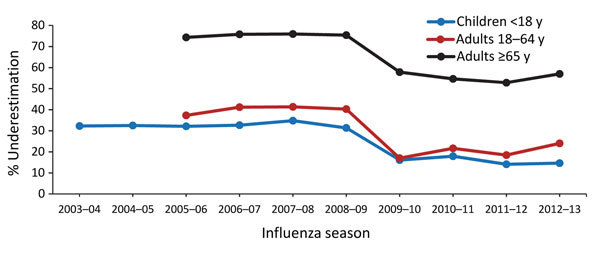
Description:Diagnostic test sensitivity affects rate estimates for laboratory-confirmed influenza-associated hospitalizations. We used data from FluSurv-NET, a national population-based surveillance system for laboratory-confirmed influenza hospitalizations, to capture diagnostic test type by patient age and influenza season. We calculated observed rates by age group and adjusted rates by test sensitivity. Test sensitivity was lowest in adults >65 years of age. For all ages, reverse transcription PCR was the most sensitive test, and use increased from <10% during 2003-2008 to ≈70% during 2009-2013. Observed hospitalization rates per 100,000 persons varied by season: 7.3-50.5 for children <18 years of age, 3.0-30.3 for adults 18-64 years, and 13.6-181.8 for adults >65 years. After 2009, hospitalization rates adjusted by test sensitivity were ≈15% higher for children <18 years, ≈20% higher for adults 18-64 years, and ≈55% for adults >65 years of age. Test sensitivity adjustments improve the accuracy of hospitalization rate estimates.
-
Subjects:
-
Source:Emerg Infect Dis. 21(9):1595-1601
-
Pubmed ID:26292017
-
Pubmed Central ID:PMC4550134
-
Document Type:
-
Funding:
-
Place as Subject:
-
Location:
-
Volume:21
-
Issue:9
-
Collection(s):
-
Main Document Checksum:urn:sha256:7da9f226e9658e2c17929a9afbfe655696b2f53e5b7dff365e810d1bbeaac360
-
Download URL:
-
File Type:
 [PDF
- 1.50 MB
]
[PDF
- 1.50 MB
]
Supporting Files


File Language:
English
ON THIS PAGE

CDC STACKS serves as an archival repository of CDC-published products including
scientific findings,
journal articles, guidelines, recommendations, or other public health information authored or
co-authored by CDC or funded partners.
As a repository, CDC STACKS retains documents in their original published format to ensure public access to scientific information.
As a repository, CDC STACKS retains documents in their original published format to ensure public access to scientific information.
You May Also Like
COLLECTION
Emerging Infectious Diseases