



Iron toxicity in the retina requires Alu RNA and the NLRP3 inflammasome
Supporting Files

-
Jun 11 2015
-
Available in CDC Stacks on 2016-06-23T00:00:00Z
Details
-
Alternative Title:Cell Rep
-
Personal Author:Gelfand, Bradley D. ; Wright, Charles B. ; Kim, Younghee ; Yasuma, Tetsuhiro ; Yasuma, Reo ; Li, Shengjian ; Fowler, Benjamin J. ; Bastos-Carvalho, Ana ; Kerur, Nagaraj ; Uittenbogaard, Annette ; Han, Youn Seon ; Lou, Dingyuan ; Kleinman, Mark E. ; McDonald, W. Hayes ; Núñez, Gabriel ; Georgel, Philippe ; Dunaief, Joshua L. ; Ambati, Jayakrishna
-
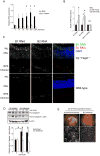
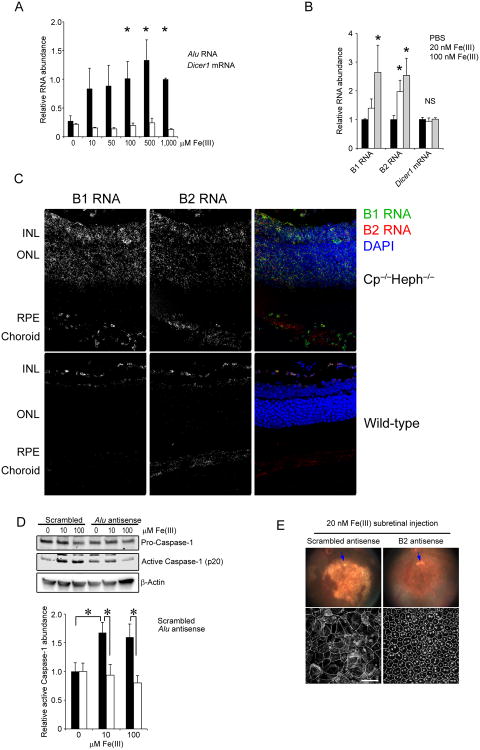
Description:Excess iron induces tissue damage and is implicated in age-related macular degeneration (AMD). Iron toxicity is widely attributed to hydroxyl radical formation through Fenton's reaction. We report that excess iron, but not other Fenton catalytic metals, induces activation of the NLRP3 inflammasome, a pathway also implicated in AMD. Additionally, iron-induced degeneration of the retinal pigmented epithelium (RPE) is suppressed in mice lacking inflammasome components caspase-1/11 or Nlrp3 or by inhibition of caspase-1. Iron overload increases abundance of RNAs transcribed from short interspersed nuclear elements (SINEs): Alu RNAs and the rodent equivalent B1 and B2 RNAs, which are inflammasome agonists. Targeting Alu or B2 RNA prevents iron-induced inflammasome activation and RPE degeneration. Iron-induced SINE RNA accumulation is due to suppression of DICER1 via sequestration of the co-factor poly(C)-binding protein 2 (PCBP2). These findings reveal an unexpected mechanism of iron toxicity, with implications for AMD and neurodegenerative diseases associated with excess iron.
-
Subjects:
-
Source:Cell Rep. 11(11):1686-1693.
-
Pubmed ID:26074074
-
Pubmed Central ID:PMC4481133
-
Document Type:
-
Funding:DP1 GM114862/GM/NIGMS NIH HHS/United States ; DP1GM114862/DP/NCCDPHP CDC HHS/United States ; K08 EY021757/EY/NEI NIH HHS/United States ; K99 EY024336/EY/NEI NIH HHS/United States ; K99EY024336/EY/NEI NIH HHS/United States ; R01 EY015240/EY/NEI NIH HHS/United States ; R01 EY018350/EY/NEI NIH HHS/United States ; R01 EY018836/EY/NEI NIH HHS/United States ; R01 EY020672/EY/NEI NIH HHS/United States ; R01 EY022238/EY/NEI NIH HHS/United States ; R01 EY024068/EY/NEI NIH HHS/United States ; R01EY018350/EY/NEI NIH HHS/United States ; R01EY018836/EY/NEI NIH HHS/United States ; R01EY020672/EY/NEI NIH HHS/United States ; R01EY022238/EY/NEI NIH HHS/United States ; R01EY024068/EY/NEI NIH HHS/United States ; T32 HL091812/HL/NHLBI NIH HHS/United States ; T32HL091812/HL/NHLBI NIH HHS/United States ; UL1 RR033173/RR/NCRR NIH HHS/United States ; UL1RR033173/RR/NCRR NIH HHS/United States
-
Volume:11
-
Issue:11
-
Download URL:
-
File Type:
 [PDF - 1.07 MB]
 -
Collection(s):
-
Main Document Checksum:urn:sha256:4df9462b90fdaaa474eb0f36bb20492094461eda61c2a72ec4fc39069527f54d
Supporting Files


 Was this page helpful?
 Found an issue?




CDC STACKS serves as an archival repository of CDC-published products including
scientific findings, journal articles, guidelines, recommendations, or other public health information authored or
co-authored by CDC or funded partners.
As a repository, CDC STACKS retains documents in their original published format to ensure public access to scientific information.
As a repository, CDC STACKS retains documents in their original published format to ensure public access to scientific information.
You May Also Like
COLLECTION
CDC Public Access