



Nucleoside reverse transcriptase inhibitors possess intrinsic anti-inflammatory activity
Supporting Files

-
Nov 21 2014
-
Available in CDC Stacks on 2015-05-21T00:00:00Z
Details
-
Alternative Title:Science
-
Personal Author:Fowler, Benjamin J. ; Gelfand, Bradley D. ; Kim, Younghee ; Kerur, Nagaraj ; Tarallo, Valeria ; Hirano, Yoshio ; Amarnath, Shoba ; Fowler, Daniel H. ; Radwan, Marta ; Young, Mark T. ; Pittman, Keir ; Kubes, Paul ; Agarwal, Hitesh K. ; Parang, Keykavous A. ; Hinton, David R. ; Bastos-Carvalho, Ana ; Li, Shengjian ; Yasuma, Tetsuhiro ; Mizutani, Takeshi ; Yasuma, Reo ; Wright, Charles ; Ambati, Jayakrishna
-
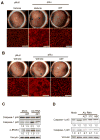
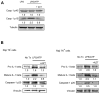
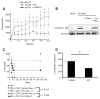
Description:Nucleoside reverse transcriptase inhibitors (NRTIs) are mainstay therapeutics for HIV that block retrovirus replication. Alu (an endogenous retroelement that also requires reverse transcriptase for its life cycle)-derived RNAs activate P2X7 and the NLRP3 inflammasome to cause cell death of the retinal pigment epithelium in geographic atrophy, a type of age-related macular degeneration. We found that NRTIs inhibit P2X7-mediated NLRP3 inflammasome activation independent of reverse transcriptase inhibition. Multiple approved and clinically relevant NRTIs prevented caspase-1 activation, the effector of the NLRP3 inflammasome, induced by Alu RNA. NRTIs were efficacious in mouse models of geographic atrophy, choroidal neovascularization, graft-versus-host disease, and sterile liver inflammation. Our findings suggest that NRTIs are ripe for drug repurposing in P2X7-driven diseases.
-
Subjects:
- Article
- Alu Elements
- Animals
- Anti-Inflammatory Agents, Non-Steroidal
- Apoptosis
- Carrier Proteins
- Caspase 1
- Choroidal Neovascularization
- Disease Models, Animal
- Geographic Atrophy
- Graft vs Host Disease
- Hepatitis
- Inflammasomes
- Liver
- Mice
- Receptors, Purinergic P2X7
- Retinal Pigment Epithelium
- Reverse Transcriptase Inhibitors
-
Source:Science. 346(6212):1000-1003.
-
Pubmed ID:25414314
-
Pubmed Central ID:PMC4274127
-
Document Type:
-
Funding:BB/J017345/1/Biotechnology and Biological Sciences Research Council/United Kingdom ; DP1 GM114862/GM/NIGMS NIH HHS/United States ; DP1GM114862/DP/NCCDPHP CDC HHS/United States ; K99 EY024336/EY/NEI NIH HHS/United States ; K99EY024336/EY/NEI NIH HHS/United States ; P30EY003040/EY/NEI NIH HHS/United States ; R01 EY018350/EY/NEI NIH HHS/United States ; R01 EY018836/EY/NEI NIH HHS/United States ; R01 EY020672/EY/NEI NIH HHS/United States ; R01 EY022238/EY/NEI NIH HHS/United States ; R01 EY024068/EY/NEI NIH HHS/United States ; R01EY001545/EY/NEI NIH HHS/United States ; R01EY018350/EY/NEI NIH HHS/United States ; R01EY018836/EY/NEI NIH HHS/United States ; R01EY020672/EY/NEI NIH HHS/United States ; R01EY022238/EY/NEI NIH HHS/United States ; R01EY024068/EY/NEI NIH HHS/United States ; T32HL091812/HL/NHLBI NIH HHS/United States ; TL1 RR033172/RR/NCRR NIH HHS/United States ; TL1 TR000115/TR/NCATS NIH HHS/United States ; UL1 RR033173/RR/NCRR NIH HHS/United States ; UL1 TR000117/TR/NCATS NIH HHS/United States ; UL1RR033173/RR/NCRR NIH HHS/United States
-
Volume:346
-
Issue:6212
-
Download URL:
-
File Type:
 [PDF - 1000.51 KB]
 -
Collection(s):
-
Main Document Checksum:urn:sha256:6c220d262e99c34653e71763bc015c3c218c22756a7e8eb05a119147e043bac9
Supporting Files


 Was this page helpful?
 Found an issue?





CDC STACKS serves as an archival repository of CDC-published products including
scientific findings, journal articles, guidelines, recommendations, or other public health information authored or
co-authored by CDC or funded partners.
As a repository, CDC STACKS retains documents in their original published format to ensure public access to scientific information.
As a repository, CDC STACKS retains documents in their original published format to ensure public access to scientific information.
You May Also Like
COLLECTION
CDC Public Access