



Analog time-reversed ultrasonically encoded light focusing inside scattering media with a 33,000× optical power gain
Supporting Files

-
Mar 10 2015
File Language:
English
Details
-
Alternative Title:Sci Rep
-
Personal Author:
-
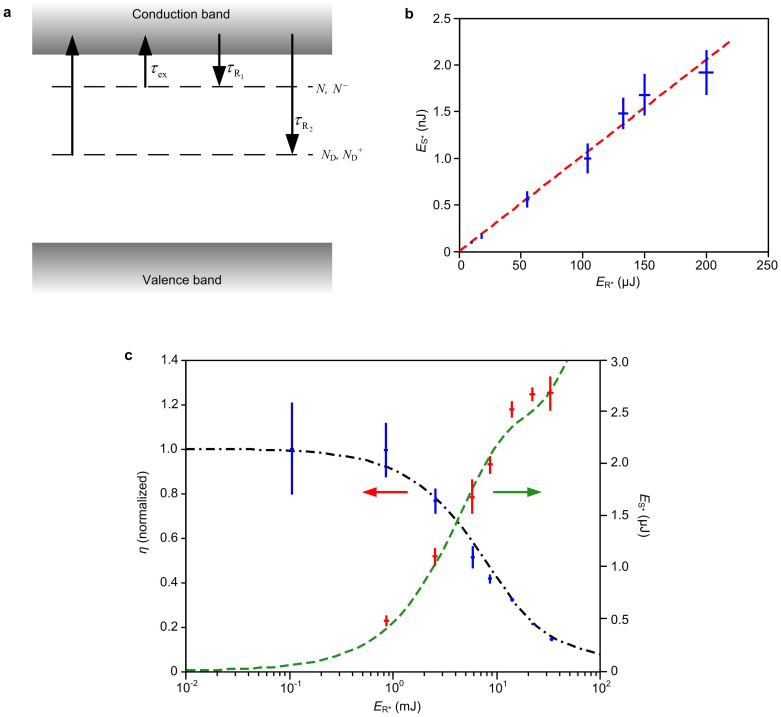
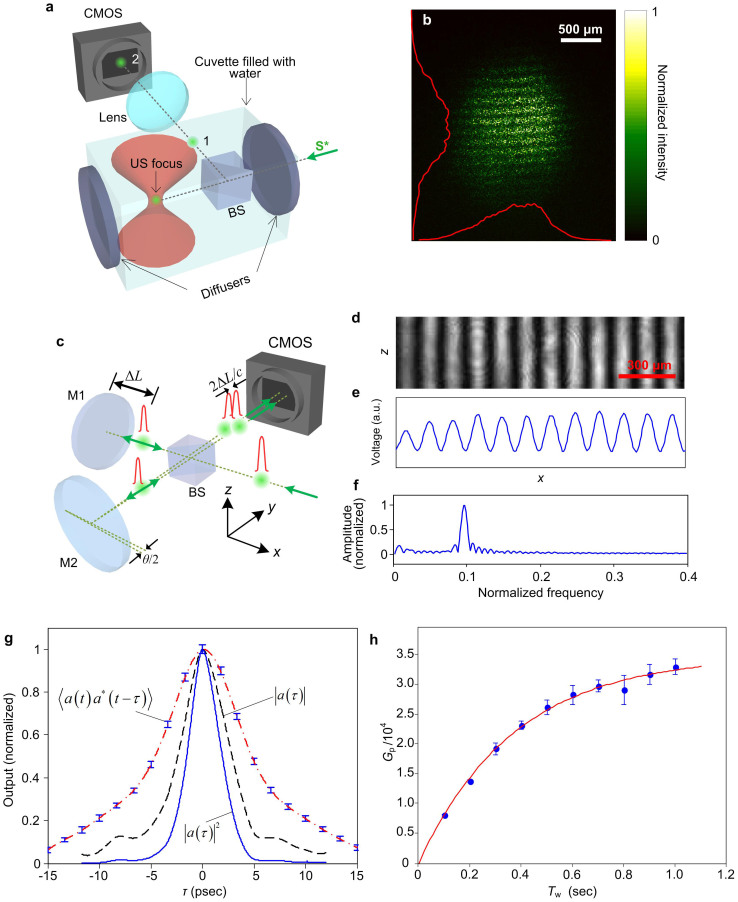
Description:Recent breakthrough in wavefront engineering shows great promises in controlling light propagation inside scattering media. At present, the digital approaches enjoy high gain, while their speeds are slow because of high data throughputs. In contrast, the analog approaches are intrinsically fast but suffer from poor efficiencies and small gains. Further improvements in both speed and gain are necessary to advance the existing technologies toward real-world applications. Here, we report analog time-reversal of acousto-optically tagged photons with a flux amplification of over 33,000 times (45 dB) at a target location inside scattering media. Such a substantial power gain enhancement is achieved when the temporal width of the time-reversed photon packet is squeezed below the carrier-recombination-limited hologram decay time in a photorefractive crystal. Despite a focusing energy gain below unity, the unprecedented power gain is expected to enable new optical imaging, sensing, manipulation and treatment applications.
-
Subjects:
-
Source:Sci Rep. 2015; 5.
-
Pubmed ID:25753905
-
Pubmed Central ID:PMC4354154
-
Document Type:
-
Funding:
-
Volume:5
-
Download URL:
-
File Type:
 [PDF - 739.46 KB]
 -
Collection(s):
-
Main Document Checksum:urn:sha256:5f6d7d69a264d450f931819f43463fde2015a0514b080c20b0d21788ad540788
Supporting Files


File Language:
English
 Was this page helpful?
 Found an issue?































CDC STACKS serves as an archival repository of CDC-published products including
scientific findings, journal articles, guidelines, recommendations, or other public health information authored or
co-authored by CDC or funded partners.
As a repository, CDC STACKS retains documents in their original published format to ensure public access to scientific information.
As a repository, CDC STACKS retains documents in their original published format to ensure public access to scientific information.
You May Also Like
COLLECTION
CDC Public Access