


Enhancing organizational capacity to provide cancer control programs among Latino churches: design and baseline findings of the CRUZA Study
Supporting Files

-
Apr 09 2015
-
File Language:
English
Details
-
Alternative Title:BMC Health Serv Res
-
Personal Author:
-
Description:Background
Faith-based organizations (FBOs) have been successful in delivering health promotion programs for African Americans, though few studies have been conducted among Latinos. Even fewer have focused on organizational change, which is required to sustain community-based initiatives. We hypothesized that FBOs serving Latinos would be more likely to offer evidence-based strategies (EBS) for cancer control after receiving a capacity enhancement intervention to implement health programs, and designed the CRUZA trial to test this hypothesis. This paper describes the CRUZA design and baseline findings.
Methods
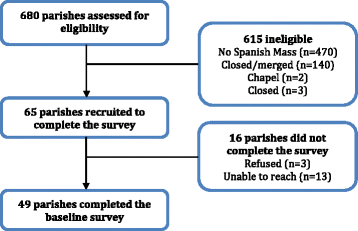
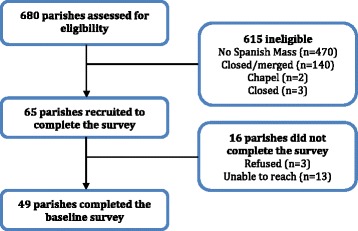
We identified Catholic parishes in Massachusetts that provided Spanish-language mass (n = 65). A baseline survey assessed organizational characteristics relevant to adoption of health programs, including readiness for adoption, “fit” between innovation and organizational mission, implementation climate, and organizational culture. In the next study phase, parishes that completed the baseline assessment will be recruited to a randomized cluster trial, with the parish as the unit of analysis. Both groups will receive a Program Manual and Toolkit. Capacity Enhancement parishes will also be offered technical support, assistance forming health committees and building inter-institutional partnerships, and skills-based training.
Results
Of the 49 parishes surveyed at baseline (75%), one-third (33%) reported having provided at least one health program in the prior year. However, only two program offerings were cancer-specific. Nearly one-fifth (18%) had an active health ministry. There was a high level of organizational readiness to adopt cancer control programs, high congruence between parish missions and CRUZA objectives, moderately conducive implementation climates, and organizational cultures supportive of CRUZA programming. Having an existing health ministry was significantly associated with having offered health programs within the past year. Relationships between health program offerings and other organizational characteristics were not statistically significant.
Conclusions
Findings suggest that many parishes do not offer cancer control programs, yet many may be ready to do so. However, the perceptions about existing organizational practices and policies may not be conducive to program initiation. A capacity enhancement intervention may hold promise as a means of increasing health programming. The efficacy of such an intervention will be tested in phase two of this study.
-
Subjects:
-
Source:BMC Health Serv Res. 15.
-
Pubmed ID:25889628
-
Pubmed Central ID:PMC4427966
-
Document Type:
-
Funding:
-
Place as Subject:
-
Volume:15
-
Collection(s):
-
Main Document Checksum:urn:sha256:64a48bbe4a5cbc101800b4d6f0dd81e0fe32ca1962e906c0fdeef302ff2f3fc3
-
Download URL:
-
File Type:
 [PDF
- 575.72 KB
]
[PDF
- 575.72 KB
]
Supporting Files


File Language:
English
ON THIS PAGE

CDC STACKS serves as an archival repository of CDC-published products including
scientific findings,
journal articles, guidelines, recommendations, or other public health information authored or
co-authored by CDC or funded partners.
As a repository, CDC STACKS retains documents in their original published format to ensure public access to scientific information.
As a repository, CDC STACKS retains documents in their original published format to ensure public access to scientific information.
You May Also Like
COLLECTION
CDC Public Access