



Foodborne Illness Acquired in the United States—Unspecified Agents
Supporting Files
Public Domain

-
Jan 2011
File Language:
English
Details
-
Alternative Title:Emerg Infect Dis
-
Personal Author:
-
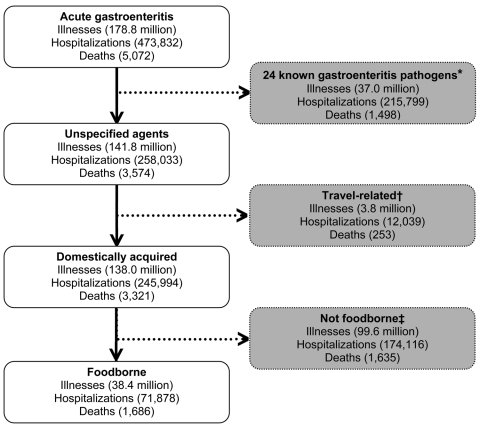
Description:Each year, 31 major known pathogens acquired in the United States caused an estimated 9.4 million episodes of foodborne illness. Additional episodes of illness were caused by unspecified agents, including known agents with insufficient data to estimate agent-specific illness, known agents not yet recognized as causing foodborne illness, substances known to be in food but of unproven pathogenicity, and unknown agents. To estimate these additional illnesses, we used data from surveys, hospital records, and death certificates to estimate illnesses, hospitalizations, and deaths from acute gastroenteritis and subtracted illnesses caused by known gastroenteritis pathogens. If the proportions acquired by domestic foodborne transmission were similar to those for known gastroenteritis pathogens, then an estimated 38.4 million (90% credible interval CrI 19.8-61.2 million) episodes of domestically acquired foodborne illness were caused by unspecified agents, resulting in 71,878 hospitalizations (90% CrI 9,924-157,340) and 1,686 deaths (90% CrI 369-3,338).
-
Subjects:
-
Source:Emerg Infect Dis. 17(1):16-22.
-
Document Type:
-
Place as Subject:
-
Location:
-
Volume:17
-
Issue:1
-
Download URL:
-
File Type:
 [PDF - 216.23 KB]
 -
Collection(s):
-
Main Document Checksum:urn:sha-512:f832730e4fa327fd1d14c56c54ff9171e51808cd07b655281d9602e102119f6fbabac18a7978a7f3fd878eab54dd46aa705561d2f50fd4d28f70490d2b247344
Supporting Files

Related Documents
-
Tilashalski, Frances P.;
 Sillence, Elizabeth M.


File Language:
English
 Was this page helpful?
 Found an issue?



CDC STACKS serves as an archival repository of CDC-published products including
scientific findings, journal articles, guidelines, recommendations, or other public health information authored or
co-authored by CDC or funded partners.
As a repository, CDC STACKS retains documents in their original published format to ensure public access to scientific information.
As a repository, CDC STACKS retains documents in their original published format to ensure public access to scientific information.
You May Also Like
COLLECTION
Emerging Infectious Diseases