



Effects of Intracoronary Infusion of Escalating Doses of Cardiac Stem Cells in Rats With Acute Myocardial Infarction
Supporting Files

-
May 20 2015
-
Available in CDC Stacks on 2016-07-01T00:00:00Z
File Language:
English
Details
-
Alternative Title:Circ Heart Fail
-
Personal Author:Tang, Xian-Liang ; Rokosh, Gregg ; Sanganalmath, Santosh K. ; Tokita, Yukichi ; Keith, Matthew C. L. ; Shirk, Gregg ; Stowers, Heather ; Hunt, Gregory N. ; Wu, Wenjian ; Dawn, Buddhadeb ; Bolli, Roberto
-
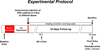
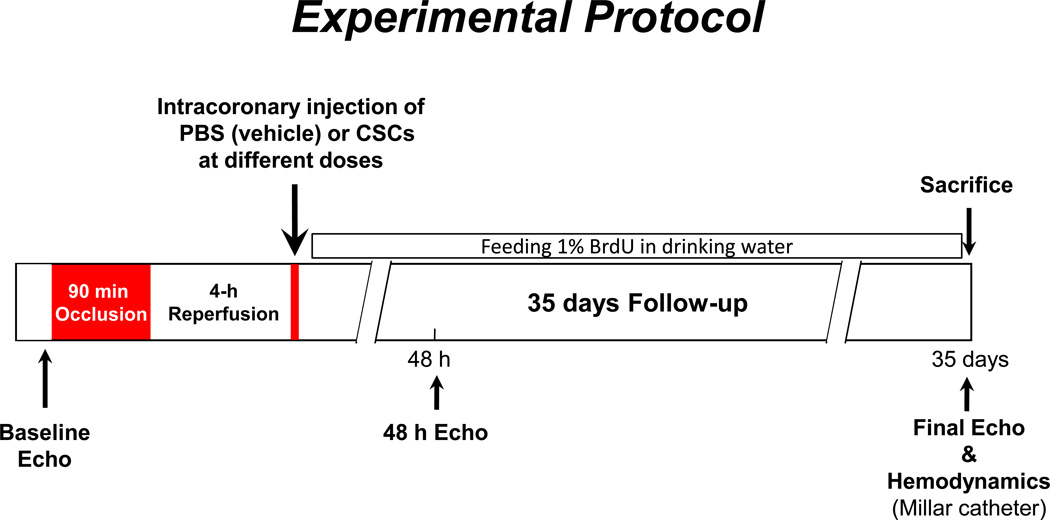
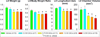
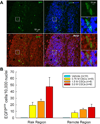
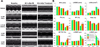
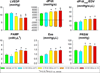
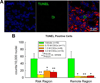
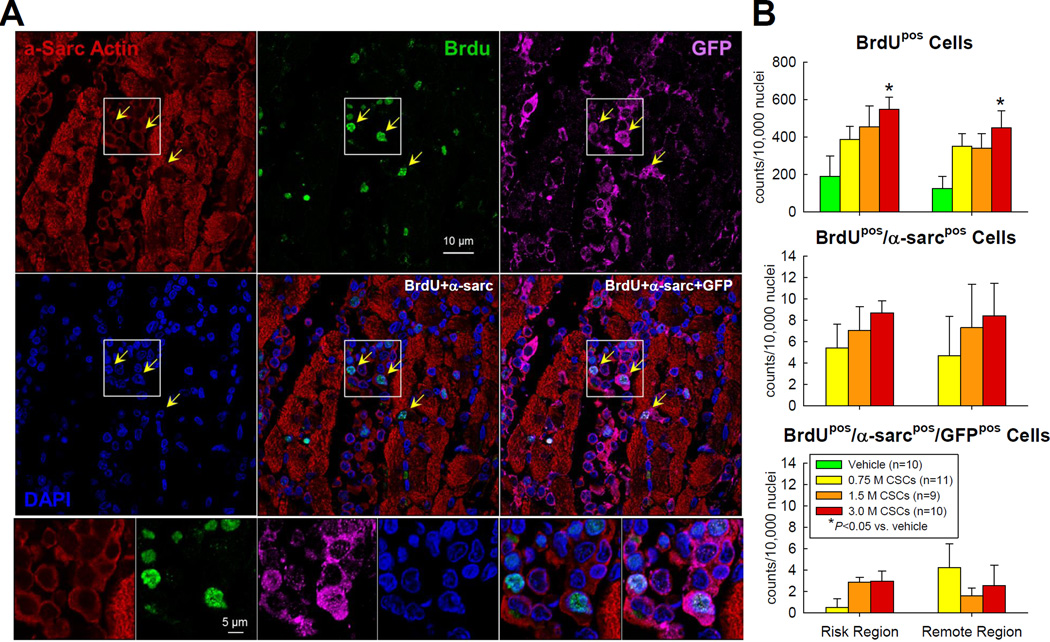
Description:Background ; Although c-kitpos cardiac stem cells (CSCs) preserve left ventricular (LV) function and structure after myocardial infarction (MI), CSC doses have been chosen arbitrarily and the dose-effect relationship is unknown. ; Methods and Results ; Rats underwent a 90-min coronary occlusion followed by 35 days of reperfusion. Vehicle or CSCs at 5 escalating doses (0.3 ×10⁶, 0.75 ×10⁶, 1.5 ×10⁶, 3.0 ×10⁶, and 6.0 ×10⁶ cells/heart) were given intracoronarily 4 h after reperfusion. The lowest dose (0.3 ×10⁶) had no effect on LV function and morphology, whereas 0.75, 1.5, and 3.0 ×10⁶ significantly improved regional and global LV function (echocardiography and hemodynamic studies). These three doses had similar effects on echocardiographic parameters (infarct wall thickening fraction, LV end-systolic and end-diastolic volumes, LV ejection fraction) and hemodynamic variables (LV end-diastolic pressure, LV dP/dtmax, preload adjusted maximal power, end-systolic elastance, preload recruitable stroke work), and produced similar reductions in apoptosis, scar size, infarct wall thinning, and LV expansion index and similar increases in viable myocardium in the risk region (morphometry). Infusion of 6.0 ×10⁶ CSCs markedly increased post-procedural mortality. GFP and BrdU staining indicated that persistence of donor cells and formation of new myocytes were negligible with all doses. ; Conclusions ; Surprisingly, in this rat model of acute MI, the dose-response relationship for intracoronary CSCs is flat. A minimal dose between 0.3 and 0.75 ×10⁶ is necessary for efficacy; above this threshold, a four-fold increase in cell number does not produce greater improvement in LV function or structure. Further increases in cell dose are harmful.
-
Subjects:
- Article
- cardiac progenitor cells
- myocardial ischemia
- myocardial regeneration
- left ventricular function
- myocardial infarction
- Animals
- Apoptosis
- Biomarkers
- Capillaries
- Cardiac Output
- Cell Differentiation
- Cell Proliferation
- Cells, Cultured
- Disease Models, Animal
- Male
- Myocardial Infarction
- Myocardium
- Myocytes, Cardiac
- Neovascularization, Physiologic
- Proto-Oncogene Proteins c-kit
- Rats, Inbred F344
- Recovery of Function
- Regeneration
- Stem Cell Transplantation
- Stem Cells
- Time Factors
- Tissue Survival
- Ultrasonography
- Ventricular Function, Left
- Ventricular Pressure
-
Source:Circ Heart Fail. 8(4):757-765.
-
Pubmed ID:25995227
-
Pubmed Central ID:PMC4512882
-
Document Type:
-
Funding:R01 HL055757/HL/NHLBI NIH HHS/United States ; R01-HL74351/HL/NHLBI NIH HHS/United States ; 1 UM1 HL-113530/HL/NHLBI NIH HHS/United States ; H75 DP424252/DP/NCCDPHP CDC HHS/United States ; P01 HL078825/HL/NHLBI NIH HHS/United States ; R01 HL074351/HL/NHLBI NIH HHS/United States ; UM1 HL113530/HL/NHLBI NIH HHS/United States ; P01-HL78825/HL/NHLBI NIH HHS/United States ; R01 HL068088/HL/NHLBI NIH HHS/United States
-
Volume:8
-
Issue:4
-
Download URL:
-
File Type:
 [PDF - 2.98 MB]
 -
Collection(s):
-
Main Document Checksum:urn:sha256:fa103c869b2f2fa6f9d7f7f2032ecff2145df641a5456ed6797d3a1db821be68
Supporting Files


File Language:
English
 Was this page helpful?
 Found an issue?








CDC STACKS serves as an archival repository of CDC-published products including
scientific findings, journal articles, guidelines, recommendations, or other public health information authored or
co-authored by CDC or funded partners.
As a repository, CDC STACKS retains documents in their original published format to ensure public access to scientific information.
As a repository, CDC STACKS retains documents in their original published format to ensure public access to scientific information.
You May Also Like
COLLECTION
CDC Public Access