



Barriers to Care for Children with Orofacial Clefts in North Carolina
Supporting Files

-
Sep 08 2014
-
Available in CDC Stacks on 2015-07-20T00:00:00Z
File Language:
English
Details
-
Alternative Title:Birth Defects Res A Clin Mol Teratol
-
Personal Author:
-
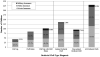
Description:Background ; Little is known about the barriers faced by families of children with birth defects in obtaining healthcare. We examined reported perceived barriers to care and satisfaction with care among mothers of children with orofacial clefts. ; Methods ; In 2006, a validated barriers to care mail/phone survey was administered in North Carolina to all resident mothers of children with orofacial clefts born between 2001 and 2004. Potential participants were identified using the North Carolina Birth Defects Monitoring Program, an active, state-wide, population-based birth defects registry. Five barriers to care subscales were examined: pragmatics, skills, marginalization, expectations, and knowledge/beliefs. Descriptive and bivariate analyses were conducted using chi-square and Fisher's exact tests. Results were stratified by cleft type and presence of other birth defects. ; Results ; Of 475 eligible participants, 51.6% (n = 245) responded. The six most commonly reported perceived barriers to care were all part of the pragmatics subscale: having to take time off work (45.3%); long waits in the waiting rooms (37.6%); taking care of household responsibilities (29.7%); meeting other family members' needs (29.5%); waiting too many days for appointments (27.0%); and cost (25.0%). Most respondents (72.3%, 175/242) felt “very satisfied” with their child's cleft care. ; Conclusion ; Although most participants reported being satisfied with their child's care, many perceived barriers to care were identified. Due to the limited understanding and paucity of research on barriers to care for children with birth defects, including orofacial clefts, additional research on barriers to care and factors associated with them are needed.
-
Subjects:
-
Source:Birth Defects Res A Clin Mol Teratol. 2014; 100(11):837-847.
-
Pubmed ID:25200965
-
Pubmed Central ID:PMC4507417
-
Document Type:
-
Funding:
-
Place as Subject:
-
Volume:100
-
Issue:11
-
Download URL:
-
File Type:
 [PDF - 547.92 KB]
 -
Collection(s):
-
Main Document Checksum:urn:sha256:0f471865e28982c5484af697c238c0bacc1417771cfed25116f2222f270ce4c6
Supporting Files


File Language:
English
 Was this page helpful?
 Found an issue?


CDC STACKS serves as an archival repository of CDC-published products including
scientific findings, journal articles, guidelines, recommendations, or other public health information authored or
co-authored by CDC or funded partners.
As a repository, CDC STACKS retains documents in their original published format to ensure public access to scientific information.
As a repository, CDC STACKS retains documents in their original published format to ensure public access to scientific information.
You May Also Like
COLLECTION
CDC Public Access