



A high performing brain-machine interface driven by low-frequency local field potentials alone and together with spikes
Supporting Files

-
May 06 2015
-
Available in CDC Stacks on 2016-06-01T00:00:00Z
Details
-
Alternative Title:J Neural Eng
-
Personal Author:
-
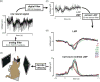
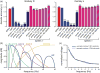
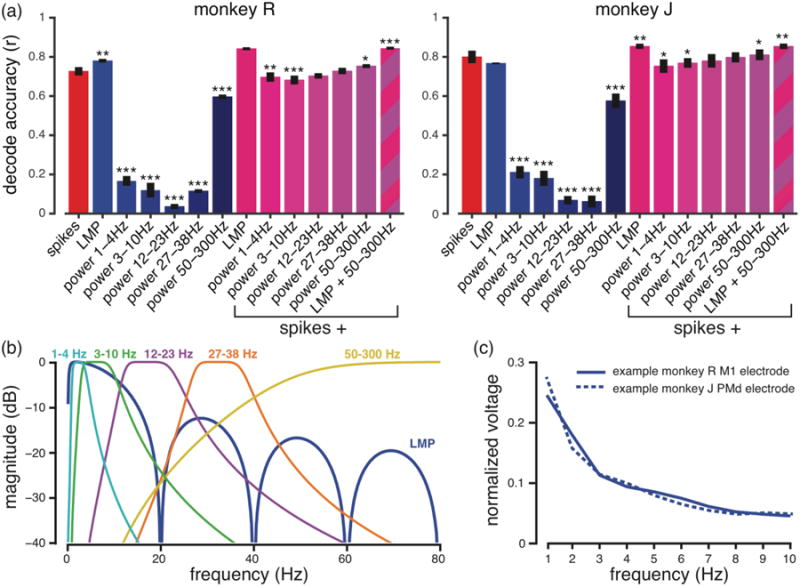
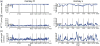
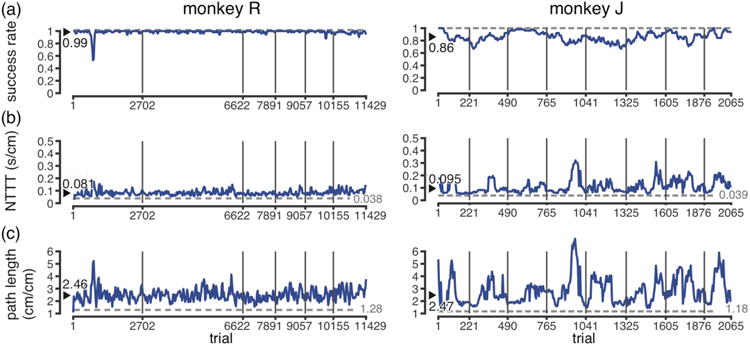
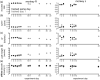
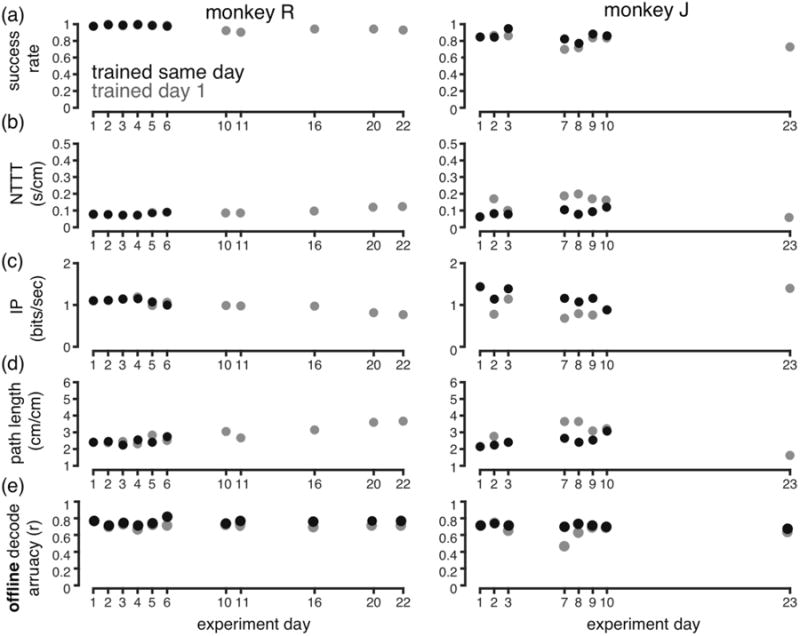
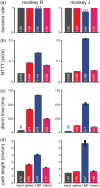
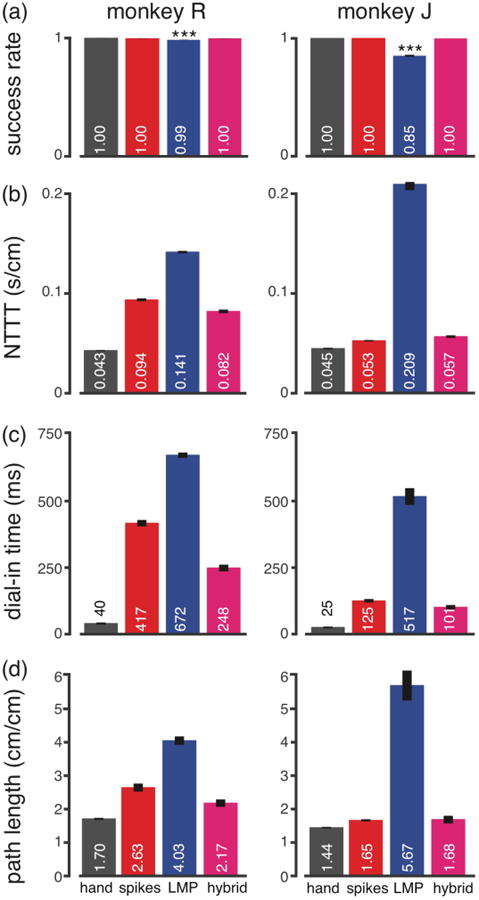
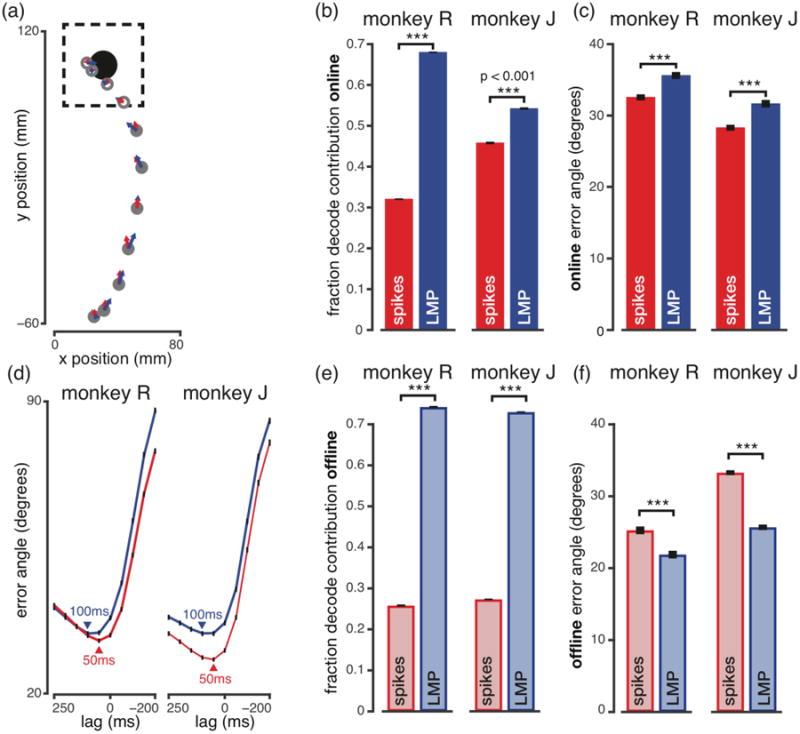
Description:Objective ; Brain-machine interfaces (BMIs) seek to enable people with movement disabilities to directly control prosthetic systems with their neural activity. Current high performance BMIs are driven by action potentials (spikes), but access to this signal often diminishes as sensors degrade over time. Decoding local field potentials (LFPs) as an alternative or complementary BMI control signal may improve performance when there is a paucity of spike signals. To date only a small handful of LFP decoding methods have been tested online; there remains a need to test different LFP decoding approaches and improve LFP-driven performance. There has also not been a reported demonstration of a hybrid BMI that decodes kinematics from both LFP and spikes. Here we first evaluate a BMI driven by the local motor potential (LMP), a low-pass filtered time-domain LFP amplitude feature. We then combine decoding of both LMP and spikes to implement a hybrid BMI. ; Approach ; Spikes and LFP were recorded from two macaques implanted with multielectrode arrays in primary and premotor cortex while they performed a reaching task. We then evaluated closed-loop BMI control using biomimetic decoders driven by LMP, spikes, or both signals together. ; Main Results ; LMP decoding enabled quick and accurate cursor control which surpassed previously reported LFP BMI performance. Hybrid decoding of both spikes and LMP improved performance when spikes signal quality was mediocre to poor. ; Significance ; These findings show that LMP is an effective BMI control signal which requires minimal power to extract and can substitute for or augment impoverished spikes signals. Use of this signal may lengthen the useful lifespan of BMIs and is therefore an important step towards clinically viable BMIs.
-
Subjects:
-
Source:J Neural Eng. 12(3):036009.
-
Pubmed ID:25946198
-
Pubmed Central ID:PMC4457459
-
Document Type:
-
Funding:
-
Volume:12
-
Issue:3
-
Download URL:
-
File Type:
 [PDF - 926.62 KB]
 -
Collection(s):
-
Main Document Checksum:urn:sha256:7f39216abff4656c6f083cb9945485adc6883a9abfc1ca9e069c6591efc8ef41
Supporting Files


 Was this page helpful?
 Found an issue?





CDC STACKS serves as an archival repository of CDC-published products including
scientific findings, journal articles, guidelines, recommendations, or other public health information authored or
co-authored by CDC or funded partners.
As a repository, CDC STACKS retains documents in their original published format to ensure public access to scientific information.
As a repository, CDC STACKS retains documents in their original published format to ensure public access to scientific information.
You May Also Like
COLLECTION
CDC Public Access