



Sumoylation of the Rad1 nuclease promotes DNA repair and regulates its DNA association
Supporting Files

-
Apr 20 2014
-
Available in CDC Stacks on 2014-04-20T00:00:00Z
Details
-
Alternative Title:Nucleic Acids Res
-
Personal Author:
-
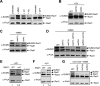
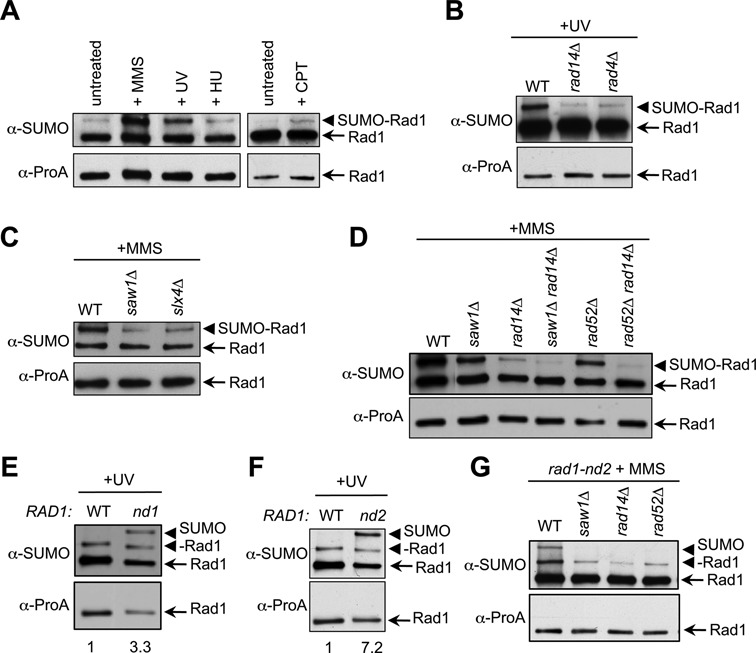
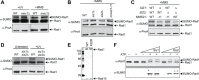
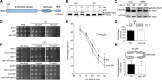
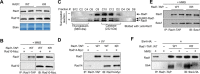
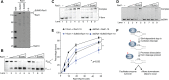
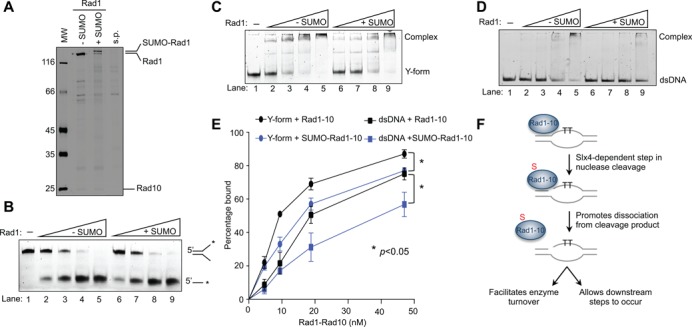
Description:The Saccharomyces cerevisiae Rad1-Rad10 complex is a conserved, structure-specific endonuclease important for repairing multiple types of DNA lesions. Upon recruitment to lesion sites, Rad1-Rad10 removes damaged sequences, enabling subsequent gap filling and ligation. Acting at mid-steps of repair, the association and dissociation of Rad1-Rad10 with DNA can influence repair efficiency. We show that genotoxin-enhanced Rad1 sumoylation occurs after the nuclease is recruited to lesion sites. A single lysine outside Rad1's nuclease and Rad10-binding domains is sumoylated in vivo and in vitro. Mutation of this site to arginine abolishes Rad1 sumoylation and impairs Rad1-mediated repair at high doses of DNA damage, but sustains the repair of a single double-stranded break. The timing of Rad1 sumoylation and the phenotype bias toward high lesion loads point to a post-incision role for sumoylation, possibly affecting Rad1 dissociation from DNA. Indeed, biochemical examination shows that sumoylation of Rad1 decreases the complex's affinity for DNA without affecting other protein properties. These findings suggest a model whereby sumoylation of Rad1 promotes its disengagement from DNA after nuclease cleavage, allowing it to efficiently attend to large numbers of DNA lesions.
-
Subjects:
-
Source:Nucleic Acids Res. 2014; 42(10):6393-6404.
-
Pubmed ID:24753409
-
Pubmed Central ID:PMC4041466
-
Document Type:
-
Funding:
-
Volume:42
-
Issue:10
-
Download URL:
-
File Type:
 [PDF - 1023.89 KB]
 -
Collection(s):
-
Main Document Checksum:urn:sha256:fb20da04dbead32a03fd9ddd73c4362008556c66dd4337b8cc37db84b52cf593
Supporting Files
-
html


 Was this page helpful?
 Found an issue?




CDC STACKS serves as an archival repository of CDC-published products including
scientific findings, journal articles, guidelines, recommendations, or other public health information authored or
co-authored by CDC or funded partners.
As a repository, CDC STACKS retains documents in their original published format to ensure public access to scientific information.
As a repository, CDC STACKS retains documents in their original published format to ensure public access to scientific information.
You May Also Like
COLLECTION
CDC Public Access