


Spatiotemporal association between birth outcomes and coke production and steel making facilities in Alabama, USA: a cross-sectional study
Supporting Files

-
Oct 23 2014
-
File Language:
English
Details
-
Alternative Title:Environ Health
-
Personal Author:
-
Description:Background
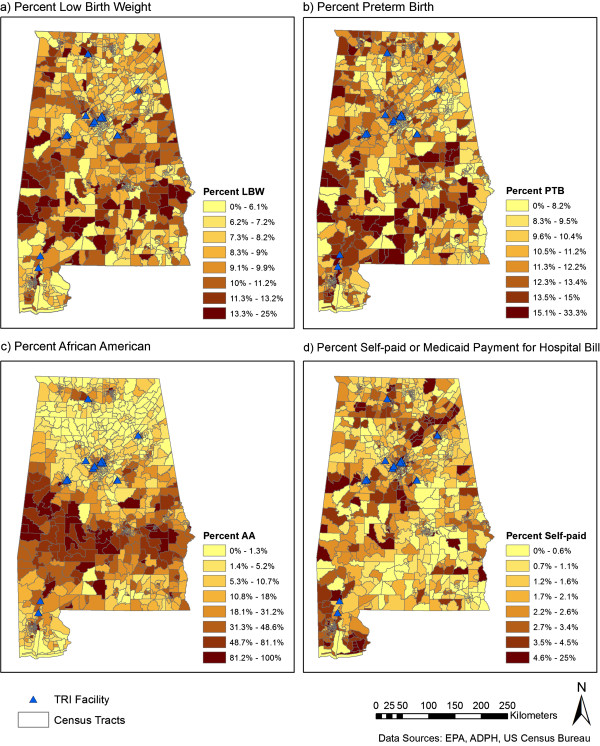
Previous research has shown exposure to air pollution increases the risk of adverse birth outcomes, although the effects of residential proximity to significant industrial point sources are less defined. The objective of the current study was to determine whether yearly reported releases from major industrial point sources are associated with adverse birth outcomes.
Methods
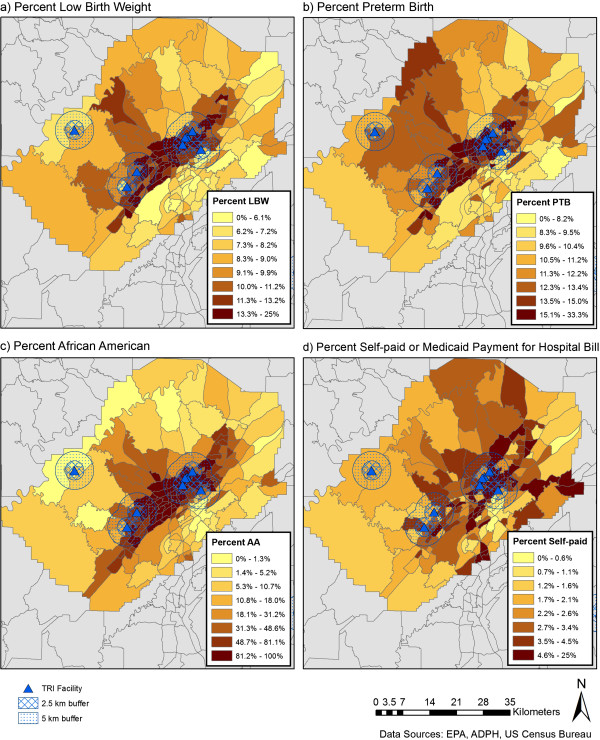
Maternal residence from geocoded Alabama birth records between 1991 and 2010 were used to calculate distances from coke and steel production industries reporting emissions to the U.S. Environmental Protection Agency. Logistic regression models were built to determine associations between distance or yearly fugitive emissions (volatile organic compounds, polycyclic aromatic compounds, and metals) from reporting facilities and preterm birth or low birth weight, adjusting for covariates including maternal age, race, payment method, education level, year and parity.
Results
A small but significant association between preterm birth and residential proximity (≤5.0 km) to coke and steel production facilities remained after adjustment for covariates (OR 1.05 95% CI: 1.01,1.09). Above average emissions from these facilities of volatile organic compounds during the year of birth were associated with low birth weight (OR 1.17 95% CI: 1.06, 1.29), whereas metals emissions were associated with preterm birth (OR 1.07 95% CI: 1.01, 1.14).
Conclusions
The present investigation suggests fugitive emissions from industrial point sources may increase the risk of adverse birth outcomes in surrounding neighborhoods. Further research teasing apart the relationship between exposure to emissions and area-level deprivation in neighborhoods surrounding industrial facilities and their combined effects on birth outcomes is needed.
Electronic supplementary material
The online version of this article (doi:10.1186/1476-069X-13-85) contains supplementary material, which is available to authorized users.
-
Subjects:
-
Source:Environ Health. 13.
-
Pubmed ID:25342170
-
Pubmed Central ID:PMC4223752
-
Document Type:
-
Funding:
-
Place as Subject:
-
Volume:13
-
Collection(s):
-
Main Document Checksum:urn:sha256:42c29ff7dc556d819636da8ef2ac57594af5954610f5ac8e0aa2432ed794d5ee
-
Download URL:
-
File Type:
 [PDF
- 1.29 MB
]
[PDF
- 1.29 MB
]
Supporting Files


File Language:
English
ON THIS PAGE

CDC STACKS serves as an archival repository of CDC-published products including
scientific findings,
journal articles, guidelines, recommendations, or other public health information authored or
co-authored by CDC or funded partners.
As a repository, CDC STACKS retains documents in their original published format to ensure public access to scientific information.
As a repository, CDC STACKS retains documents in their original published format to ensure public access to scientific information.
You May Also Like
COLLECTION
CDC Public Access