


Barriers and Facilitators to Implementing Cancer Survivorship Care Plans
Supporting Files

-
Nov 2013
-
Details
-
Alternative Title:Oncol Nurs Forum
-
Personal Author:
-
Description:Purpose/Objectives
To evaluate the process of survivorship care plan (SCP) completion and to survey oncology staff and primary care physicians (PCPs) regarding challenges of implementing SCPs.
Design
Descriptive pilot study.
Setting
Two facilities in Vermont, an urban academic medical center and a rural community academic cancer center.
Sample
17 oncology clinical staff created SCPs, 39 PCPs completed surveys, and 58 patients (breast or colorectal cancer) participated in a telephone survey.
Methods
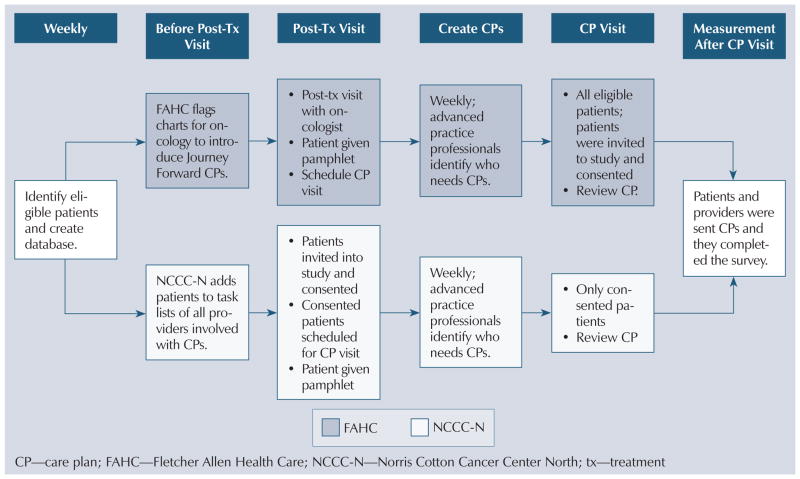
Using Journey Forward tools, SCPs were created and presented to patients. PCPs received the SCP with a survey assessing its usefulness and barriers to delivery. Oncology staff were interviewed to assess perceived challenges and benefits of SCPs. Qualitative and quantitative data were used to identify challenges to the development and implementation process as well as patient perceptions of the SCP visit.
Main Research Variables
SCP, healthcare provider perception of barriers to completion and implementation, and patient perception of SCP visit.
Findings
Oncology staff cited the time required to obtain information for SCPs as a challenge. Completing SCPs 3–6 months after treatment ended was optimal. All participants felt advanced practice professionals should complete and review SCPs with patients. The most common challenge for PCPs to implement SCP recommendations was insufficient knowledge of cancer survivor issues. Most patients found the care plan visit very useful, particularly within six months of diagnosis.
Conclusions
Creation time may be a barrier to widespread SCP implementation. Cancer survivors find SCPs useful, but PCPs feel insufficient knowledge of cancer survivor issues is a barrier to providing best follow-up care. Incorporating SCPs in electronic medical records may facilitate patient identification, appropriate staff scheduling, and timely SCP creation.
Implications for Nursing
Oncology nurse practitioners are well positioned to create and deliver SCPs, transitioning patients from oncology care to a PCP in a shared-care model of optimal wellness. Institution support for the time needed for SCP creation and review is imperative for sustaining this initiative.
Knowledge Translation
Accessing complete medical records is an obstacle for completing SCPs. A 3–6 month window to develop and deliver SCPs may be ideal. PCPs perceive insufficient knowledge of cancer survivor issues as a barrier to providing appropriate follow-up care.
-
Subjects:
-
Source:Oncol Nurs Forum. 40(6):575-580.
-
Pubmed ID:24161636
-
Pubmed Central ID:PMC4501016
-
Document Type:
-
Funding:
-
Volume:40
-
Issue:6
-
Collection(s):
-
Main Document Checksum:urn:sha256:ba52de7b7c13bc7f743d3e793dc52054146e4c3815fb004f3d9ed0bcac31f9dc
-
Download URL:
-
File Type:
 [PDF
- 346.62 KB
]
[PDF
- 346.62 KB
]
Supporting Files


ON THIS PAGE


CDC STACKS serves as an archival repository of CDC-published products including
scientific findings,
journal articles, guidelines, recommendations, or other public health information authored or
co-authored by CDC or funded partners.
As a repository, CDC STACKS retains documents in their original published format to ensure public access to scientific information.
As a repository, CDC STACKS retains documents in their original published format to ensure public access to scientific information.
You May Also Like
COLLECTION
CDC Public Access