



Whole blood gene expression profiles distinguish clinical phenotypes of venous thromboembolism☆
Supporting Files

-
4 2015 ; 4-2015
-
Available in CDC Stacks on April 01, 2016, 12:00 AM
File Language:
English
Details
-
Alternative Title:Thromb Res
-
Personal Author:
-
Description:Introduction
Recurrent venous thromboembolism (VTE) occurs infrequently following a provoked event but occurs in up to 30% of individuals following an initial unprovoked event. There is limited understanding of the biological mechanisms that predispose patients to recurrent VTE.
Objectives
To identify whole blood gene expression profiles that distinguished patients with clinically distinct patterns of VTE.
Patients/Methods
We studied 107 patients with VTE separated into 3 groups: (1) ‘low-risk’ patients had one or more provoked VTE; (2) ‘moderate-risk’ patients had a single unprovoked VTE; (3) ‘high-risk’ patients had ≥2 unprovoked VTE. Each patient group was also compared to twenty-five individuals with no personal history of VTE. Total RNA from whole blood was isolated and hybridized to Illumina HT-12 V4 Beadchips to assay whole genome expression.
Results
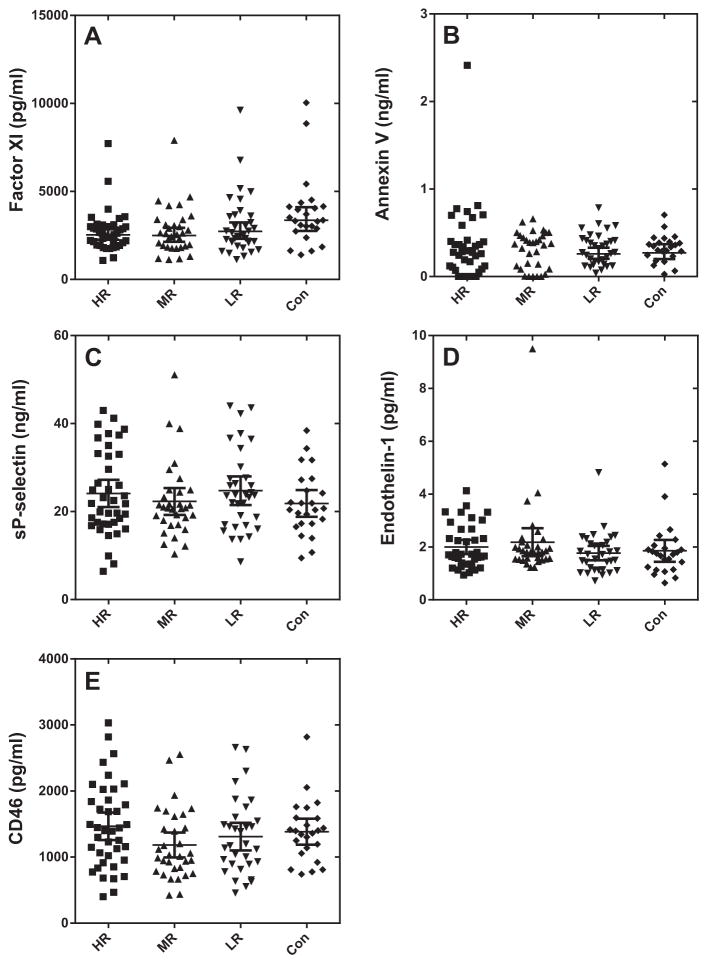
Using class prediction analysis, we distinguished high-risk patients from low-risk patients and healthy controls with good receiver operating curve characteristics (AUC = 0.81 and 0.84, respectively). We also distinguished moderate-risk individuals and low-risk individuals from healthy controls with AUC’s of 0.69 and 0.80, respectively. Using differential expression analysis, we identified several genes previously implicated in thrombotic disorders by genetic analyses, including SELP, KLKB1, ANXA5, and CD46. Protein levels for several of the identified genes were not significantly different between the different groups.
Conclusion
Gene expression profiles are capable of distinguishing patients with different clinical presentations of VTE, and genes relevant to VTE risk are frequently differentially expressed in these comparisons. -
Subjects:
-
Source:Thromb Res. 2015; 135(4):659-665
-
Pubmed ID:25684211
-
Pubmed Central ID:PMC4493863
-
Document Type:
-
Funding:U01 DD000235/DD/NCBDD CDC HHSUnited States/ ; DD000016/DD/NCBDD CDC HHSUnited States/ ; U01 DD000014/DD/NCBDD CDC HHSUnited States/ ; DD000014/DD/NCBDD CDC HHSUnited States/ ; DD000235/DD/NCBDD CDC HHSUnited States/ ; U01 DD000017/DD/NCBDD CDC HHSUnited States/ ; DD000017/DD/NCBDD CDC HHSUnited States/ ; U18 DD000014/DD/NCBDD CDC HHSUnited States/ ; U01 DD000292/DD/NCBDD CDC HHSUnited States/ ; DD000292/DD/NCBDD CDC HHSUnited States/ ; U01 DD000016/DD/NCBDD CDC HHSUnited States/ ; U18 DD000017/DD/NCBDD CDC HHSUnited States/ ; U18 DD000016/DD/NCBDD CDC HHSUnited States/
-
Volume:135
-
Issue:4
-
Download URL:
-
File Type:
 [PDF - 572.08 KB]
 -
Collection(s):
-
Main Document Checksum:urn:sha256:1f4dd325d9a6f17a0c8ff665f286a25510e07b81cc9eaacdce8f544ae37ec834
Supporting Files


File Language:
English
 Was this page helpful?
 Found an issue?

CDC STACKS serves as an archival repository of CDC-published products including
scientific findings, journal articles, guidelines, recommendations, or other public health information authored or
co-authored by CDC or funded partners.
As a repository, CDC STACKS retains documents in their original published format to ensure public access to scientific information.
As a repository, CDC STACKS retains documents in their original published format to ensure public access to scientific information.
You May Also Like
COLLECTION
CDC Public Access