


Optical focusing deep inside dynamic scattering media with near-infrared time-reversed ultrasonically encoded (TRUE) light
Supporting Files

-
January 05 2015
-
File Language:
English
Details
-
Alternative Title:Nat Commun
-
Personal Author:
-
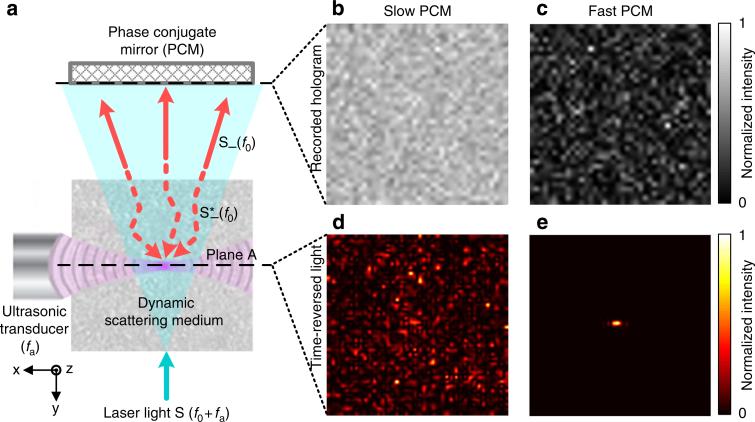
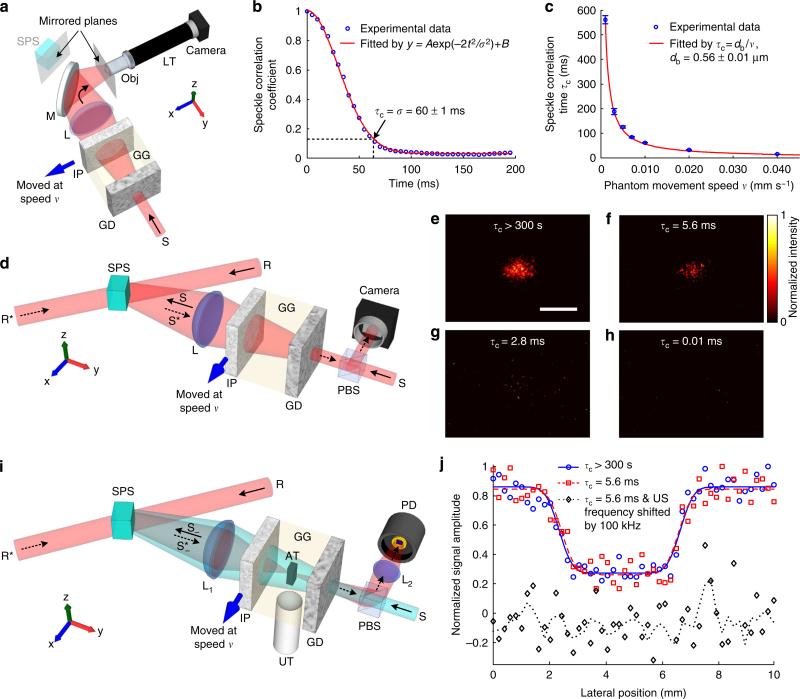
Description:Focusing light deep inside living tissue has not been achieved despite its promise to play a central role in biomedical imaging, optical manipulation and therapy. To address this challenge, internal-guide-star-based wavefront engineering techniques--for example, time-reversed ultrasonically encoded (TRUE) optical focusing--were developed. The speeds of these techniques, however, were limited to no greater than 1 Hz, preventing them from in vivo applications. Here we improve the speed of optical focusing deep inside scattering media by two orders of magnitude, and focus diffuse light inside a dynamic scattering medium having a speckle correlation time as short as 5.6 ms, typical of living tissue. By imaging a target, we demonstrate the first focusing of diffuse light inside a dynamic scattering medium containing living tissue. Since the achieved focusing speed approaches the tissue decorrelation rate, this work is an important step towards in vivo deep tissue noninvasive optical imaging, optogenetics and photodynamic therapy.
-
Subjects:
-
Source:Nat Commun. 2015; 6:5904
-
Pubmed ID:25556918
-
Pubmed Central ID:PMC4477952
-
Document Type:
-
Funding:
-
Volume:6
-
Collection(s):
-
Main Document Checksum:urn:sha256:a44793b78bf4f5b043c128ed3ff37555b13d22d203ba8a35dcc2049970c7c385
-
Download URL:
-
File Type:
 [PDF
- 1.13 MB
]
[PDF
- 1.13 MB
]
Supporting Files


File Language:
English
ON THIS PAGE



CDC STACKS serves as an archival repository of CDC-published products including
scientific findings,
journal articles, guidelines, recommendations, or other public health information authored or
co-authored by CDC or funded partners.
As a repository, CDC STACKS retains documents in their original published format to ensure public access to scientific information.
As a repository, CDC STACKS retains documents in their original published format to ensure public access to scientific information.
You May Also Like
COLLECTION
CDC Public Access