



Prevalence of Duchenne and Becker Muscular Dystrophies in the United States
Supporting Files

-
2015/03/01
-
Available in CDC Stacks on March 01, 2016, 12:00 AM
File Language:
English
Details
-
Alternative Title:Pediatrics
-
Personal Author:Romitti, Paul A. ; Zhu, Yong ; Puzhankara, Soman ; James, Katherine A. ; Nabukera, Sarah K. ; Zamba, Gideon K.D. ; Ciafaloni, Emma ; Cunniff, Christopher ; Druschel, Charlotte M. ; Mathews, Katherine D. ; Matthews, Dennis J. ; Meaney, F. John ; Andrews, Jennifer G. ; Caspers Conway, Kristin M. ; Fox, Deborah J. ; Street, Natalie ; Adams, Melissa M. ; Bolen, Julie
-
Description:OBJECTIVE
To estimate prevalence of childhood-onset Duchenne and Becker muscular dystrophies (DBMD) in 6 sites in the United States by race/ethnicity and phenotype (Duchenne muscular dystrophy DMD or Becker muscular dystrophy BMD).
METHODS
In 2002, the Centers for Disease Control and Prevention established the Muscular Dystrophy Surveillance, Tracking, and Research Network (MD STARnet) to conduct longitudinal, population-based surveillance and research of DBMD in the United States. Six sites conducted active, multiple-source case finding and record abstraction to identify MD STARnet cases born January 1982 to December 2011. We used cross-sectional analyses to estimate prevalence of DBMD per 10 000 boys, ages 5 to 9 years, for 4 quinquennia (1991-1995, 1996-2000, 2001-2005, and 2006-2010) and prevalence per 10 000 male individuals, ages 5 to 24 years, in 2010. Prevalence was also estimated by race/ethnicity and phenotype.
RESULTS
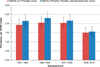
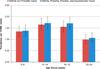
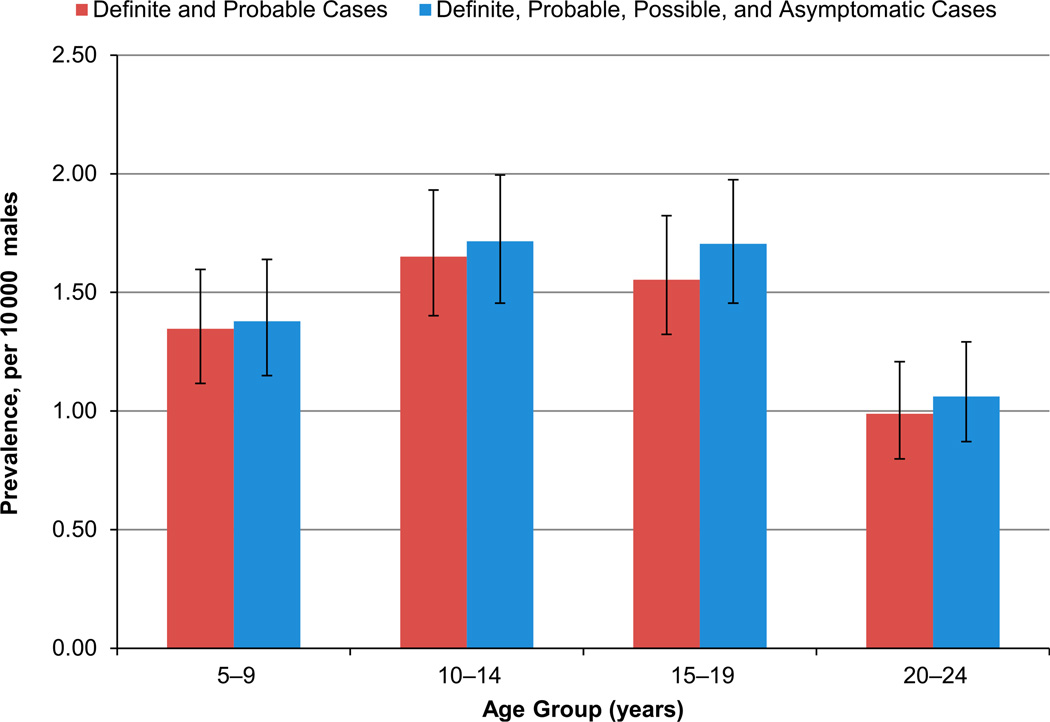
Overall, 649 cases resided in an MD STARnet site during $1 quinquennia. Prevalence estimates per 10 000 boys, ages 5 to 9 years, were 1.93, 2.05, 2.04, and 1.51, respectively, for 1991-1995, 1996-2000, 2001-2005, and 2006-2010. Prevalence tended to be higher for Hispanic individuals than non-Hispanic white or black individuals, and higher for DMD than BMD. In 2010, prevalence of DBMD was 1.38 per 10 000 male individuals, ages 5 to 24 years.
CONCLUSIONS
We present population-based prevalence estimates for DBMD in 6 US sites. Prevalence differed by race/ethnicity, suggesting potential cultural and socioeconomic influences in the diagnosis of DBMD. Prevalence also was higher for DMD than BMD. Continued longitudinal surveillance will permit us to examine racial/ethnic and socioeconomic differences in treatment and outcomes for MD STARnet cases. -
Subjects:
-
Source:Pediatrics. 2015; 135(3):513-521
-
Pubmed ID:25687144
-
Pubmed Central ID:PMC4477633
-
Document Type:
-
Funding:
-
Genre:
-
Volume:135
-
Issue:3
-
Download URL:
-
File Type:
 [PDF - 631.51 KB]
 -
Collection(s):
-
Main Document Checksum:urn:sha-512:e9f715a7b0d0f9e7c4c7c91f85a15c465b1efd98cda8fc0c4d305aa4b765db6d7c6d89ec54804ee30f599fc2bddc8ba0d92c077a9f1d4946b1d09a9cb6938209
Supporting Files


File Language:
English
 Was this page helpful?
 Found an issue?


CDC STACKS serves as an archival repository of CDC-published products including
scientific findings, journal articles, guidelines, recommendations, or other public health information authored or
co-authored by CDC or funded partners.
As a repository, CDC STACKS retains documents in their original published format to ensure public access to scientific information.
As a repository, CDC STACKS retains documents in their original published format to ensure public access to scientific information.
You May Also Like
COLLECTION
CDC Public Access