


Macaque models of enhanced susceptibility to HIV
Supporting Files

-
Jun 14 2015
-
Details
-
Alternative Title:Virol J
-
Personal Author:
-
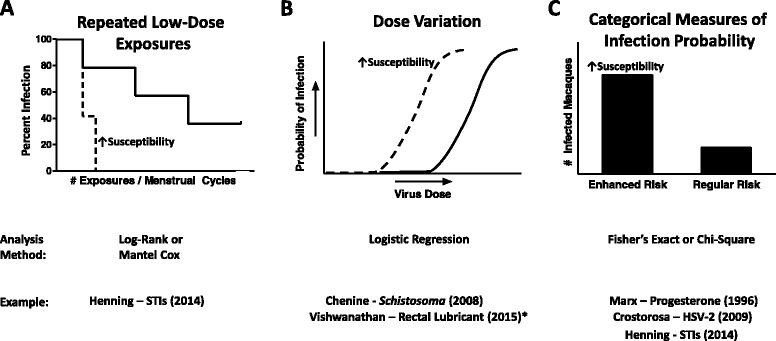
Description:There are few nonhuman primate models of enhanced HIV susceptibility. Such models can improve comprehension of HIV acquisition risk factors and provide rigorous testing platforms for preclinical prevention strategies. This paper reviews past, current, and proposed research on macaque HIV acquisition risk models and identifies areas where modeling is significantly lacking. We compare different experimental approaches and provide practical considerations for designing macaque susceptibility studies. Modifiable (mucosal and systemic coinfections, hormonal contraception, and rectal lubricants) and non-modifiable (hormonal fluctuations) risk factors are highlighted. Risk acquisition models via vaginal, rectal, and penile challenge routes are discussed. There is no consensus on the best statistical model for evaluating increased susceptibility, and additional research is required. The use of enhanced susceptibility macaque models would benefit multiple facets of the HIV research field, including basic acquisition and pathogenesis studies as well as the vaccine and other biomedical preventions pipeline.
-
Subjects:
-
Source:Virol J. 12.
-
Pubmed ID:26070461
-
Pubmed Central ID:PMC4479314
-
Document Type:
-
Funding:
-
Volume:12
-
Collection(s):
-
Main Document Checksum:urn:sha256:74323375dbe763a0c6ed7bb7cbdba12463f687e22980eb4728bcf6ac7366448c
-
Download URL:
-
File Type:
 [PDF
- 672.21 KB
]
[PDF
- 672.21 KB
]
Supporting Files


ON THIS PAGE


CDC STACKS serves as an archival repository of CDC-published products including
scientific findings,
journal articles, guidelines, recommendations, or other public health information authored or
co-authored by CDC or funded partners.
As a repository, CDC STACKS retains documents in their original published format to ensure public access to scientific information.
As a repository, CDC STACKS retains documents in their original published format to ensure public access to scientific information.
You May Also Like
COLLECTION
CDC Public Access