



Respirator Donning in Post-Hurricane New Orleans
Supporting Files
Public Domain
Peer Reviewed

-
2007/05/01
File Language:
English
Details
-
Alternative Title:Emerg Infect Dis
-
Journal Article:Emerging Infectious Diseases
-
Personal Author:
-
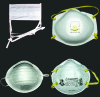
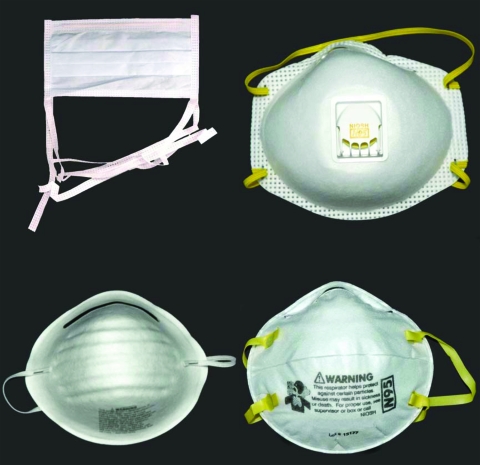
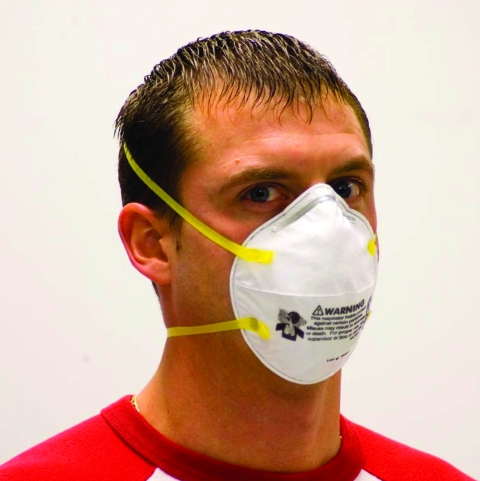
Description:We evaluated correctness of N95 filtering facepiece respirator donning by the public in post-hurricane New Orleans, where respirators were recommended for mold remediation. We randomly selected, interviewed, and observed 538 participants, using multiple logistic regression for analysis. Only 129 (24%) participants demonstrated proper donning. Errors included nose clip not tightened (71%) and straps incorrectly placed (52%); 22% put on the respirator upside down. Factors independently associated with proper donning were as follows: ever having used a mask or respirator (odds ratio OR 5.28; 95% confidence interval CI, 1.79-22.64); ever having had a respirator fit test (OR 4.40; 95% CI, 2.52-7.81); being male (OR 2.44; 95% CI, 1.50-4.03); Caucasian race (OR 2.09; 95% CI, 1.32-3.33); having a certified respirator (OR 1.99, 95% CI 1.20-3.28); and having participated in mold clean-up (OR 1.82; 95% CI,1.00-3.41). Interventions to improve respirator donning should be considered in planning for influenza epidemics and disasters. Noncertified masks and certified respirators. A surgical mask (upper left) and a dust mask (lower left) are examples of disposable masks that are not designed to filter small particles. Properly donned disposable N95 filtering facepiece respirator. To be properly donned, the respirator must be correctly oriented on the face and held in position with both straps. Many respirators certified by the National Institute for Occupational Safety and Health (NIOSH), particularly disposable N95 filtering facepiece respirators (N95 FF respirators), are available to the public. The certification indicates that the respirator material will perform at a given filter efficiency (1). Because proper fit is also necessary for respirator function, US regulations state that an employer who requires workers to wear respirators must establish a respiratory protection program that covers respirator selection and maintenance, fit testing, and worker instruction (2). Although nonoccupational respirator use has not been well studied, members of the public who use respirators may be less likely than workers in a respiratory protection program to achieve a proper fit, given lack of formal training (3). Public health agencies have recommended N95 FF respirators to members of the public for some situations. Such occasions have included after major floods, for potential heavy exposure to bioaerosols in water-damaged buildings (Grand Forks, North Dakota, 1997; eastern North Carolina after Hurricane Floyd, 1999) (4), and for settings that pose a risk for airborne transmission of infection, such as during the severe acute respiratory syndrome (SARS) epidemic (for select patients at risk of acquiring the infection and for persons visiting patients with SARS) (5-7). There is also a longstanding recommendation for N95 FF respirator use for visitors of hospitalized patients with tuberculosis (8). The US Department of Health and Human Services (HHS) currently recommends that persons living in or visiting an area affected by avian influenza A (H5N1) wear N95 FF respirators when in contact with birds in an enclosed environment (9). In the fall of 2005, after the unprecedented flooding in New Orleans, Louisiana caused by Hurricanes Katrina and Rita, public health officials recommended that members of the public use N95 FF respirators when cleaning or remediating mold-contaminated buildings (10). A survey of 159 New Orleans area residents 7 weeks after Katrina found that 68% of those interviewed were aware of the recommendation (11) and that at least 30% of those participating in remediation activities had used a NIOSH-certified respirator (12). Despite these levels of awareness and experience, subsequent anecdotal reports suggested that some New Orleans residents were not properly donning N95 FF respirators. Improper donning would promote the entry of unfiltered air through leaks or gaps between the respirator and the skin, compromising the protection offered (13). To better understand respirator use by the public, we investigated the nonoccupational use and donning of N95 FF respirators in post-hurricane New Orleans. Description provided by NIOSH
-
Subjects:
-
Keywords:
-
Source:Emerg Infect Dis 2007 May; 13(5):700-707
-
ISSN:1080-6040
-
Document Type:
-
Genre:
-
Place as Subject:
-
CIO:
-
Division:
-
Topic:
-
Location:
-
Pages in Document:8 pdf pages
-
Volume:13
-
Issue:5
-
NIOSHTIC Number:nn:20031837
-
Contact Point Address:Kristin J. Cummings, MD, MPH, National Institute for Occupational Safety and Health, Division of Respiratory Disease Studies, Mailstop 2800, 1095 Willowdale Road, Morgantown, WV 26505
-
Email:cvx5@cdc.gov
-
Federal Fiscal Year:2007
-
NORA Priority Area:
-
Peer Reviewed:True
-
Download URL:
-
File Type:
 [PDF - 368.56 KB]
 -
Collection(s):
-
Main Document Checksum:urn:sha-512:784641c97ec270ef035fbbc6a21e3082077a695487320463f07d838a368677cf6a6d447dfa31e9f6f53ba9c935a6376b64b954d18081e00e1aa3d166ec03ac00
Supporting Files


File Language:
English
 Was this page helpful?
 Found an issue?


CDC STACKS serves as an archival repository of CDC-published products including
scientific findings, journal articles, guidelines, recommendations, or other public health information authored or
co-authored by CDC or funded partners.
As a repository, CDC STACKS retains documents in their original published format to ensure public access to scientific information.
As a repository, CDC STACKS retains documents in their original published format to ensure public access to scientific information.
You May Also Like