



Pet Rodents and Fatal Lymphocytic Choriomeningitis in Transplant Patients
Multi-Language
Supporting Files
Public Domain

-
May 2007
File Language:
Details
-
Alternative Title:Emerg Infect Dis
-
Personal Author:Amman, Brian R. ; Pavlin, Boris I. ; Albariño, Cesar G. ; Comer, James A. ; Erickson, Bobbie R. ; Oliver, Jennifer B. ; Sealy, Tara K. ; Vincent, Martin J. ; Nichol, Stuart T. ; Paddock, Christopher D. ; Tumpey, Abbigail J. ; Wagoner, Kent D. ; Glauer, R. David ; Smith, Kathleen A. ; Winpisinger, Kim A. ; Parsely, Melody S. ; Wyrick, Phil ; Hannafin, Christopher H. ; Bandy, Utpala ; Zaki, Sherif ; Rollin, Pierre E. ; Ksiazek, Thomas G.
-
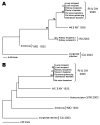
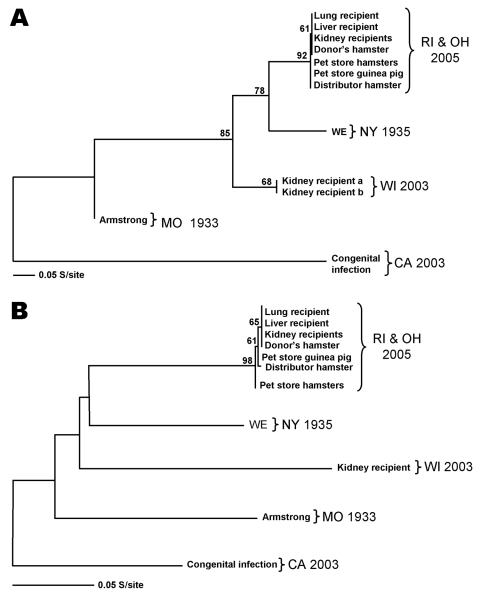
Description:In April 2005, 4 transplant recipients became ill after receiving organs infected with lymphocytic choriomeningitis virus (LCMV); 3 subsequently died. All organs came from a donor who had been exposed to a hamster infected with LCMV. The hamster was traced back through a Rhode Island pet store to a distribution center in Ohio, and more LCMV-infected hamsters were discovered in both. Rodents from the Ohio facility and its parent facility in Arkansas were tested for the same LCMV strain as the 1 involved in the transplant-associated deaths. Phylogenetic analysis of virus sequences linked the rodents from the Ohio facility to the Rhode Island pet store, the index hamster, and the transplant recipients. This report details the animal traceback and the supporting laboratory investigations.
-
Subjects:
-
Source:Emerg Infect Dis. 13(5):719-725.
-
Document Type:
-
Place as Subject:
-
Location:
-
Volume:13
-
Issue:5
-
Download URL:
-
File Type:
 [PDF - 180.01 KB]
 -
Collection(s):
-
Main Document Checksum:urn:sha-512:a654e5443e0476ac235b15879862ee3cb4b73c05c9be33b325aa695ac091fc470ff06c32ae25d8cba583e43cb192b1071e8d12bfe82c9f2c32a1871e56440247
Supporting Files


File Language:
 Was this page helpful?
 Found an issue?

CDC STACKS serves as an archival repository of CDC-published products including
scientific findings, journal articles, guidelines, recommendations, or other public health information authored or
co-authored by CDC or funded partners.
As a repository, CDC STACKS retains documents in their original published format to ensure public access to scientific information.
As a repository, CDC STACKS retains documents in their original published format to ensure public access to scientific information.
You May Also Like
COLLECTION
Emerging Infectious Diseases