



Colonoscopy Screening Among US Adults Aged 40 or Older With a Family History of Colorectal Cancer
Supporting Files

-
May 21 2015
File Language:
English
Details
-
Journal Article:Preventing Chronic Disease (PCD)
-
Personal Author:
-
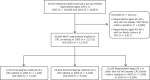
Description:Introduction ; Colonoscopy screening reduces colorectal cancer (CRC) incidence and mortality. CRC screening is recommended at age 50 for average-risk people. Screening of first-degree relatives of CRC patients is recommended to begin at age 40 or 10 years before the age at diagnosis of the youngest relative diagnosed with CRC. CRC incidence has increased recently among younger Americans while it has declined among older Americans. The objective of this study was to determine whether first-degree relatives of CRC patients are being screened according to recommended guidelines. ; Methods ; We studied colonoscopy screening rates among the US population reporting a CRC family history using 2005 and 2010 National Health Interview Survey data. ; Results ; Of 26,064 study-eligible respondents, 2,470 reported a CRC family history; of those with a family history, 45.6% had a colonoscopy (25.2% in 2005 and 65.8% 2010). The colonoscopy rate among first-degree relatives aged 40 to 49 in 2010 (38.3%) was about half that of first-degree relatives aged 50 or older (69.7%). First-degree relatives were nearly twice as likely as nonfirst-degree relatives to have a colonoscopy (adjusted odds ratio AOR, 1.7; 95% confidence interval, 1.5–1.9), but those aged 40 to 49 were less likely to have a colonoscopy than those in older age groups (AOR, 2.6 for age 50–64; AOR, 3.6 for age ≥65). Interactions with age, insurance, and race/ethnicity were not significant. Having health insurance tripled the likelihood of screening. ; Conclusion ; Despite a 5-fold increase in colonoscopy screening rates since 2005, rates among first-degree relatives younger than the conventional screening age have lagged. Screening promotion targeted to this group may halt the recent rising trend of CRC among younger Americans.
-
Subjects:
-
Source:Prev Chronic Dis. 12.
-
DOI:
-
ISSN:1545-1151
-
Pubmed ID:25996988
-
Pubmed Central ID:PMC4454413
-
Document Type:
-
Funding:
-
Place as Subject:
-
Volume:12
-
Download URL:
-
File Type:
 [PDF - 304.80 KB]
 -
Collection(s):
-
Main Document Checksum:urn:sha-512:0b8c0e23dc090e48436016424489ed9903ca1655242a187f70160036bf7a7aed38a5591b67c5467af329323ca88a84ed47d68b3c489b3d223395282e2f8caf34
Supporting Files


File Language:
English
 Was this page helpful?
 Found an issue?


CDC STACKS serves as an archival repository of CDC-published products including
scientific findings, journal articles, guidelines, recommendations, or other public health information authored or
co-authored by CDC or funded partners.
As a repository, CDC STACKS retains documents in their original published format to ensure public access to scientific information.
As a repository, CDC STACKS retains documents in their original published format to ensure public access to scientific information.
You May Also Like
COLLECTION
Preventing Chronic Disease