


Increasing Sample Size in Prospective Birth Cohorts: Back-Extrapolating Prenatal Levels of Persistent Organic Pollutants in Newly Enrolled Children
Supporting Files

-
Feb 27 2015
-
Details
-
Alternative Title:Environ Sci Technol
-
Personal Author:
-
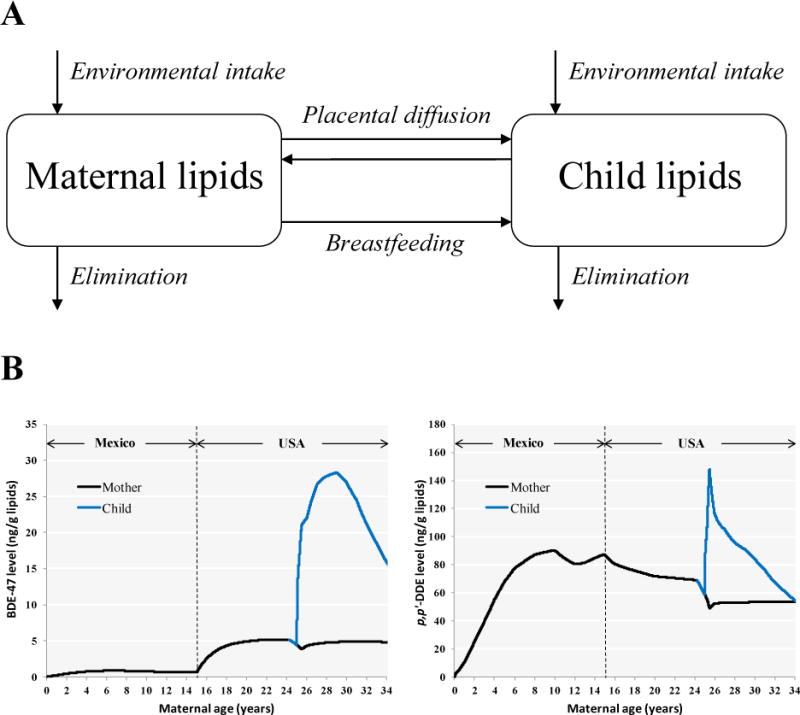
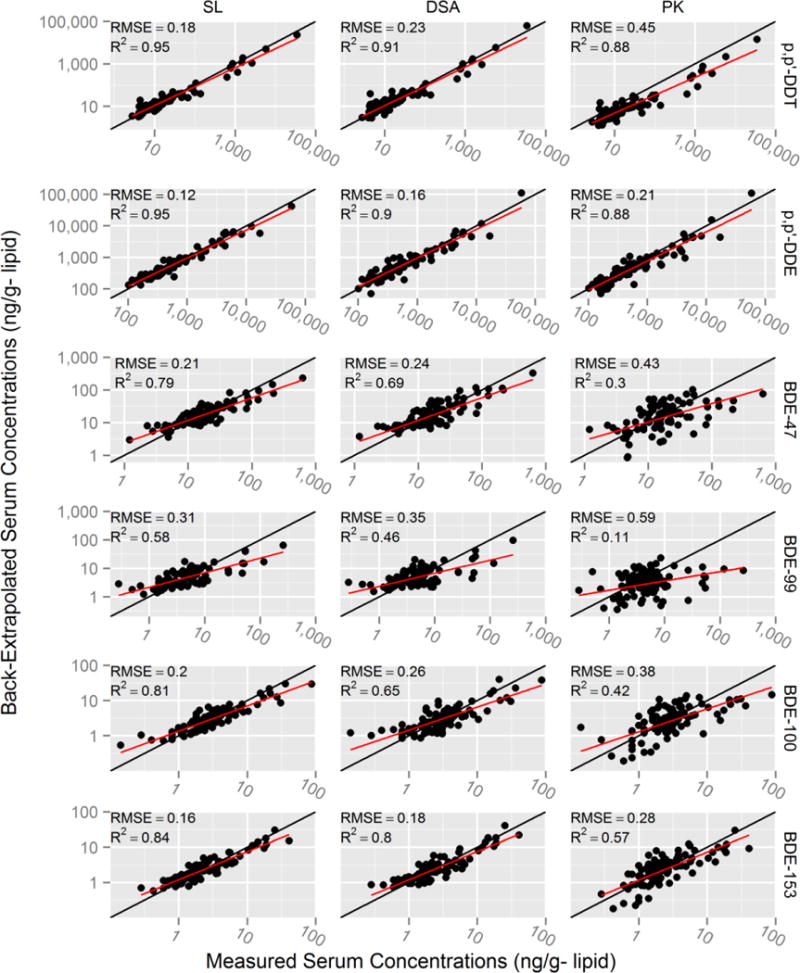
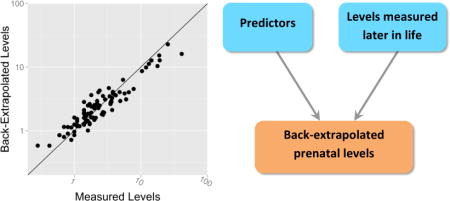
Description:Study sample size in prospective birth cohorts of prenatal exposure to persistent organic pollutants (POPs) is limited by costs and logistics of follow-up. Increasing sample size at the time of health assessment would be beneficial if predictive tools could reliably back-extrapolate prenatal levels in newly enrolled children. We evaluated the performance of three approaches to back-extrapolate prenatal levels of p,p'-dichlorodiphenyltrichloroethane (DDT), p,p'-dichlorodiphenyldichloroethylene (DDE) and four polybrominated diphenyl ether (PBDE) congeners from maternal and/or child levels 9 years after delivery: a pharmacokinetic model and predictive models using deletion/substitution/addition or Super Learner algorithms. Model performance was assessed using the root mean squared error (RMSE), R2, and slope and intercept of the back-extrapolated versus measured levels. Super Learner outperformed the other approaches with RMSEs of 0.10 to 0.31, R2s of 0.58 to 0.97, slopes of 0.42 to 0.93 and intercepts of 0.08 to 0.60. Typically, models performed better for p,p'-DDT/E than PBDE congeners. The pharmacokinetic model performed well when back-extrapolating prenatal levels from maternal levels for compounds with longer half-lives like p,p'-DDE and BDE-153. Results demonstrate the ability to reliably back-extrapolate prenatal POP levels from levels 9 years after delivery, with Super Learner performing best based on our fit criteria.
-
Subjects:
-
Source:Environ Sci Technol. 49(6):3940-3948.
-
Pubmed ID:25698216
-
Pubmed Central ID:PMC4451835
-
Document Type:
-
Funding:ES015572/ES/NIEHS NIH HHS/United States ; ES017054/ES/NIEHS NIH HHS/United States ; OH007400/OH/NIOSH CDC HHS/United States ; P01 ES0009605/ES/NIEHS NIH HHS/United States ; P01 ES009605/ES/NIEHS NIH HHS/United States ; R01 ES015572/ES/NIEHS NIH HHS/United States ; R01 ES017054/ES/NIEHS NIH HHS/United States
-
Volume:49
-
Issue:6
-
Collection(s):
-
Main Document Checksum:urn:sha256:c68c9fdf94daf7004b52751601e682346659095da964fb8b8769fa6b787bb3fe
-
Download URL:
-
File Type:
 [PDF
- 861.96 KB
]
[PDF
- 861.96 KB
]
Supporting Files


ON THIS PAGE

CDC STACKS serves as an archival repository of CDC-published products including
scientific findings,
journal articles, guidelines, recommendations, or other public health information authored or
co-authored by CDC or funded partners.
As a repository, CDC STACKS retains documents in their original published format to ensure public access to scientific information.
As a repository, CDC STACKS retains documents in their original published format to ensure public access to scientific information.
You May Also Like
COLLECTION
CDC Public Access