



Hypertensive Disorders and Pregnancy-Related Stroke
Supporting Files

-
1 2015 ; 1-2015
-
Available in CDC Stacks on May 27, 2015, 12:00 AM
File Language:
English
Details
-
Alternative Title:Obstet Gynecol
-
Personal Author:
-
Description:OBJECTIVE
To evaluate trends and associations of hypertensive disorders of pregnancy with stroke risk and test the hypothesis that hypertensive disorders of pregnancy-associated stroke results in higher rates of stroke-related complications than pregnancy-associated stroke without hypertensive disorders.
METHODS
A cross-sectional study was performed using 81,983,216 pregnancy hospitalizations from the 1994–2011 Nationwide Inpatient Sample. Rates of stroke hospitalizations with and without these hypertensive disorders were reported per 10,000 pregnancy hospitalizations. Using logistic regression, adjusted odds ratios (OR) with 95% confidence intervals were obtained.
RESULTS
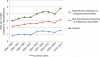
Between 1994–1995 and 2010–2011, the nationwide rate of stroke with hypertensive disorders of pregnancy increased from 0.8 to 1.6 per 10,000 pregnancy hospitalizations (103%), whereas the rate without these disorders increased from 2.2 to 3.2 per 10,000 pregnancy hospitalizations (47%). Women with hypertensive disorders of pregnancy were 5.2 times more likely to have a stroke than those without. Having traditional stroke risk factors (eg, congenital heart disease, atrial fibrillation, sickle cell anemia, congenital coagulation defects) substantially increased the stroke risk among hypertensive disorders of pregnancy hospitalizations: from adjusted OR 2.68 for congenital coagulation defects to adjusted OR 13.1 for congenital heart disease. Stroke-related complications were increased in stroke with hypertensive disorders of pregnancy compared with without (from adjusted OR 1.23 for nonroutine discharge to adjusted OR 1.93 for mechanical ventilation).
CONCLUSION
Having traditional stroke risk factors substantially increased the stroke risk among hypertensive disorders of pregnancy hospitalizations. Stroke with hyper-tensive disorders in pregnancy had two distinctive characteristics: a greater increase in frequency since the mid-1990s and significantly higher stroke-related complication rates. -
Subjects:
-
Source:Obstet Gynecol. 2014; 125(1):124-131
-
Pubmed ID:25560114
-
Pubmed Central ID:PMC4445352
-
Document Type:
-
Funding:
-
Volume:125
-
Issue:1
-
Download URL:
-
File Type:
 [PDF - 259.58 KB]
 -
Collection(s):
-
Main Document Checksum:urn:sha256:a62e91488e6ebbbbaf52c14b0623a458701c679cdc7b859b3997fecbd7fda50a
Supporting Files


File Language:
English
 Was this page helpful?
 Found an issue?


CDC STACKS serves as an archival repository of CDC-published products including
scientific findings, journal articles, guidelines, recommendations, or other public health information authored or
co-authored by CDC or funded partners.
As a repository, CDC STACKS retains documents in their original published format to ensure public access to scientific information.
As a repository, CDC STACKS retains documents in their original published format to ensure public access to scientific information.
You May Also Like
COLLECTION
CDC Public Access