



Endemic, Notifiable Bioterrorism-Related Diseases, United States, 1992–1999
Multi-Language
Supporting Files
Public Domain

-
May 2003
File Language:
Details
-
Alternative Title:Emerg Infect Dis
-
Personal Author:
-
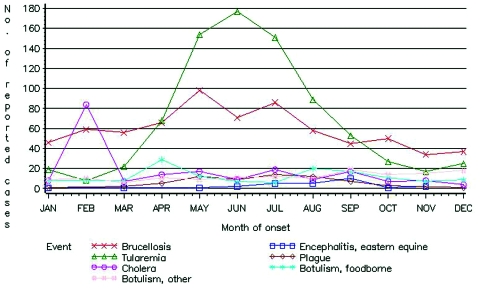
Description:Little information is available in the United States regarding the incidence and distribution of diseases caused by critical microbiologic agents with the potential for use in acts of terrorism. We describe disease-specific, demographic, geographic, and seasonal distribution of selected bioterrorism-related conditions (anthrax, botulism, brucellosis, cholera, plague, tularemia, and viral encephalitides) reported to the National Notifiable Diseases Surveillance System in 1992 to 1999. Tularemia and brucellosis were the most frequently reported diseases. Anthrax, plague, western equine encephalitis, and eastern equine encephalitis were rare. Higher incidence rates for cholera and plague were noted in the western United States and for tularemia in the central United States. Overall, the incidence of conditions caused by these critical agents in the United States is low. Individual case reports should be considered sentinel events. For potential bioterrorism-related conditions that are endemic and have low incidence, the use of nontraditional surveillance methods and complementary data sources may enhance our ability to rapidly detect changes in disease incidence.
-
Subjects:
-
Source:Emerg Infect Dis. 9(5):556-564.
-
Document Type:
-
Place as Subject:
-
Location:
-
Volume:9
-
Issue:5
-
Download URL:
-
File Type:
 [PDF - 291.19 KB]
 -
Collection(s):
-
Main Document Checksum:urn:sha-512:faed456bd128f02dd1760a85e8218fe3931f1bb0db3a987f8963c50b39ec28221f1b1bd348c575597b670bf80fceead7afd37b71c2e89b73ad3dba95ba89cb69
Supporting Files


File Language:
 Was this page helpful?
 Found an issue?


CDC STACKS serves as an archival repository of CDC-published products including
scientific findings, journal articles, guidelines, recommendations, or other public health information authored or
co-authored by CDC or funded partners.
As a repository, CDC STACKS retains documents in their original published format to ensure public access to scientific information.
As a repository, CDC STACKS retains documents in their original published format to ensure public access to scientific information.
You May Also Like
COLLECTION
Emerging Infectious Diseases