


The role of γδ T cells in airway epithelial injury and bronchial responsiveness after chlorine gas exposure in mice
Supporting Files

-
Mar 07 2007
-
Details
-
Alternative Title:Respir Res
-
Personal Author:
-
Description:Background
Acute exposure to chlorine (Cl2) gas causes epithelial injury and airway dysfunction. γδ T cells are present in the mucosal surface of the airways and may contribute to the injury/repair response of the epithelium.
Methods
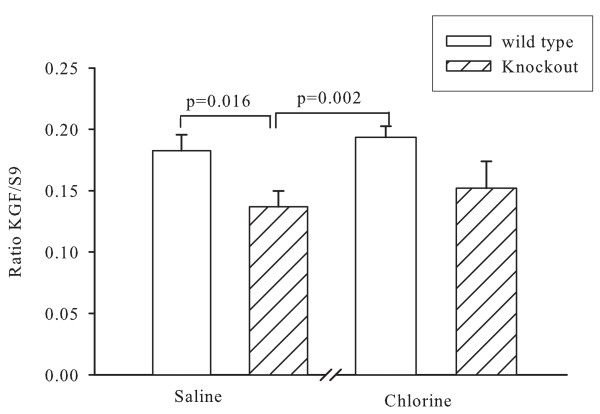
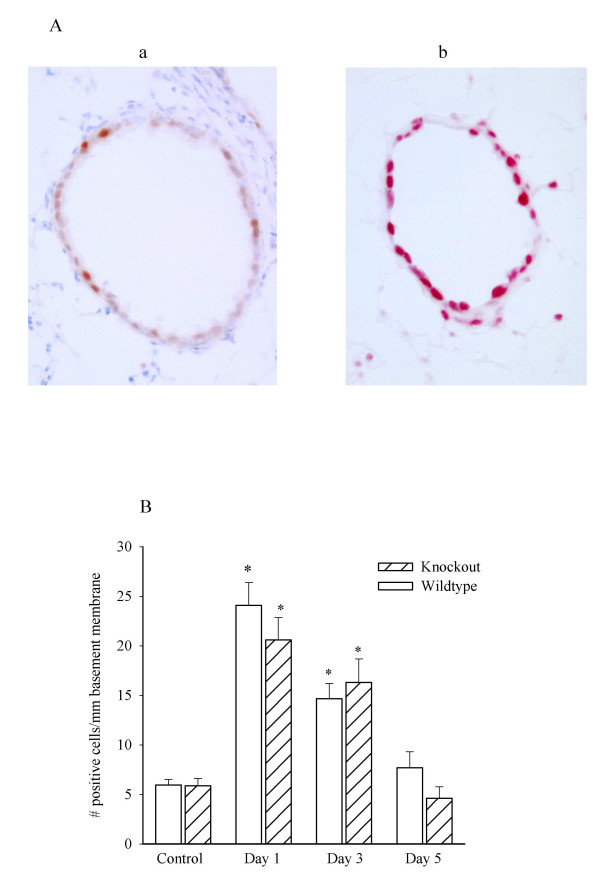
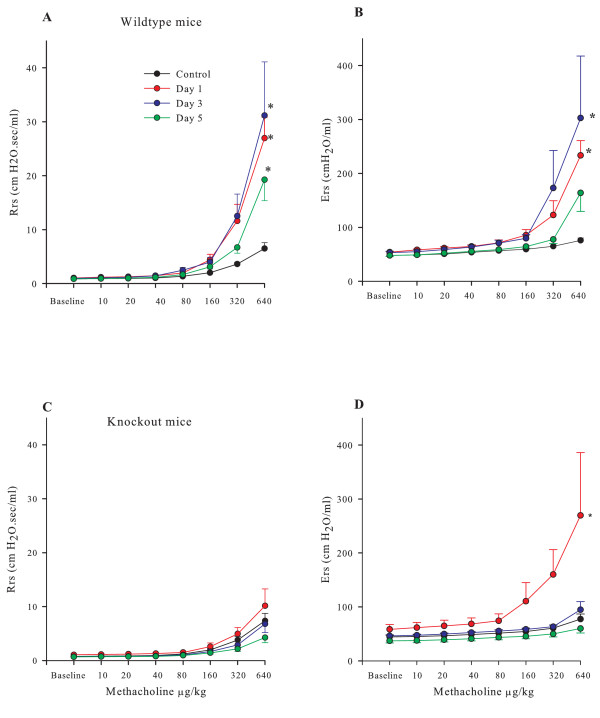
C57Bl/6J (wild type) and TCR-δ-/- mice exposed to Cl2 (400 ppm) for 5 minutes underwent measurements of airway responses to i.v. methacholine (MCh) at 1, 3, and 5 days after exposure. Bronchoalveolar lavage was performed to determine epithelial and leukocyte counts, and protein content. Tissue repair was assessed by proliferating cell nuclear antigen (PCNA) immunoreactivity and by expression of keratinocyte growth factor (KGF) mRNA by real-time PCR.
Results
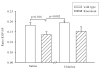
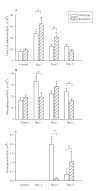
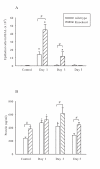
Wild type mice developed a greater degree of airway hyperresponsiveness to MCh at 1 day post exposure to Cl2 compared with TCR-δ-/- mice. Epithelial cell counts in BAL after Cl2 exposure were greater in TCR-δ-/- mice, but macrophages showed a later peak and granulocyte numbers were lower in TCR-δ-/- than in wild type mice. Both groups had increased levels of total protein content in BAL after Cl2 exposure that resolved after 3 and 5 days, respectively. Epithelial proliferating cell nuclear antigen staining was increased at 1 and 3 days post exposure and was similar in the two groups. KGF mRNA was constitutively expressed in both groups and did not increase significantly after Cl2 but expression was lower in TCR-δ-/- mice.
Conclusion
The severity of airway epithelial injury after Cl2 is greater in TCR-δ-/- mice but the inflammatory response and the change in airway responsiveness to methacholine are reduced. The rates of epithelial regeneration are comparable in both groups.
-
Subjects:
-
Source:Respir Res. 2007; 8(1):21.
-
Document Type:
-
Funding:
-
Volume:8
-
Issue:1
-
Collection(s):
-
Main Document Checksum:urn:sha256:2fe7e22a5047c34b1dd365e59b5f79a0af56750f5382651cd5759a24f2101f53
-
Download URL:
-
File Type:
 [PDF
- 752.12 KB
]
[PDF
- 752.12 KB
]
Supporting Files


ON THIS PAGE



CDC STACKS serves as an archival repository of CDC-published products including
scientific findings,
journal articles, guidelines, recommendations, or other public health information authored or
co-authored by CDC or funded partners.
As a repository, CDC STACKS retains documents in their original published format to ensure public access to scientific information.
As a repository, CDC STACKS retains documents in their original published format to ensure public access to scientific information.
You May Also Like
COLLECTION
CDC Public Access